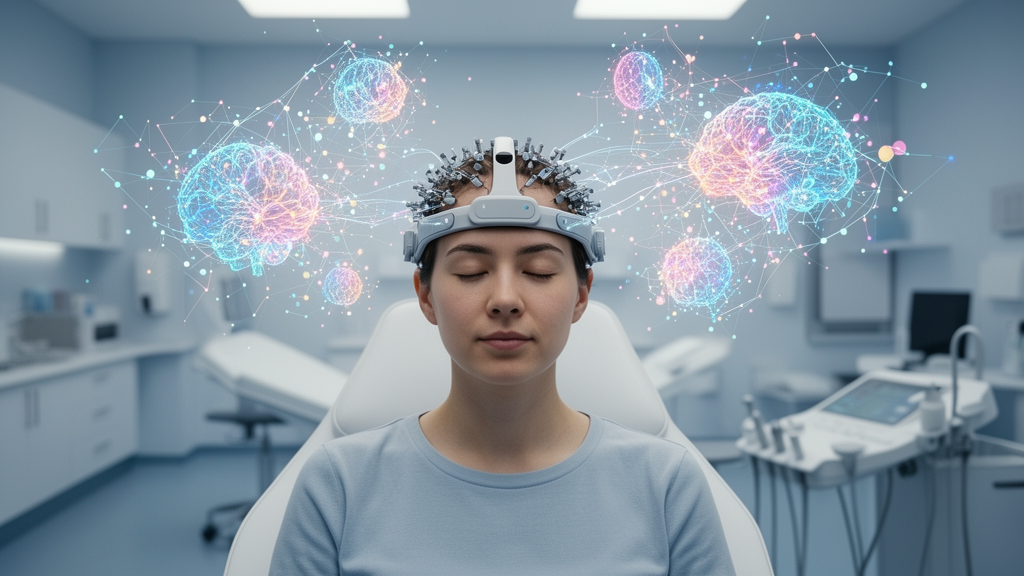
A computational framework combining parallel multi-scale convolutions, channel-wise feature recalibration, and automated recurrent neural architecture search achieved benchmark classification accuracies exceeding 97 percent across valence, arousal, and dominance tasks in public electroencephalography recordings. In a retrospective validation study published in Frontiers in Medicine, researchers evaluated the system, designated MFANet, across two widely studied affective computing benchmarks: the DEAP and DREAMER datasets. The analysis demonstrated that extracting temporal patterns across varied receptive fields and systematically searching recurrent temporal architectures yielded substantial improvements over standard convolutional-recurrent baselines and established graph neural network approaches. However, the investigators emphasized that the findings reflect trial-grouped, subject-dependent benchmark performance on healthy volunteers rather than generalizable clinical diagnostic capability.
Affective-state recognition using electroencephalography (EEG) has drawn sustained interest in translational medicine and human-computer interaction because cortical electrical activity provides an objective, millisecond-resolution physiological signal that does not depend on self-report questionnaires or behavioral observations. In clinical settings, tracking fluctuations in emotional states is relevant to monitoring mood symptoms, stress reactivity, and therapeutic interventions, yet conventional self-assessment scales remain vulnerable to retrospective recall bias and limited temporal sampling. Despite the clear theoretical advantages of scalp-recorded electroencephalography, building reliable affective decoding algorithms has proved notoriously challenging. Brainwave traces exhibit low signal-to-noise ratios, pronounced non-stationarity over time, high inter-individual heterogeneity, and strong dependence on specific experimental stimulus induction protocols.
Earlier approaches to affective brainwave analysis typically coupled handcrafted time-domain, spectral, time-frequency, or nonlinear entropy descriptors with standard classification algorithms, including support vector machines, random forests, and k-nearest-neighbor classifiers. More recently, deep learning methods have largely superseded manual feature engineering by using convolutional, recurrent, graph-based, and transformer architectures to process multichannel recordings. Nonetheless, many existing deep learning models rely on rigid, preselected temporal receptive fields or manually specified recurrent structures. The authors observed that emotional responses in brain electrical signals simultaneously contain brief, localized transient shifts and extended, sustained dynamics. Fixed-scale convolutional networks often miss the broader context, whereas manual choices regarding recurrent network depth, hidden units, cell types, and directionality risk introducing arbitrary design bias into model pipelines.
To overcome these structural limitations, the investigators designed MFANet around four integrated components: multi-scale temporal feature extraction, channel-wise attention recalibration, feature fusion, and recurrent temporal modeling guided by neural architecture search. In the front-end module, preprocessed log band-power features pass through three parallel one-dimensional convolutional branches equipped with kernel sizes of 3, 5, and 7, each containing 64 filters with batch normalization and rectified linear unit activations. Smaller kernels target localized signal fluctuations, whereas wider receptive fields capture extended temporal dependencies. Concatenating the outputs of these three parallel branches yields 192 latent feature channels, which are subsequently recalibrated by a channel-wise attention mechanism using global average and max pooling combined through a two-layer shared multilayer perceptron.
Temporal sequence modeling is handled by an automated recurrent search module termed LNAS, implemented as a single-path weight-sharing supernet across a discrete search space of 108 candidate configurations. The search space varies cell architecture between long short-term memory (LSTM) and gated recurrent units (GRU), stacking depth from one to three layers, uni- or bidirectional data flow, hidden dimensions of 64, 96, or 128 units, and dropout rates of 0.20, 0.35, or 0.50. To eliminate optimistic data leakage, candidate ranking and model selection were strictly confined within the training partition of each outer fold, using an inner-validation objective penalized for floating-point operations. The resulting optimal networks contained approximately 0.47 million parameters and 6.9 million floating-point operations, executing single-window inference in a median of 0.93 milliseconds on modern graphical processing hardware.
The evaluation protocol utilized two open-access benchmarks characterized by differing hardware configurations and experimental designs. The DEAP benchmark encompasses 32 healthy participants who viewed 40 one-minute music videos while providing 1-to-9 ratings for valence, arousal, dominance, and liking. The DREAMER benchmark comprises recordings from 23 healthy individuals exposed to 18 audiovisual film segments using a 14-channel Emotiv EPOC headset and 1-to-5 rating scales. For cross-dataset comparability, the researchers primarily examined a matched 14-channel montage covering bilateral frontal, temporal, parietal, and occipital recording sites: AF3, F3, F7, FC5, T7, P7, O1, AF4, F4, F8, FC6, T8, P8, and O2. Each recording was divided into non-overlapping four-second windows subdivided into seven half-second-hop frames, with fast Fourier transforms extracting log band power across theta, alpha, low-beta, high-beta, and gamma frequency bands.
To rigorously control for optimistic data leakage across temporal windows, the study employed a five-fold, trial-grouped subject-dependent cross-validation scheme. Under this setup, all temporal windows originating from a given stimulus trial were allocated exclusively to the same outer cross-validation fold, ensuring that adjacent time slices from the same trial never crossed between training and testing sets. Feature scaling parameters, architecture search candidate rankings, early-stopping criteria, and model checkpoint selections were derived strictly from the training data of each outer split. The primary evaluation treated valence, arousal, and dominance as independent binary classification tasks, defining high and low affective states using the midpoint threshold of each benchmark scale: scores above 5 for DEAP and scores above 3 for DREAMER.
Ablation experiments conducted on the DEAP dataset revealed that both multi-scale representation and automated recurrent architecture search contributed substantially to overall classification accuracy. A basic convolutional-recurrent baseline achieved mean accuracies of 81.24 ± 5.14% for valence, 79.84 ± 5.23% for arousal, and 82.23 ± 4.97% for dominance, corresponding to an average performance of 81.10%. Adding the multi-scale temporal fusion module increased the average accuracy to 91.27%, an absolute gain of 10.17 percentage points or a relative improvement of 12.5%. Isolating the searched recurrent module yielded an average accuracy of 91.97%, representing a 10.87-percentage-point absolute improvement. Integrating all components within the full MFANet model yielded mean accuracies of 97.20 ± 1.63% for valence, 97.32 ± 1.27% for arousal, and 97.14 ± 1.21% for dominance, generating an overall average accuracy of 97.22%.
In comparative evaluations against established machine learning and deep learning baselines, MFANet consistently exceeded conventional methods such as decision trees, multilayer perceptrons, and support vector machines, as well as complex 3D convolutional and recurrent network variants. When compared directly with dynamic graph convolutional neural networks (DGCNN), the strongest benchmark baseline in the study, MFANet exhibited mean accuracy gains of 4.13 percentage points for valence, 3.39 percentage points for arousal, and 3.71 percentage points for dominance. Participant-level paired differences showed non-normal distributions according to Shapiro-Wilk testing, leading the authors to perform two-sided Wilcoxon signed-rank tests; all paired improvements remained statistically significant after Holm multiplicity adjustment, yielding adjusted p-values below 0.001. A sensitivity analysis evaluating the full 32-channel DEAP configuration produced accuracies of 97.58% for valence, 97.66% for arousal, and 97.49% for dominance, representing non-significant gains of less than 0.4 percentage points over the prespecified 14-channel setup.
Despite the high numerical performance achieved across both benchmark datasets, the authors explicitly outlined critical limitations regarding clinical and translational interpretation. The reported accuracies reflect within-subject generalization across held-out stimulus trials from participants already represented in the training data, meaning the findings cannot be interpreted as subject-independent performance on unseen individuals. Furthermore, the datasets reflect laboratory recordings from healthy volunteers exposed to brief audiovisual stimuli and categorized by dichotomized self-reported ratings, which do not reflect the complex clinical phenotyping required for diagnosing psychiatric or affective disorders. The investigators concluded that while multi-scale fusion and nested recurrent architecture search establish a robust computational baseline for affective computing, prospective validation in clinically characterized patient cohorts and cross-dataset testing remain mandatory before such models can support clinical decision-making.
Subject of Research: Deep learning architectures for electroencephalography-based affective-state recognition
Article Title: Multi-scale feature fusion and neural architecture search for electroencephalography-based affective-state recognition in public benchmark datasets
Article References: Guan, C., & Wang, Y. (2026). Multi-scale feature fusion and neural architecture search for electroencephalography-based affective-state recognition in public benchmark datasets. Frontiers in Medicine, 13, Article 1893480. https://doi.org/10.3389/fmed.2026.1893480
Image Credits: AI Generated
DOI: 10.3389/fmed.2026.1893480
Keywords: affective computing, electroencephalography, emotion recognition, MFANet, neural architecture search, multi-scale feature fusion, channel attention, long short-term memory, DEAP dataset, DREAMER dataset, valence classification, arousal classification, dominance classification, trial-grouped validation, subject-dependent cross-validation, dynamic graph convolutional neural network, biomedical signal processing
News Source: Blake Davidson. (November 16, 2026). Deep Learning Framework Improves Benchmark EEG Affective State Recognition Accuracy. Scienmag.