Atomistic simulations investigating nuclear reactor materials have uncovered a complex, non-additive interplay between dissolved hydrogen and irradiation-induced point defects in alpha-zirconium. While researchers have long recognized that hydrogen ingress and radiation damage separately alter the mechanical and thermal characteristics of zirconium components, new molecular dynamics modeling demonstrates that their simultaneous presence fundamentally reshapes material behavior. Rather than acting as independent perturbations whose consequences simply accumulate, interstitial hydrogen solutes and radiation-induced crystalline defects exert reciprocal, moderating effects on each other within the dilute concentration regime. Vacancies and self-interstitial atoms actively suppress the lattice-stiffening tendencies normally introduced by dissolved hydrogen. Simultaneously, the presence of hydrogen partially offsets the severe elastic softening and structural degradation caused by point defects. This mutual compensation mechanism provides a unified framework for predicting the structural integrity and thermodynamic performance of zirconium under operational reactor environments.
Zirconium and its alloys serve as vital structural materials in nuclear energy systems, chemical processing, medical hardware, and aerospace engineering due to their low thermal neutron absorption cross-section, outstanding corrosion resistance, and favorable mechanical properties. Under service conditions inside nuclear reactors, however, zirconium cladding and core components are continuously exposed to intense neutron irradiation and corrosive coolant interactions. These harsh environments inevitably drive hydrogen pickup from corrosion reactions alongside the relentless generation of lattice defects, specifically vacant lattice sites and self-interstitial atoms. Over extended operation, hydrogen ingress can trigger embrittlement, alter acoustic wave propagation, and modify heat conduction, while radiation-induced displacement damage severely compromises structural resilience. Accurately forecasting how these coupled degradation pathways evolve has historically posed substantial challenges for materials scientists, as conventional engineering assessments often assume that solute and defect effects accumulate in a purely linear, uncoupled fashion.
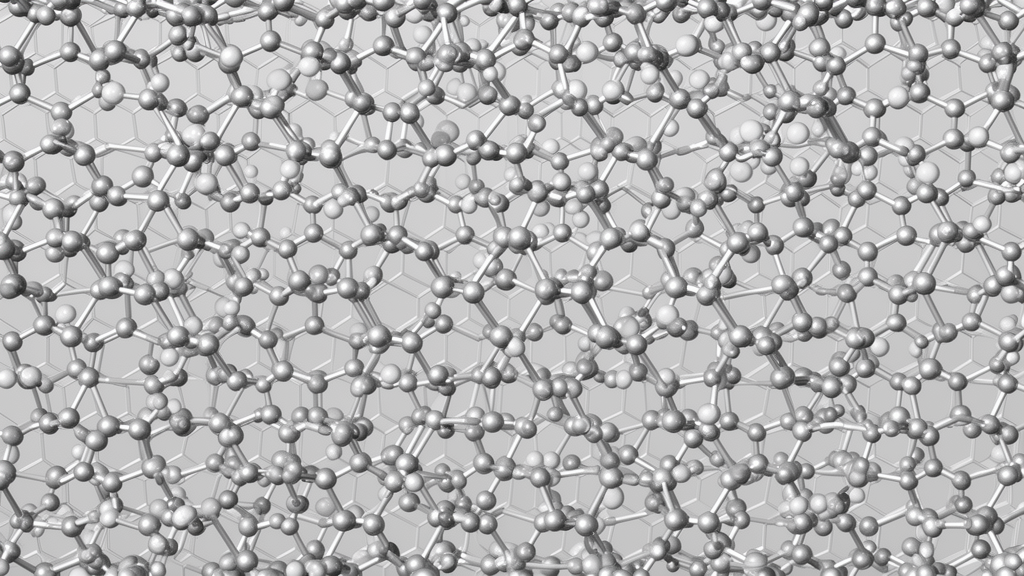
To resolve the atomic-scale mechanisms driving these coupled phenomena, researchers deployed large-scale molecular dynamics simulations using the open-source LAMMPS software package. A foundational requirement for reliable atomistic modeling is the selection of an interatomic potential capable of capturing multi-element interactions with high fidelity. The investigators adopted an embedded atom method potential developed by Wimmer and colleagues, which accurately reproduces the energetic and mechanical interactions between zirconium host atoms, interstitial hydrogen, and intrinsic lattice defects. Computational simulation cells containing 25,600 atoms were constructed using the Atomsk toolkit, establishing dimensions of twenty-five times lattice constant a along the X-axis, sixteen times the square root of three times a along the Y-axis, and sixteen times lattice constant c along the Z-axis. The crystallographic axes were oriented along the specific low-index directions [1-bar 2 1-bar 0], [10 1-bar 0], and [0001], with experimental lattice parameters set to 3.2312 angstroms and 5.1477 angstroms, respectively.
Within these constructed supercells, hydrogen atoms were randomly distributed across interstitial sites, while vacancy and self-interstitial defects were introduced by removing or inserting zirconium atoms into the pristine hexagonal close-packed matrix. The research team systematically investigated defect and solute concentrations spanning 0.1 to 2.0 atomic percent, with an additional 5.0 atomic percent case evaluated for pure hydrogen configurations. Full periodic boundary conditions were applied across all three spatial dimensions. To ensure structural stability, each configuration underwent conjugate-gradient energy minimization to extinguish residual interatomic forces, followed by rigorous equilibration within canonical (NVT) and isobaric-isothermal (NPT) ensembles maintained at 300 Kelvin and zero external pressure. Elastic constants were subsequently evaluated via the strain fluctuation method, applying controlled axial deformations across strain rates from 0.0005 to 0.1, from which an optimal strain rate of 0.001 was established for definitive mechanical assessments.
Evaluation of mass density revealed distinct, competing physical mechanisms governing dimensional and volumetric stability across isolated systems. In hydrogen-only configurations, increasing solute concentration produced a monotonic reduction in mass density, decreasing from 6.5068 grams per cubic centimeter in pure zirconium to 6.4976 grams per cubic centimeter at two atomic percent hydrogen. This decline occurs because interstitial hydrogen drives local lattice dilation, expanding the unit cell volume at a rate that outweighs the modest mass gained from light hydrogen atoms. Conversely, vacancy defects caused a steep, linear decline in density down to 6.4255 grams per cubic centimeter at two atomic percent, directly reflecting the physical loss of host atomic mass. Self-interstitial atoms displayed a non-monotonic density response: at low concentrations, added atomic mass slightly dominated lattice expansion, but at higher concentrations, accumulated distortion triggered net volumetric swelling, driving density down to 6.4983 grams per cubic centimeter.
The acoustic response of the material proved equally sensitive to defect chemistry, as characterized through longitudinal, transverse, and average sound velocities derived from macroscopic density, bulk modulus, and shear modulus values. In isolated hydrogen systems, the simulations revealed an intriguing anisotropic divergence. The longitudinal sound velocity, reflecting compressional wave propagation, decreased monotonically with rising hydrogen content, indicating reduced resistance to compressive deformation. In sharp contrast, the transverse sound velocity increased steadily, demonstrating localized enhancement of shear rigidity driven by solute-induced lattice strain and local electronic interactions. Because the shear modulus enhancement outweighed compressional softening, the average sound velocity exhibited a net increase from 2539.3 meters per second to 2542.2 meters per second across the zero to two percent hydrogen range. In stark contrast, isolated vacancies and self-interstitial atoms monotonically degraded all acoustic modes, disrupting lattice periodicity and creating intense scattering centers that suppressed sound propagation.
When hydrogen and vacancy defects coexisted in interactive configurations, the molecular simulations demonstrated that their joint acoustic impact diverged sharply from simple linear superposition. In systems containing a fixed one atomic percent vacancy concentration, increasing hydrogen from zero to two atomic percent resulted in a longitudinal velocity decrease from 4729.9 to 4688.9 meters per second, compared to 4738.8 down to 4704.7 meters per second in vacancy-free zirconium. While transverse velocity rose from 2240.4 to 2242.9 meters per second and average velocity increased from 2520.7 to 2522.3 meters per second, both baseline values and the total magnitude of hydrogen-induced stiffening were significantly reduced. Conversely, examining varying vacancy concentrations at a fixed 0.5 atomic percent hydrogen revealed that hydrogen occupancy partially buffered the material against vacancy-induced degradation. The longitudinal velocity decreased from 4727.6 to 4705.3 meters per second at two percent vacancy, exhibiting a less severe decline than the 4738.8 to 4712.7 meters per second drop recorded in hydrogen-free vacancy systems.
An analogous moderating behavior characterized the interactive hydrogen and self-interstitial atom configurations. At a fixed one atomic percent self-interstitial defect concentration, introducing hydrogen up to two atomic percent caused longitudinal velocity to drop from 4675.4 to 4656.9 meters per second, while transverse velocity rose from 2205.9 to 2218.5 meters per second and average sound velocity climbed from 2482.4 to 2495.4 meters per second. Although interstitial defects drastically reduced baseline acoustic speeds through localized strain fields, the presence of dissolved hydrogen preserved shear stiffening. In reciprocal simulations where self-interstitial concentrations increased up to two atomic percent under a fixed 0.5 atomic percent hydrogen background, longitudinal velocity fell from 4727.6 to 4658.0 meters per second. This drop proved distinctly less severe than the unmitigated decline from 4730.9 to 4637.9 meters per second observed in hydrogen-free interstitial systems, verifying that dissolved hydrogen solutes consistently moderate radiation-induced elastic softening across diverse defect geometries.
The investigation of vibrational thermodynamics through the Debye temperature reinforced this picture of coupled structural interplay. In defect-free zirconium, increasing dissolved hydrogen content elevated the Debye temperature from 264.77 Kelvin to 264.93 Kelvin, signaling an intrinsic stiffening of interatomic bonds in solid solution prior to any hydride phase precipitation. Interstitial hydrogen forms directional bonds with neighboring zirconium atoms, increasing local force constants and shifting the phonon spectrum toward higher vibrational frequencies. In stark contrast, isolated vacancies reduced the Debye temperature to 259.05 Kelvin at two atomic percent by lowering atomic coordination, while self-interstitial atoms exerted an even more damaging effect, depressing it to 256.17 Kelvin due to severe compressive strain. In interactive systems with one percent vacancies, the Debye temperature remained virtually pinned between 262.26 and 262.27 Kelvin, proving that vacancy populations suppress hydrogen-driven vibrational stiffening while hydrogen simultaneously prevents deeper defect-driven declines.
Thermodynamic anharmonicity, evaluated through the Grüneisen parameter using the Belomestnykh formulation based on Poisson’s ratio, provided deeper insight into high-pressure lattice stability and nonlinear atomic vibrations. In isolated zirconium-hydrogen systems, the Grüneisen parameter decreased monotonically from 2.158 to 2.130 across the zero to two atomic percent range, indicating that dissolved hydrogen suppresses vibrational anharmonicity and potentially alters ductile response. Conversely, introducing vacancies or self-interstitial atoms amplified anharmonicity, raising the parameter to 2.199 and 2.196, respectively, as broken bonds and severe lattice distortions enhanced nonlinear phonon scattering. Under interactive conditions with one percent vacancies, increasing hydrogen concentration reduced the Grüneisen parameter from 2.177 to 2.145. At a fixed 0.5 atomic percent hydrogen concentration, increasing vacancy content drove the parameter upward from 2.150 to 2.187, showing a restrained rate of increase compared to defect-only systems. Hydrogen incorporation thus moderates defect-induced anharmonic amplification by redistributing local interatomic forces.
Finally, the team modeled minimum thermal conductivity under high-temperature limits using both the Clarke and Cahill formulations. Across non-interactive systems, hydrogen concentration exerted negligible influence on minimum thermal transport, with Cahill values hovering near 2.086 to 2.078 watts per meter-kelvin and Clarke values remaining between 1.806 and 1.805 watts per meter-kelvin up to five atomic percent hydrogen. Vacancies and self-interstitial atoms, however, triggered noticeable linear reductions in thermal transport by disrupting crystal periodicity and amplifying phonon-defect scattering, with interstitials causing the steepest decline. In interactive configurations, the presence of hydrogen marginally mitigated defect-driven thermal conductivity losses, preserving partial lattice coherence without introducing disruptive scattering channels of its own. By capturing this coupled, non-additive balance across elastic moduli, sound propagation, vibrational frequencies, and thermal conduction, this unified atomistic framework delivers indispensable quantitative insight for evaluating material longevity and engineering radiation-tolerant zirconium alloys for advanced nuclear service.
Subject of Research: Thermodynamic and structural response of zirconium to coupled hydrogen-defect interactions
Article Title: An atomistic modelling approach to the thermodynamic and structural response of zirconium to hydrogen-defect interactions
Article References: Alivaliollahi, A., Nemati, H. R., & Alahyarizadeh, G. (2026). An atomistic modelling approach to the thermodynamic and structural response of zirconium to hydrogen-defect interactions. Discover Mechanical Engineering, 5(1), Article 166. https://doi.org/10.1007/s44245-026-00354-0
Image Credits: AI Generated
DOI: 10.1007/s44245-026-00354-0
Keywords: zirconium, molecular dynamics, hydrogen uptake, point defects, vacancies, self-interstitial atoms, Debye temperature, Grüneisen parameter, minimum thermal conductivity, sound wave velocities, elastic constants, LAMMPS, embedded atom method, nuclear structural materials, lattice stiffness, anharmonicity, Cahill model, Clarke model
News Source: Denise Maddox. (November 16, 2026). Zirconium Atomistic Models Reveal Non-Additive Interplay Between Hydrogen and Radiation Defects. Scienmag.