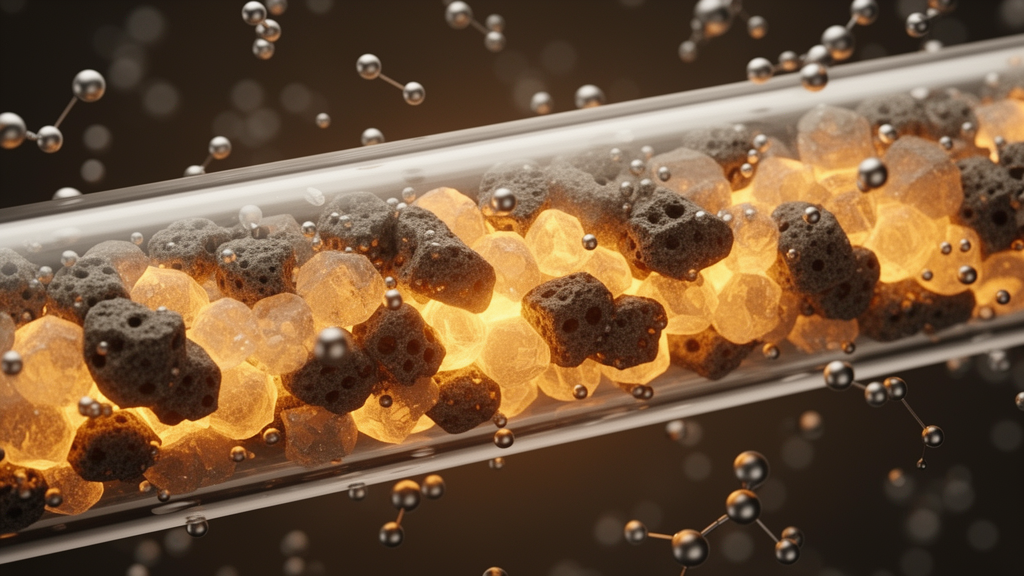
A comprehensive review published in Discover Catalysis by Nada Abounahia, Sumia Manzoor, Alessandro Sinopoli, and colleagues evaluates the development of hydrotalcite-derived catalysts across multiple methane reforming pathways, demonstrating that layered double hydroxide precursors provide a versatile structural foundation for sustainable syngas and hydrogen production. The escalating global demand for cleaner energy carriers and carbon dioxide mitigation has intensified interest in converting greenhouse gases like methane and carbon dioxide into synthesis gas. Conventional reforming catalysts frequently suffer from severe active metal sintering, rapid carbon deposition, and hydrothermal degradation under demanding high-temperature industrial operating conditions. The authors show that catalysts derived from layered double hydroxides address these traditional stability limitations through atomic-level elemental mixing, tunable surface basicity, high specific surface areas, and resilient metal-support interactions across dry reforming, steam reforming, partial oxidation, autothermal reforming, combined reforming, and tri-reforming processes.
Hydrotalcites and related layered double hydroxides possess a crystalline layered architecture derived from brucite, wherein divalent metal cations octahedrally coordinated by hydroxide groups are partially substituted by trivalent metal cations to generate positively charged host sheets. This positive layer charge is balanced by interlayer water molecules and exchangeable anions, conforming to the general formula where divalent species such as magnesium and trivalent species such as aluminum maintain structural stability. Thermal treatment of these precursors induces dehydration, dehydroxylation, and anion decomposition, causing the ordered lamellar framework to collapse into highly dispersed mixed metal oxides that include magnesium-oxide-like solid solutions and embedded spinel phases. Under specific conditions, calcined mixed metal oxides exhibit a reversible memory effect that allows partial reconstruction of the original layered double hydroxide phase upon exposure to aqueous solutions containing suitable anions. Although thermodynamic instability at reforming temperatures between 700 and 900 degrees Celsius causes the material to remain as mixed metal oxides during catalytic operation, the memory effect provides practical protocols for post-synthesis promoter incorporation and structural regeneration following deactivation.
The synthesis pathway chosen for the precursor material decisively governs the resulting catalyst morphology, metal dispersion, and operational durability under reforming atmospheres. Co-precipitation remains the most common and industrially viable approach, operating through the simultaneous precipitation of divalent and trivalent cations at constant alkaline pH between 9 and 10 using sodium hydroxide and sodium carbonate, which yields mesoporous materials with surface areas ranging from 130 to 180 square meters per gram. Alternatively, sol-gel processing utilizes alkoxide or salt hydrolysis and condensation to generate nanostructured mixed oxides exhibiting molecular dispersion and elevated surface areas between 230 and 250 square meters per gram. Comparative studies demonstrate that sol-gel preparation imparts exceptionally strong metal-support interactions that suppress coking at 800 degrees Celsius over extended runs, whereas ion exchange strategies frequently suffer from incomplete carbonate displacement and structural instability. Hydrothermal treatment between 120 and 200 degrees Celsius sharpens precursor X-ray diffraction peaks, increases crystallite dimensions, reduces lattice defect density, and yields calcined catalysts with surface areas exceeding 200 square meters per gram that consistently demonstrate enhanced resistance to sintering.
The surface chemistry of hydrotalcite-derived mixed oxides provides distinct active sites that facilitate reactant adsorption and intermediate conversion. Temperature-programmed desorption of carbon dioxide reveals a clear distribution of basic sites categorized by desorption temperature: weak sites below 350 degrees Celsius corresponding to surface hydroxyl groups, medium Lewis basic sites between 350 and 600 degrees Celsius originating from metal-oxygen pairs, and strong basic sites above 600 degrees Celsius associated with low-coordinated lattice oxygen anions. Incorporating rare-earth dopants such as samarium increases the concentration of medium and strong basic sites, directly promoting carbon dioxide chemisorption and generating reactive oxygen species that gasify carbonaceous intermediates before graphitization occurs. Nitrogen physisorption identifies type V isotherms with H3 hysteresis loops typical of mesoporous platelet aggregates that enhance internal mass transport and delay pore plugging. Transmission electron microscopy confirms that preparation methods dictate metallic particle sizes, showing that combined co-precipitation and impregnation generates nickel nanoparticles around 15 nanometers compared to 22 nanometers from conventional impregnation and 42 nanometers from direct co-precipitation, with smaller crystallites yielding superior reforming conversions.
In dry reforming of methane, the endothermic reaction between methane and carbon dioxide requires operating temperatures between 700 and 900 degrees Celsius to yield synthesis gas with an H2/CO ratio near unity, making the process prone to active site deactivation. Catalyst durability is governed by a dynamic kinetic balance between methane cracking on metallic nickel sites and continuous carbon gasification mediated by carbon dioxide activation on basic magnesium oxide domains and interfacial oxygen vacancies. Experimental investigations demonstrate that nickel loading exhibits an optimal threshold near 15 weight percent, beyond which excessive metal content promotes particle agglomeration, enlarged crystalline ensembles, and accelerated coke accumulation. Similarly, adjusting the magnesium-to-aluminum ratio regulates performance, with an intermediate ratio around 1 achieving an optimal compromise between basic site density, nickel dispersion, and structural stabilization against sintering. The formation of magnesium-aluminate and nickel-aluminate spinel phases during calcination anchors active metal crystallites firmly to the oxide support; however, overly stable spinel lattices require elevated reduction temperatures and risk sequestering nickel away from accessible catalytic surfaces.
Promoter engineering significantly extends the operational lifespan and selectivity of hydrotalcite-derived dry reforming catalysts without relying strictly on elevated active metal loadings. Rare-earth promoters such as cerium utilize reversible Ce4+/Ce3+ redox cycling to enhance oxygen storage capacity and oxygen vacancy formation, facilitating continuous interfacial oxygen migration to oxidatively gasify carbon deposits and allowing cerium-promoted catalysts to sustain conversions above 85 percent for over 100 hours. Transition-metal additives such as cobalt, zinc, and gallium modify the electronic d-band structure and promote surface alloy formation, thereby reducing active ensemble sizes and suppressing carbon nucleation. Precious metals including rhodium, ruthenium, iridium, and platinum promote hydrogen spillover to accelerate the low-temperature reduction of recalcitrant nickel species. Furthermore, multi-promoter configurations, including cerium-zirconium, zirconium-yttrium, and gold-cerium formulations, generate synergistic effects that combine high lattice oxygen mobility with reinforced metal-support anchoring, providing dual protection against both thermal sintering and graphitic carbon encapsulation during prolonged high-temperature exposure.
Steam reforming of methane remains the benchmark industrial route for hydrogen manufacturing, utilizing the highly endothermic reaction of methane with steam between 700 and 900 degrees Celsius. In hydrotalcite-derived nickel systems, basic and hydroxylated mixed oxide surfaces facilitate steam dissociation and the water-gas shift reaction, while finely dispersed metallic nickel nanoparticles catalyze methane activation. Precursor modification through anion exchange improves metal dispersion and water-gas shift activity, allowing unpromoted co-precipitated catalysts to achieve stable performance across test periods up to 120 hours. When integrated into sorption-enhanced steam methane reforming, the incorporation of calcium-oxide-based carbon dioxide sorbents shifts reaction equilibria toward enhanced hydrogen purity, enabling methane conversions approaching or exceeding 90 percent at significantly reduced temperatures between 450 and 650 degrees Celsius. However, repeated carbonation and calcination cycles induce calcium oxide sintering and loss of sorbent surface area, demonstrating that the operational durability of sorption-enhanced systems depends fundamentally upon stabilizing sorbent regenerability alongside catalytic activity.
Partial oxidation of methane presents a mildly exothermic alternative that produces synthesis gas with a theoretical H2/CO ratio near two at short residence times, though localized hot spots present severe sintering hazards. Under partial oxidation conditions, nickel active centers continuously alternate between metallic and oxidized states, requiring the hydrotalcite mixed oxide framework to serve as a dynamic redox buffer that regulates oxygen transfer and prevents total combustion. Monometallic Ni-Mg-Al catalysts have demonstrated stable methane conversions of approximately 85 percent and stoichiometric syngas ratios over 20 hours of operation through strong metal anchoring. Low concentrations of noble metals promote rapid re-reduction of transiently oxidized nickel sites, preserving active metallic ensembles under fluctuating oxygen partial pressures. Simultaneously, rare-earth oxides like cerium and lanthanum enhance lattice oxygen mobility to ensure uniform oxygen redistribution across the catalyst bed, thereby preventing localized oxygen depletion, minimizing hot-spot formation, and suppressing excessive carbon deposition across oxidative reforming regimes.
Advanced reforming pathways combine multiple reaction schemes within a single reactor to optimize thermal efficiency and customize product ratios. Combined or dual reforming couples steam and dry reforming, where catalysts calcined at 700 degrees Celsius have achieved methane and carbon dioxide conversions of 93.4 percent and 75.2 percent over 36 hours by harmonizing steam dissociation and carbon dioxide chemisorption. Tri-reforming simultaneously feeds methane, steam, carbon dioxide, and oxygen, utilizing flue gases directly without comprehensive separation.
Advanced operando and in situ analytical techniques have resolved transient catalyst transformations that remain undetectable through conventional ex situ characterization of fresh and spent samples. In situ X-ray diffraction monitors lamellar collapse, the formation of periclase mixed oxides, active metal reduction, and the emergence of spinel structures that influence active site accessibility. Ambient-pressure X-ray photoelectron spectroscopy traces active metal oxidation states and identifies adsorbed surface intermediates, verifying interfacial C-H bond activation and surface carbonate dynamics. Operando Raman spectroscopy tracks the evolution of disordered D bands and graphitic G bands, demonstrating that carbon deposition proceeds via a dynamic nucleation-and-growth mechanism across reactor beds. Diffuse reflectance infrared Fourier transform spectroscopy identifies bicarbonate, monodentate, and bidentate carbonate species alongside formate intermediates, distinguishing active catalytic intermediates from spectator species. Complementary X-ray absorption spectroscopy and environmental transmission electron microscopy directly visualize nanoscale metal particle migration, bimetallic alloy demixing, and the structural growth modes of carbon filaments under reacting gas mixtures.
Computational modeling methods have evolved into predictive frameworks that corroborate experimental observations and accelerate the targeted design of hydrotalcite-derived materials. Molecular dynamics simulations demonstrate that mixed oxides possessing a magnesium-to-aluminum ratio near 3 exhibit the longest carbon dioxide residence times, highest diffusion activation energies, and strongest Mg-O-CO2 binding affinities, directly explaining experimental adsorption maxima. Simulated diffraction profiles accurately replicate the thermal progression from layered precursors through amorphous intermediates to recrystallized periclase and spinel structures. Density functional theory calculations show that gallium doping shifts the nickel d-band center closer to the Fermi level, facilitating charge transfer and elevating experimental methane and carbon dioxide conversions to 66 percent and 74 percent. Similar calculations on noble-metal-promoted systems demonstrate that iridium and rhodium strengthen carbon dioxide adsorption energies, with iridium reaching -27.7 kilocalories per mole, matching experimental runs where both catalysts maintained conversions above 80 percent for 20 hours with negligible carbon accumulation.
Despite significant laboratory achievements, widespread industrial implementation of hydrotalcite-derived reforming catalysts requires overcoming several material and engineering challenges. Precursor synthesis is exceptionally sensitive to pH, precipitation kinetics, and aging conditions, demanding rigorous quality control to ensure batch reproducibility during production scale-up. In commercial operations, fine catalyst powders must be engineered into mechanically robust pellets, extrudates, or washcoated monoliths without sacrificing porosity, active surface area, or basic site availability. Furthermore, practical feedstocks like biogas and landfill gas contain contaminants such as hydrogen sulfide, sulfur dioxide, carbonyl sulfide, and siloxanes that rapidly poison exposed nickel ensembles. Future development must focus on evaluating catalyst durability under prolonged time-on-stream and realistic thermal cycling, improving poisoning tolerance, utilizing industrial by-products like blast furnace slag and desalination brine for circular precursor synthesis, and integrating structured reactors with downstream carbon capture systems to support sustainable industrial deployment.
Subject of Research: Advances in hydrotalcite-derived catalysts for methane reforming technologies
Article Title: Recent advances in hydrotalcite-derived catalysts for methane reforming technologies
Article References: Abounahia, N., Manzoor, S., Sinopoli, A., Mroue, K., Gladich, I., Moussa, A., Alshamari, M., Altay, A., Al-Ansari, T., & Abotaleb, A. (2026). Recent advances in hydrotalcite-derived catalysts for methane reforming technologies. Discover Catalysis, 3(1), Article 18. https://doi.org/10.1007/s44344-026-00048-5
Image Credits: AI Generated
DOI: 10.1007/s44344-026-00048-5
Keywords: hydrotalcite-derived catalysts, methane reforming, dry reforming of methane, steam reforming of methane, partial oxidation of methane, autothermal reforming, tri-reforming of methane, layered double hydroxides, mixed metal oxides, surface basicity, carbon deposition, operando characterization, density functional theory, syngas production, hydrogen generation, sorption-enhanced reforming
News Source: Bethany Barker. (November 16, 2026). Hydrotalcite Derived Catalysts Enable Tunable Performance Across Methane Reforming Technologies. Scienmag.