• HOME
  • NEWS
  • EXPLORE
    • CAREER
      • Companies
      • Jobs
    • EVENTS
    • iGEM
      • News
      • Team
    • PHOTOS
    • VIDEO
    • WIKI
  • BLOG
  • COMMUNITY
    • FACEBOOK
    • INSTAGRAM
    • TWITTER
Monday, November 16, 2026
BIOENGINEER.ORG
No Result
View All Result
  • Login
  • HOME
  • NEWS
  • EXPLORE
    • CAREER
      • Companies
      • Jobs
        • Lecturer
        • PhD Studentship
        • Postdoc
        • Research Assistant
    • EVENTS
    • iGEM
      • News
      • Team
    • PHOTOS
    • VIDEO
    • WIKI
  • BLOG
  • COMMUNITY
    • FACEBOOK
    • INSTAGRAM
    • TWITTER
No Result
View All Result
Bioengineer.org
No Result
View All Result
Home NEWS Science News Technology

Parallel AI Model Diagnoses Power Metering Circuit Faults in Controlled Tests

by
November 16, 2026
in Technology
Reading Time: 2 mins read
0
Parallel AI Model Diagnoses Power Metering Circuit Faults in Controlled Tests

Parallel AI Model Diagnoses Power Metering Circuit Faults in Controlled Tests

Share on FacebookShare on TwitterShare on LinkedinShare on RedditShare on Telegram

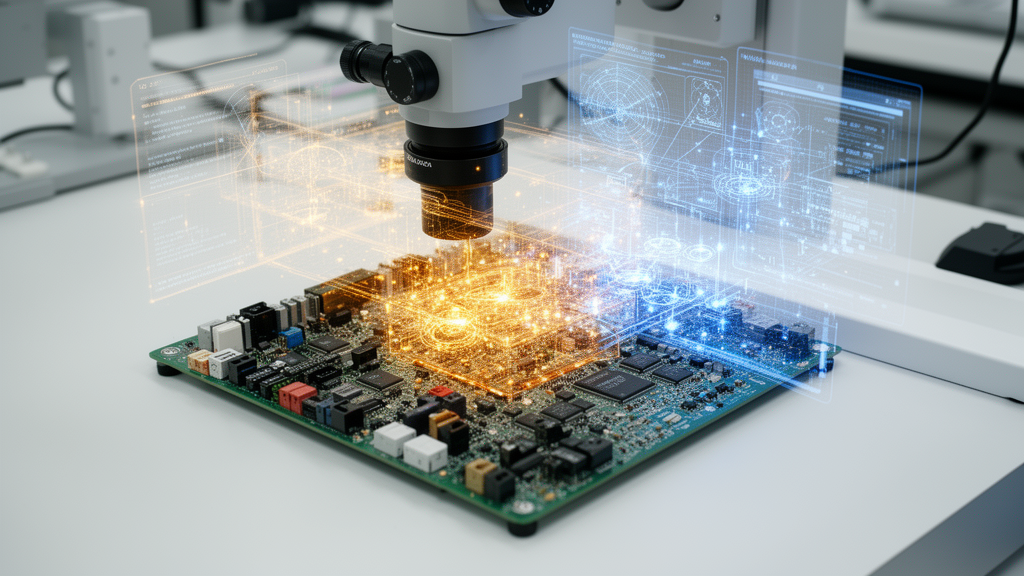
Researchers have developed and evaluated an artificial intelligence-driven dual-path framework designed for real-time fault diagnosis in power metering secondary circuits, reaching an accuracy of 96.5% ± 1.3% on a controlled test platform. In modern power systems, the reliable operation of power metering secondary circuits is essential for accurate energy measurement and safe power-system management. However, conventional fault diagnosis methods depend heavily on manual inspection and fixed rules, which struggle with nonlinear, transient, and composite faults.

To resolve the limitations of traditional inspection rules, the proposed framework processes six operational inputs: current, voltage, active power, reactive power, phase angle, and harmonic-distortion signals. These electrical signals are systematically aligned, denoised, segmented, normalized, and represented by both statistical and wavelet-packet features. Unlike conventional serial CNN–SVM schemes, the framework combines a lightweight one-dimensional convolutional neural network (1D-CNN) with a support vector machine (SVM) operating simultaneously in two distinct analytical branches.

Within the dual-path architecture, the two branches fulfill distinct and complementary diagnostic roles. The 1D-CNN branch learns local patterns directly from normalized signal windows, while the parallel SVM branch operates on physically interpretable statistical features. Rather than forcing a sequential decision pipeline, the calibrated probabilities from each branch are integrated by sample-wise confidence-adaptive fusion. This adaptive mechanism allows the system to balance localized signal features with interpretable statistical metrics for each analyzed sample.

The researchers validated the hybrid framework on a controlled platform containing 500 independently acquired records categorized into eight operating classes. Under standard conditions, grouped evaluation yielded 96.5% ± 1.3% accuracy, a 2.1% misjudgment rate, and a 0.42 s mean response time. These quantitative results confirm that the dual-path design can achieve high diagnostic precision alongside response speeds suitable for real-time monitoring under controlled experimental conditions.

To evaluate the design comprehensively, the team conducted comparative evaluations alongside standalone SVM, decision tree, 1D-CNN, BiGRU, CNN–LSTM, and a lightweight Transformer. Additional ablation and perturbation tests further supported the individual contributions of the parallel branches and the sample-wise adaptive fusion strategy. The evidence establishes a reproducible edge-oriented proof of concept, though the authors emphasize that multi-site field validation remains necessary before operational deployment in live power grids.

Subject of Research: Dual-path artificial intelligence framework for fault diagnosis in power metering secondary circuits

Article Title: An AI-driven hybrid CNN–SVM framework for real-time fault diagnosis in power metering secondary circuits

Article References: Chen, X., Zhang, C., Liang, F., Tian, R., Yan, Y., & Xu, Y. (2026). An AI-driven hybrid CNN–SVM framework for real-time fault diagnosis in power metering secondary circuits. Discover Applied Sciences. https://doi.org/10.1007/s42452-026-09921-2

Image Credits: AI Generated

DOI: 10.1007/s42452-026-09921-2

Keywords: power metering secondary circuits, fault diagnosis, one-dimensional convolutional neural network, support vector machine, confidence-adaptive fusion, wavelet-packet features, harmonic-distortion signals, active power, reactive power, phase angle, signal denoising, transient faults, composite faults, edge-oriented proof of concept, bidirectional gated recurrent units, convolutional neural network long short-term memory, lightweight transformer

News Source: Denise Maddox. (November 16, 2026). Parallel AI Model Diagnoses Power Metering Circuit Faults in Controlled Tests. Scienmag.


Tags: active powerbidirectional gated recurrent unitscomposite faultsconfidence-adaptive fusionconvolutional neural network long short-term memoryedge-oriented proof of conceptFault Diagnosisharmonic-distortion signalslightweight transformerone-dimensional convolutional neural networkphase anglepower metering secondary circuitsreactive powersignal denoisingsupport vector machinetransient faultswavelet-packet features
Share12Tweet7Share2ShareShareShare1

Related Posts

Comprehensive Review Examines Biopolymers and Advanced Manufacturing for Sustainable Materials

Comprehensive Review Examines Biopolymers and Advanced Manufacturing for Sustainable Materials

November 16, 2026
China Fuel Cell Vehicle Industrialization Faces Heavy Duty Ownership Cost Barriers

China Fuel Cell Vehicle Industrialization Faces Heavy Duty Ownership Cost Barriers

November 16, 2026

Architectural Analysis Reinterprets Classical Fabrica to Bridge Design and Manual Craft

November 16, 2026

Confinement-Compensated Stress Index Predicts Roadway Rockbursts Near Residual Coal Pillars

November 16, 2026

POPULAR NEWS

  • Review Assesses Biochar Membranes as Sustainable Candidates for Industrial Carbon Dioxide Capture

    Review Assesses Biochar Membranes as Sustainable Candidates for Industrial Carbon Dioxide Capture

    29 shares
    Share 12 Tweet 7
  • Stacking Machine Learning Model Detects Toddler Autism Signs With Ninety-Nine Percent Accuracy

    29 shares
    Share 12 Tweet 7
  • Engineered Statistical Features Drive Network Anomaly Detection Over Complex Deep Architectures

    29 shares
    Share 12 Tweet 7
  • Integrated Camera and Laser Mapping Enables Automated 3D Tunnel Defect Inspection

    29 shares
    Share 12 Tweet 7

About

We bring you the latest biotechnology news from best research centers and universities around the world. Check our website.

Follow us

Recent News

Computational Phenotyping of Motivation Proves Reliable and Valid in Repeated Testing

Rhodnius prolixus Embryo Cell Lines Share Nearly Nine Thousand Expressed Genes

Natural Killer Cell Therapies Show Potential to Clear Senescent Cells and Combat Aging

Subscribe to Blog via Email

Enter your email address to subscribe to this blog and receive notifications of new posts by email.

Join 87 other subscribers
  • Contact Us

Bioengineer.org © Copyright 2023 All Rights Reserved.

Welcome Back!

Login to your account below

Forgotten Password?

Retrieve your password

Please enter your username or email address to reset your password.

Log In
No Result
View All Result
  • Homepages
    • Home Page 1
    • Home Page 2
  • News
  • National
  • Business
  • Health
  • Lifestyle
  • Science

Bioengineer.org © Copyright 2023 All Rights Reserved.