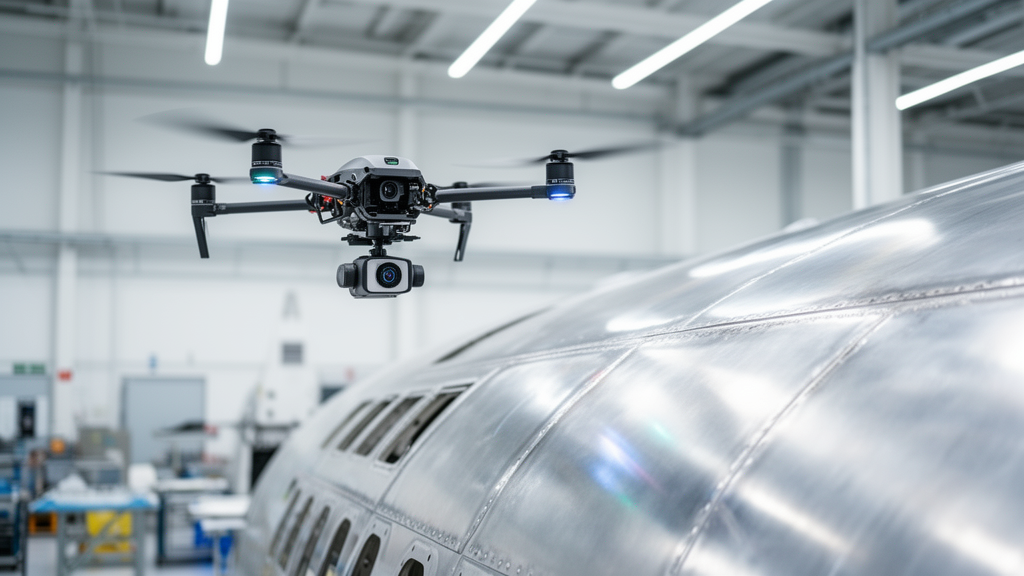
A new systematic review establishes that the integration of machine-learning-enhanced unmanned aerial vehicle systems into Industry 4.0 paradigms represents a critical shift toward proactive, autonomous, and predictive quality management. By acting as mobile cyber-physical nodes, these drones transcend the limitations of traditional manual inspection, providing the spatial coverage, velocity, and high-fidelity data streams required to monitor complex industrial assets in real time. The integration of sophisticated machine learning architectures—including convolutional neural networks, vision transformers, and reinforcement learning—with multi-modal sensor arrays allows for the investigation of surface transport phenomena such as heat transfer, corrosion kinetics, thermo-mechanical coupling, and surface wettability. These interconnected physical processes are fundamental determinants of product performance, asset longevity, and operational reliability in smart manufacturing environments, yet their interrogation has historically been constrained by limited sensor accessibility and the subjectivity of manual thermographic interpretation.
The fundamental architecture of these drone-based systems involves the autonomous collection of multimodal sensor data, which is then fed into digital twin frameworks and predictive analytics platforms. Unlike traditional systems that rely on periodic, sample-based inspections, the drone-led paradigm utilizes continuous measurement streams to inform the plan-do-check-act cycle, enabling a transition from reactive error identification to systemic, predictive quality assurance. Drones equipped with high-resolution thermal, LiDAR, hyperspectral, and visible imaging sensors capture rich, geotagged data from inaccessible or hazardous industrial areas. This information is subsequently transformed into actionable intelligence through edge-based artificial intelligence, which performs real-time inference on the flight controller. This processing efficiency significantly reduces the reliance on bandwidth-heavy cloud connectivity while ensuring that critical quality notifications, such as defect detection or thermal anomalies, are generated instantaneously for immediate operational response.
A critical focus of this research involves the analysis of surface-level transport phenomena using advanced thermal imaging. Thermal fields, including temperature distributions, thermal gradients, and heat flux patterns, serve as quantitative indicators of surface integrity, process stability, and equipment health. Drones provide the vantage point necessary to map these thermal fields across large-scale infrastructure, recording thermal behaviors that correlate to underlying degradation mechanisms such as friction-induced heating, Joule heating in electrical contacts, or boiling regime transitions. By employing machine learning models to automatically classify these thermal signatures, industry operators can detect signs of impending failure—such as micro-cracks, material fatigue, or fouling—long before they result in catastrophic equipment downtime. This diagnostic capability is essential for predictive maintenance, allowing for the precise scheduling of interventions that optimize thermal efficiency and extend the useful service life of industrial components.
The role of digital twins in this framework provides a virtual analytical sandbox where drone-acquired data is synchronized with physical assets. When a digital twin is updated with high-resolution geometric and thermal data—such as the exact coordinates of a surface corrosion patch or a localized thermal anomaly—it can leverage physics-informed neural networks to simulate the development of the defect under various environmental loads. This computational modeling, which includes techniques such as the finite element method or computational fluid dynamics, enables a new paradigm of surface integrity management. Instead of simple predictive scheduling, maintenance teams can simulate exactly how surface functional degradation will impact overall performance at projected future loads. This closed-loop feedback mechanism ensures that the virtual and physical systems remain aligned, facilitating high-stakes decision support in real time for quality experts and plant leadership.
The integration of reinforcement learning has further revolutionized drone autonomy, particularly for operations within cluttered, GPS-denied environments like warehouses or manufacturing halls. These autonomous agents learn optimal navigation policies through trial and error, enabling them to dynamically calculate efficient inspection paths that maximize coverage while minimizing energy consumption and delivery times. In intralogistics, this capability translates to the rapid, automated validation of inventory and pre-transport quality verification. By using deep learning-based object detection to recognize components, labels, and packaging integrity, these drones perform poka-yoke error-proofing at the point of use. This ensures that only verified, conforming materials proceed into the production stream, thereby eliminating the costly propagation of defects that would otherwise be discovered only during downstream assembly or at the end-customer stage.
Despite the promise of this technology, the review identifies significant technical and physical limitations that continue to hinder widespread industrial deployment. Thermal imaging is particularly sensitive to emissivity variation, which is inseparably associated with surface material properties, roughness, and coatings, and is subject to alteration over time due to oxidation or contamination. Measurements are also affected by atmospheric interference from humidity, particulates, and heat gradients, which attenuate infrared radiation over distance. Furthermore, the spatial resolution of current drone-mounted thermal cameras is often insufficient to capture micro-scale behaviors like boiling heat transfer or early-stage fatigue cracking. While super-resolution machine learning techniques are in development, they currently possess limitations in recovering lost physical information and can inadvertently introduce artifacts, necessitating further research into sensor development and calibration under varying flight conditions.
Algorithmic challenges remain a central hurdle for these cyber-physical quality systems. The performance of deep learning architectures depends heavily on high-quality, labeled datasets, which are notoriously difficult to acquire in industrial settings where defects are relatively rare and annotation by domain experts is expensive. Furthermore, models often suffer from domain shift—where an algorithm trained in one factory setting fails to generalize to another due to variations in geometry, material, or environmental factors. The lack of explainable artificial intelligence also poses a regulatory risk, as deep learning models are often opaque, limiting the trust required for their application in critical quality and safety sectors like nuclear power or aerospace. Addressing these challenges through the development of physics-informed neural networks, which constrain predictions with known heat conduction or Navier-Stokes equations, is viewed as a primary research objective to improve predictive accuracy even in data-scarce scenarios.
The roadmap for future development emphasizes a transition toward hyper-automated, collaborative industrial ecosystems. This vision includes the deployment of heterogeneous drone swarms capable of coordinated, multi-agent reinforcement learning, where units autonomously assign tasks and share computational workloads. Future orchestrators will enable closed-loop surface remediation, where a drone identifies a defect, transmits an alert to a central planner, and a ground-based robot is dispatched to perform repairs, with the drone then overseeing the post-remediation validation. Such systems will rely on standardized frameworks for data exchange, including the Asset Administration Shell, and the maturation of regulatory frameworks that permit the safe operation of autonomous units beyond the visual line of sight. By standardizing benchmarks and test protocols, researchers aim to move beyond laboratory-scale demonstration into robust, certifiable industrial quality standards.
In specialized industrial domains, the benefits of this integration are already becoming apparent. In the power generation sector, thermal surveillance of wind turbine blades and photovoltaic arrays is facilitating the identification of hotspots caused by cell failure or contamination, allowing for energy-loss estimation and predictive maintenance. Similarly, in metal processing, drones map the temperature distributions of strands exiting continuous casting molds to identify areas susceptible to breakouts, providing information on shell thickness that was previously inaccessible to fixed sensors. In the pharmaceutical and chemical processing sectors, non-invasive thermal imaging of reactor surfaces allows for the estimation of internal mixing quality and the early detection of localized hot spots that may signal reaction runaway, thereby ensuring product quality, yield, and safety through real-time thermal homogenization monitoring.
Ultimately, the synthesis of these findings suggests that the convergence of drone mobility, multi-modal sensing, and advanced machine learning is transforming quality management from a downstream checkpoint activity into a pervasive, predictive, and data-driven component of the production process. The shift toward integrated cyber-physical quality platforms allows for the management of coupled transport phenomena at length scales ranging from microscopic surface features to infrastructure-scale assets. As interdisciplinary research continues to bridge the gap between macroscopic industrial performance and atomic-scale surface physics, the future of these drone-enabled quality ecosystems rests on the ability to unify data-driven learning with governing physical laws. When fully realized, such autonomous systems will provide a new paradigm for industrial reliability, ensuring that the functional performance of engineered surfaces is maintained consistently across the entire lifecycle of the industrial product.
Subject of Research: Integration of machine learning-optimized drones for intelligent quality management and functional surface analysis in industrial manufacturing.
Article Title: Machine learning optimized drone based investigation of multiphysics transport phenomena on functional surfaces for thermal imaging digital twins and quality management in Industry 4.0
Article References: Dey, K., Kumar, R., & Debnath, S. (2026). Machine learning optimized drone based investigation of multiphysics transport phenomena on functional surfaces for thermal imaging digital twins and quality management in Industry 4.0. Discover Surfaces, 1(1), Article 7. https://doi.org/10.1007/s44507-026-00008-4
Image Credits: AI Generated
DOI: 10.1007/s44507-026-00008-4
Keywords: Industry 4.0, Unmanned Aerial Vehicles, Machine Learning, Total Quality Management, Thermal Imaging, Digital Twin, Surface Transport Phenomena, Predictive Maintenance, Edge AI, Multimodal Sensor Fusion, Cyber-Physical Systems, Surface Wettability, Thermo-mechanical Coupling, Reinforcement Learning, Process Optimization
News Source: Teresa Odom. (November 16, 2026). Machine Learning Drones Advance Predictive Surface Quality Management in Industry. Scienmag.