In a field validation conducted along the subaquatic segment of Qingdao Metro Line 8 in Shandong Province, China, civil engineering researchers demonstrated an integrated inspection framework that resolves a persistent trade-off in underground infrastructure monitoring by unifying optical line scan imagery with mobile laser scanning point clouds. Shield tunnels represent vital urban transportation corridors constructed under complex geological conditions, yet conventional inspection methodologies struggle to simultaneously deliver millimetric crack identification and dependable spatial positioning across curved concrete linings. By mounting high-speed imaging arrays and profile scanning instruments onto a dedicated mobile inspection cart designated MTI-300, the research team established an automated workflow achieving multi-defect instance segmentation, coordinate extraction, and three-dimensional virtual reconstruction. The methodology leverages deep convolutional networks to detect surface deteriorations from planar photographs, aligns localized defect geometries with spatial point coordinates through feature matching, and synthesizes the merged structural data into an interactive three-dimensional model for maintenance evaluation.
The operational preservation of shield tunnel linings demands periodic evaluation because structural distress mechanisms such as cracking, leakage, spalling, and deformation can compromise passenger safety and tunnel longevity. Recent automation initiatives deployed computer vision alongside mobile laser scanning systems, but individual sensor modalities exhibit technical limitations when operated independently. Mobile laser scanners gather millions of spatial coordinates and reflectivity intensities per second, permitting precise computation of structural deformation, yet their spatial resolution frequently exceeds one millimeter. This point cloud density proves inadequate for distinguishing fine cracks with widths under zero point five millimeters. Conversely, optical cameras yield rich texture details at sub-millimeter scales but lack three-dimensional spatial coordinates, hindering precise spatial localization and causing substantial geometric distortion during direct reconstruction from uncalibrated pinhole projection models without physical depth.
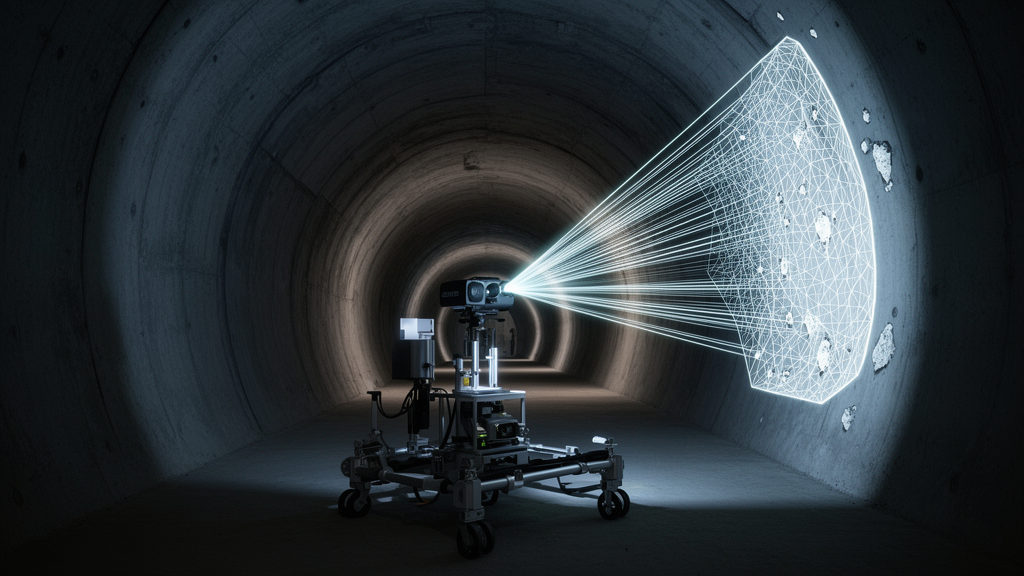
To overcome the physical limitations of single-sensor approaches, the investigators engineered the MTI-300 inspection cart, an integrated rolling apparatus mounted upon an electric vehicle designed for railway track traversal. The image acquisition subsystem incorporates five autonomous line scan camera assemblies configured to image the tunnel cross-section during travel. Each camera unit comprises an industrial computer, a rechargeable battery pack, dedicated lighting sources, and an optical lens with focal lengths of fifty or eighty millimeters. The line scan sensors integrate eight thousand one hundred ninety-two discrete elements operating at a horizontal scanning frequency of approximately two thousand five hundred three hertz, generating an image resolution of zero point two millimeters per pixel during operational tunnel testing. Complementing the optical camera assembly, the vehicle carries a Z and F PROFILER 9012 laser scanner capable of rotating at speeds up to two hundred hertz with a peak acquisition rate of one million points per second.
To optimize storage capacity and inspection efficiency, the researchers operated the laser scanner at one hundred revolutions per second while navigating the inspection cart at zero point five meters per second. This operational configuration produced a five-millimeter distance between consecutive spiral scanning traces along the tunnel perimeter, approximating the distance between parallel ring lines. The scanning procedure yields a four-dimensional dataset containing three-dimensional Cartesian coordinates alongside a normalized laser reflection intensity measurement for each recorded surface point. To establish direct mathematical correspondence with optical imagery, the researchers converted the point cloud into planar raster representations. Spatial coordinates were projected onto an idealized cylindrical envelope matching the engineered design radius of the tunnel lining, unrolled along its parent line, and partitioned into a discrete regular grid with five-millimeter side lengths. Grid cells devoid of points received mean filtering, producing a two-dimensional intensity image with five-millimeter pixel resolution.
The automated defect interpretation pipeline relies on YOLOv8-seg, a single-stage, anchor-free deep learning instance segmentation architecture optimized to process high-resolution sub-images partitioned from the extensive line scan camera captures. The architecture utilizes an enhanced Cross Stage Partial DarkNet backbone comprising fifty-three convolutional layers, employing cross-stage partial connections to improve information transmission across deep network stages. Within this backbone, core C2f functional blocks split feature map channels into dual computational paths, routing representations through cascading bottleneck units derived from residual learning architectures to mitigate gradient vanishing and exploding. Downstream from feature extraction, the network incorporates a dual-module neck structure combining a Feature Pyramid Network with a Path Aggregation Network. The feature pyramid synthesizes multi-scale semantic contexts through lateral connections, while the path aggregation module reinforces bottom-up localized boundary details through systematic feature concatenation, enabling the terminal detection heads to concurrently execute category classification, bounding box regression, and pixel-level segmentation for identified tunnel surface anomalies.
Network training was conducted on a workstation featuring an NVIDIA GeForce RTX 2080 Ti processor using three thousand annotated tunnel inspection images compiled from prior engineering studies. The dataset was partitioned according to a seven-to-two-to-one ratio across training, validation, and testing sets. Over consecutive training epochs, loss metrics on the training set declined steadily, whereas validation loss exhibited a slight increase after extended iterations, indicating emergent model overfitting. Consequently, model weights captured at the one hundred twentieth training epoch were designated for final deployment. When benchmarked across the independent test partition at an optimal confidence threshold of zero point five two zero, the segmentation network achieved a maximum mean average precision of zero point eight seven and a peak F1 score of zero point eight zero. The model demonstrated superior recognition precision for water leakage defects, while registering comparatively reduced detection sensitivity for minor cracks and concrete spalling due to limited pixel representation.
To merge semantic segmentation masks from high-resolution optical imagery with the spatial coordinate framework of the laser scanner, the methodology implements a post-fusion strategy centered on automated homography estimation between sensor modalities. The framework utilizes the Scale Invariant Feature Transform operator to detect stable keypoints across scale-space octaves constructed through Difference of Gaussian filtering, refining sub-pixel coordinates via second-order Taylor series expansion. Local gradient orientations are compiled into one-hundred-twenty-eight-dimensional descriptor vectors, establishing feature invariance against variations in rotation, illumination, and scale. Correspondence matching across line scan photographs and rasterized point cloud intensity images is executed via the Fast Library for Approximate Nearest Neighbors to accelerate high-dimensional querying. Matches are validated using a strict distance ratio test, confirming an association only when the distance to the nearest feature candidate is significantly smaller than the second-nearest neighbor. When verified feature correspondences exceed ten pairs, a planar homography matrix is resolved.
Following homography estimation, the system executes pixel-level color space fusion to highlight identified structural defects against the geometric lining background. Applying the homography transformation reprojects the coordinates of binary defect segmentation masks directly into the coordinate space of the rasterized point cloud image. The single-channel grayscale point cloud representation is converted into a three-channel red-green-blue format, where mapped defect pixels receive a maximum intensity value of two hundred fifty-five in the red channel, delineating cracks and leakage in prominent red hues. To validate registration accuracy without subjective manual bias, the Segment Anything Model foundation architecture automatically segmented structural bolt holes on both image types. Evaluating alignment through the Intersection over Union metric yielded an average overlap score of zero point eight eight. In comparative feature matching benchmarks, the Scale Invariant Feature Transform operator surpassed Speeded Up Robust Features and Oriented FAST and Rotated BRIEF, securing the largest quantity of matched feature pairs and the highest alignment fidelity.
Field validation was conducted along an active one-point-two-kilometer underwater segment of Qingdao Metro Line 8 comprising eight hundred seventeen lining rings traversing four undersea fault fracture zones. From the collected point cloud data, transverse convergence and segment ring misalignment were quantified through automated ellipse fitting routines. To demonstrate spatial visualization, an extended continuous section comprising thirty tunnel rings exhibiting diverse distress conditions underwent three-dimensional reconstruction, successfully mapping five cracks, eleven leakage patches, and one spalling defect. The reconstruction pipeline converts two-dimensional composite image pixels into ordered planar point arrays, connects adjacent points into linear segments, and links adjoining lines into triangular mesh facets without requiring iterative nearest-neighbor search algorithms. The resulting planar mesh is subsequently projected around a geometric cylinder possessing the engineered tunnel design radius and exported in OBJ format. When loaded into the Unity software platform, the reconstructed model affords an immersive digital walkthrough displaying verified defect locations alongside concurrent plots of structural convergence.
Quantitative assessment of spatial reconstruction accuracy demonstrated substantial performance advantages for the fused multimodal pipeline when measured against single-sensor baselines using the relative distance error metric. Fused reconstruction achieved a relative distance error reduction of one point two compared to reconstruction derived exclusively from line scan camera images, which suffered an average relative distance error of one point five alongside severe perspective distortion caused by uncalibrated pinhole projection. Relative distance error was likewise reduced by zero point six compared to point clouds alone, which routinely overlooked narrow fractures due to five-millimeter resolution limits. Computational timing evaluations on a twenty-five-meter tunnel segment showed that feature-based fusion required approximately zero point three three seconds per image, avoiding lengthy optical photo stitching while matching the geometric accuracy of conventional Poisson surface reconstruction at lower computational expense. For operational deployments, the authors note that battery mass required for high-intensity lighting systems remains heavy, recommending future algorithm refinement to support low-illumination optical defect detection and long-term predictive safety monitoring.
Subject of Research: Automated multimodal 3D defect inspection and reconstruction for shield tunnel linings
Article Title: Automated 3D defect inspection in shield tunnel linings through integration of image and point cloud data
Article References: Huang, H., Liu, S., Zhou, M., Shao, H., Li, Q., & Thansirichaisree, P. (2025). Automated 3D defect inspection in shield tunnel linings through integration of image and point cloud data. AI in Civil Engineering, 4(1), Article 12. https://doi.org/10.1007/s43503-025-00054-w
Image Credits: AI Generated
DOI: 10.1007/s43503-025-00054-w
Keywords: tunnel inspection, shield tunnels, point clouds, line scan cameras, YOLOv8, deep learning, image fusion, 3D reconstruction, civil engineering, Automated, defect, inspection
News Source: Denise Maddox. (November 16, 2026). Integrated Camera and Laser Mapping Enables Automated 3D Tunnel Defect Inspection. Scienmag.