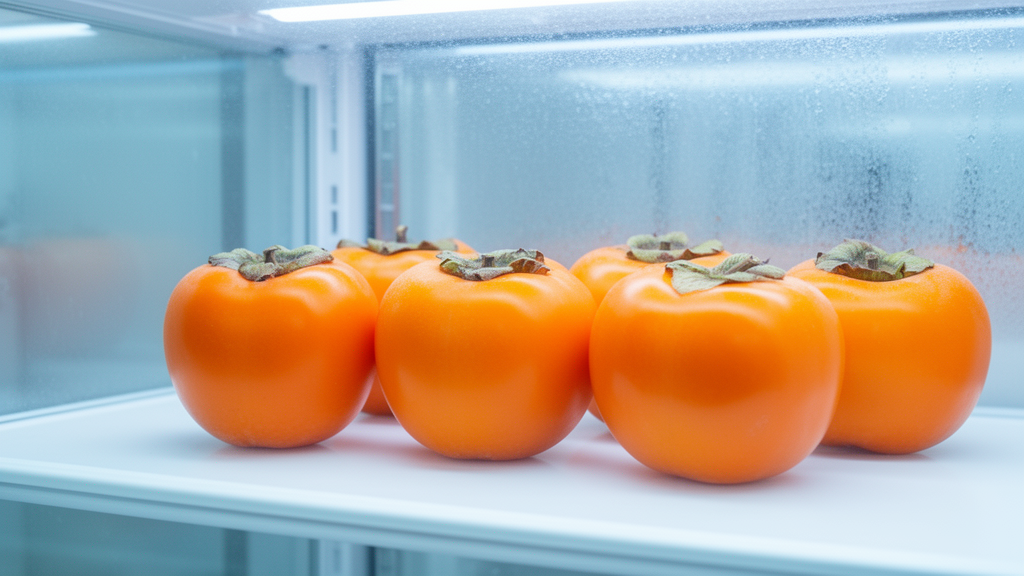
By employing a comprehensive multiparametric approach, researchers from the Instituto Valenciano de Investigaciones Agrarias evaluated how different storage temperatures and the application of 1-methylcyclopropene (1-MCP) influence the physical and structural integrity of the fruit. The findings demonstrate that reducing storage temperatures from 1 °C to 0 °C can substantially delay the structural breakdown and softening typically associated with prolonged cold storage, thereby extending the commercial potential of the fruit beyond conventional limits.
Persimmon production is a significant agricultural sector in regions such as Spain, where ‘Rojo Brillante’ is the predominant variety. While highly valued for its firm and crisp texture, this cultivar is particularly susceptible to chilling injury when subjected to cold storage to extend its short marketing season. The most common manifestation of this injury is a marked loss of firmness, which becomes especially pronounced during the transition from cold storage to shelf-life conditions.
In this investigation, researchers followed 1,110 fruits harvested at commercial maturity, characterized by a uniform reddish-orange external color. After sorting for uniformity, fruits were divided into groups treated with 1-MCP or left untreated, then subjected to storage at 0, 1, or 5 °C for durations of up to 90 days. To evaluate texture, the team employed both puncture tests—which measured fracture strength, fracture distance, and the slope of force-displacement curves—and whole-fruit compression tests. These instrumental techniques were complemented by Cryo-scanning electron microscopy, transmission electron microscopy, and assays of cell-wall-modifying enzymes, specifically pectin methylesterase and polygalacturonase.
The study revealed that while fracture strength, or conventional firmness, is a widely used metric for operational decision-making, it often fails to capture the full spectrum of structural changes occurring during prolonged storage. The research identified a distinct intermediate mechanical state, termed a rubbery texture, in which fruit maintained commercially acceptable firmness values but exhibited increased tissue deformability and reduced rigidity. This rubbery state represents a transitional stage between the crispness expected at harvest and the eventual structural collapse characterized by severe tissue breakdown and non-elastic softening, which was observed most rapidly in fruit stored at 5 °C.
A critical observation from the data was the superior performance of 0 °C storage compared to the industry-standard 1 °C. Fruit stored at 0 °C, especially when treated with 1-MCP, maintained lower deformation values and higher structural integrity throughout the 90-day period. At 5 °C, conversely, the application of 1-MCP proved largely ineffective at preventing rapid firming loss, with mechanical analysis and microscopy confirming severe tissue damage, including deformed cells, degraded cell walls, and widespread disintegration of cellular membranes. These findings underscore that small temperature variations in the cold chain significantly impact the efficacy of preservation treatments.
The mechanical observations were closely mirrored by the measured activity of cell-wall enzymes. The research found that PME and PG activities are modulated by both temperature and 1-MCP treatment, with higher enzymatic activity at 5 °C correlating with the rapid loss of flesh resistance. In untreated fruit, the transition toward a rubbery texture between 60 and 90 days of storage at 0 and 1 °C coincided with a marked increase in PME activity alongside a decline in PG activity. This enzymatic imbalance is believed to facilitate pectin remodeling, leading to the accumulation of high-molecular-weight pectins that contribute to a gel-like, rubbery consistency rather than conventional softening.
Microstructural examinations provided visual evidence of these mechanical and enzymatic shifts. Fruit stored at 0 °C retained well-structured parenchyma and strong cell-to-cell adhesion even after 90 days, whereas fruit at 5 °C showed clear signs of structural collapse, with large solute-filled intercellular spaces and disintegrated cellulose microfibrils. In 1-MCP-treated samples stored at 0 and 1 °C, the maintenance of membrane integrity and cell wall cohesion was significantly improved compared to the untreated control group, confirming the role of the treatment in delaying the onset of chilling injury.
The study highlights that characterizing texture evolution in persimmons requires more than just measuring the maximum force at rupture. The multiparametric framework adopted here—incorporating fracture distance, slope, and whole-fruit deformation—offers a more robust approach to investigating postharvest quality. By providing a multidimensional view of how fruit respond to storage conditions, this method enables more precise assessments of structural and mechanical integrity, moving beyond the limitations of univariate firmness measurements. The authors conclude that these insights are essential for optimizing postharvest protocols and extending the storage life of ‘Rojo Brillante’ persimmons in a commercial context.
Future research is needed to correlate these instrumental texture profiles with sensory perception to fully understand the consumer experience of the rubbery texture identified in the study. Additionally, investigating the antioxidant response and other physiological factors may help elucidate why ‘Rojo Brillante’ persimmons show such a differential response to minor changes in storage temperature.
At harvest, the persimmons exhibited high rigidity, with an average firmness of 56 Newtons and a minimal fracture distance of approximately 2.5 millimeters. This state, marked by a compact parenchyma and turgid cells, serves as the baseline for the observed mechanical decline. As storage progressed, the puncture test revealed that fracture distance—the probe displacement until the flesh yields—is a critical metric for detecting incipient internal changes. While fracture strength remained relatively stable in early stages at 0 °C, the fracture distance doubled after 60 and 90 days, signaling that the tissue had transitioned to an elastic state before any significant softening was detectable by traditional force measurements. This increase in deformability indicates that the cellular architecture is undergoing internal reorganization, a process that conventional firmness metrics consistently overlook.
The compression tests on whole fruit provided an integrated assessment that corroborated the puncture data. While puncture tests measure localized flesh resistance, compression evaluates the fruit’s overall mechanical response to a 10 Newton force. Fruit stored at 5 °C reached a significant 6 percent deformation after 90 days, rising to 8 percent after the subsequent shelf-life simulation. This high level of deformation, paired with a low fracture distance, confirms that storage at 5 °C induces structural collapse rather than a controlled loss of crispness. In contrast, 1-MCP-treated fruit stored at 0 °C consistently maintained deformation values near 2 percent, demonstrating that the treatment significantly enhances the fruit’s mechanical resistance to stress even during extended storage periods. The divergence between these mechanical states highlights the extreme sensitivity of the ‘Rojo Brillante’ variety to temperature fluctuations within the cold chain.
The study also elucidates the enzymatic mechanics behind these textural transitions. Pectin methylesterase (PME) and polygalacturonase (PG) activity profiles varied significantly across temperature treatments. In non-treated fruit, PME activity surged fivefold after 90 days at 0 and 1 °C, while PG activity simultaneously declined. Conversely, at 5 °C, the enzyme activity remained relatively stagnant between 60 and 90 days, coinciding with observed cellular disintegration and the loss of structural integrity. This lack of enzymatic evolution at higher temperatures implies that substrate depletion or enzyme inactivation may terminate the remodeling process prematurely, leading directly to tissue collapse.
Microstructural analysis via Cryo-scanning electron microscopy and transmission electron microscopy provided direct visual confirmation of these mechanical findings. In contrast, 1 °C storage at the same duration revealed initial signs of middle-lamella dissolution and microfibril disorganization. At 5 °C, the parenchyma exhibited severe deformation and extensive solute-filled intercellular spaces, indicating that cellular membranes had suffered widespread deterioration. These ultrastructural snapshots demonstrate that the preservation of cell-wall cohesion is a primary determinant of fruit texture, with the 1-MCP treatment serving as a crucial intervention to maintain membrane continuity.
Subject of Research: Postharvest texture evolution and chilling injury mitigation in 'Rojo Brillante' persimmons.
Article Title: A multiparametric approach to characterize texture evolution during prolonged cold storage of ‘Rojo Brillante’ persimmon
Article References: Moreno, A., Vilhena, N. Q., Llorca, E., Quiles, A., Talens, P., Gil, R., & Salvador, A. (2026). A multiparametric approach to characterize texture evolution during prolonged cold storage of ‘Rojo Brillante’ persimmon. Journal of Agriculture and Food Research, 32, Article 103441. https://doi.org/10.1016/j.jafr.2026.103441
Image Credits: AI Generated
DOI: 10.1016/j.jafr.2026.103441
Keywords: Diospyros kaki, Rojo Brillante, postharvest storage, chilling injury, 1-methylcyclopropene, fruit texture, multiparametric analysis, mechanical behavior, cold storage temperature, parenchyma integrity, pectin methylesterase, polygalacturonase, cell-wall remodeling, tissue elasticity, fruit deformation, food science
News Source: Alan Morgan. (November 16, 2026). Lowering Storage Temperature to Zero Celsius Preserves Persimmon Texture and Quality. Scienmag.