• HOME
  • NEWS
  • EXPLORE
    • CAREER
      • Companies
      • Jobs
    • EVENTS
    • iGEM
      • News
      • Team
    • PHOTOS
    • VIDEO
    • WIKI
  • BLOG
  • COMMUNITY
    • FACEBOOK
    • INSTAGRAM
    • TWITTER
Monday, November 16, 2026
BIOENGINEER.ORG
No Result
View All Result
  • Login
  • HOME
  • NEWS
  • EXPLORE
    • CAREER
      • Companies
      • Jobs
        • Lecturer
        • PhD Studentship
        • Postdoc
        • Research Assistant
    • EVENTS
    • iGEM
      • News
      • Team
    • PHOTOS
    • VIDEO
    • WIKI
  • BLOG
  • COMMUNITY
    • FACEBOOK
    • INSTAGRAM
    • TWITTER
No Result
View All Result
Bioengineer.org
No Result
View All Result
Home NEWS Science News Biology

Protocol Outlines Robotics and Machine Learning Workflow for All-Natural Plastic Substitutes

by
November 16, 2026
in Biology
Reading Time: 2 mins read
0
Protocol Outlines Robotics and Machine Learning Workflow for All-Natural Plastic Substitutes

Protocol Outlines Robotics and Machine Learning Workflow for All-Natural Plastic Substitutes

Share on FacebookShare on TwitterShare on LinkedinShare on RedditShare on Telegram

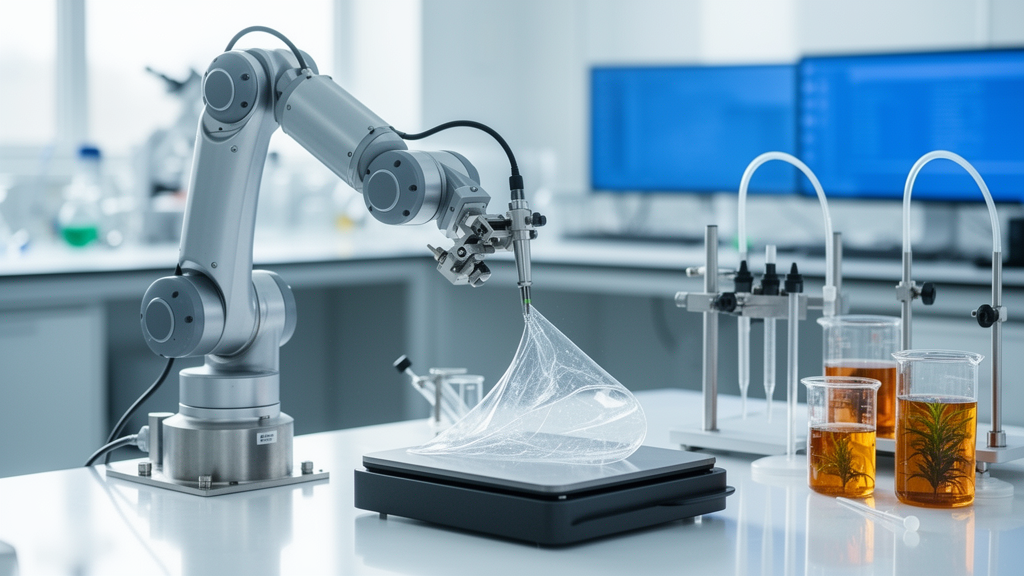
A protocol describes a robotics- and machine learning-integrated workflow to accelerate the screening process for all-natural plastic substitutes. As global concerns regarding nondegradable plastic waste escalate, researchers have faced persistent difficulties in identifying all-natural composite materials that match the optical, thermal, and mechanical performance of commercial plastics. Traditional methods of iterative experimental optimization are frequently inefficient, hindering the speed at which functional substitutes can be identified and deployed.

This newly established protocol addresses these inefficiencies by automating the early stages of material screening. The procedure begins with a pipetting robot tasked with preparing a diverse library of 286 nanocomposites. By utilizing the basic physical properties of these initial samples, the research team trained a support vector machine classifier. This machine learning tool serves to distinguish between feasible and infeasible film compositions within the four-component system, effectively defining a manageable design space for subsequent exploration.

To further refine the library, the researchers employed 14 active learning loops integrated with data augmentation techniques. During this stage, small random variations were introduced to the characterization data within the observed experimental error range, allowing the robot to fabricate 135 additional all-natural nanocomposites in a structured, stagewise manner. This systematic data collection was fundamental to constructing an artificial neural network model capable of sophisticated predictive analysis.

The resulting prediction model allows researchers to estimate the physicochemical properties of a nanocomposite directly from its constituent composition. Furthermore, the workflow supports inverse design, enabling the identification of specific compositions that are likely to satisfy user-defined performance targets, such as transparency or fire resistance.

The team utilized Shapley Additive Explanations to interpret model decisions, alongside validation via molecular dynamics simulations to verify material behavior.

The hybrid approach detailed in this protocol can be completed in approximately two months, providing a substantial reduction in time compared to conventional screening strategies. By utilizing components drawn from databases of substances Generally Recognized As Safe, the workflow facilitates the accelerated discovery of eco-friendly materials with programmable functions. This integrated methodology not only streamlines the development of plastic substitutes but also offers a template for the inverse design of functional materials across other chemical systems.

Furthermore, the protocol describes a strategy for model expansion, enabling the integration of new building blocks into the existing framework.

Subject of Research: Protocol for automated discovery of all-natural, biodegradable plastic substitutes.

Article Title: A robotics- and machine learning-integrated workflow for discovering all-natural plastic substitutes

Article References: Li, Y., Sose, A. T., Chen, T., & Chen, P.-Y. (2026). A robotics- and machine learning-integrated workflow for discovering all-natural plastic substitutes. Nature Protocols. https://doi.org/10.1038/s41596-026-01449-4

Image Credits: AI Generated

DOI: 10.1038/s41596-026-01449-4

Keywords: Robotics, Machine Learning, Materials Science, Biodegradable Plastics, Nanocomposites, Automated Experimentation, Active Learning, Artificial Neural Networks, Support Vector Machine, Material Properties, Eco-Friendly Materials, Inverse Design, Molecular Dynamics, Shapley Additive Explanations, Programmable Functionality

News Source: Teresa Odom. (November 16, 2026). Protocol Outlines Robotics and Machine Learning Workflow for All-Natural Plastic Substitutes. Scienmag.


Tags: active learningArtificial neural networksautomated experimentationbiodegradable plasticsEco-Friendly Materialsinverse designMachine LearningMaterial Propertiesmaterials sciencemolecular dynamicsNanocompositesProgrammable FunctionalityRoboticsShapley additive explanationssupport vector machine
Share12Tweet7Share2ShareShareShare1

Related Posts

Fungal Enzyme Expression in Arabidopsis Reduces Cell Wall Recalcitrance and Bolsters Immunity

Fungal Enzyme Expression in Arabidopsis Reduces Cell Wall Recalcitrance and Bolsters Immunity

November 16, 2026
Dynamo Protocol Models Single-Cell Vector Fields to Predict Lineage Fate Transitions

Dynamo Protocol Models Single-Cell Vector Fields to Predict Lineage Fate Transitions

November 16, 2026

New Nextflow Pipeline Standardizes Long-Read DNA Methylation Analysis Across Sequencing Platforms

November 16, 2026

Ruminally Available Methionine Analog Alters Fermentation and Nutrient Digestibility in Laboratory Tests

November 16, 2026

POPULAR NEWS

  • Chaotic Encryption Scheme Secures Sensitive Image Regions Using Blurring and Scrambling

    Chaotic Encryption Scheme Secures Sensitive Image Regions Using Blurring and Scrambling

    29 shares
    Share 12 Tweet 7
  • Problematic Smartphone Use Linked to Youth Distress in Comparative Study

    29 shares
    Share 12 Tweet 7
  • Dynamo Protocol Models Single-Cell Vector Fields to Predict Lineage Fate Transitions

    29 shares
    Share 12 Tweet 7
  • Global Meta-Analysis Reveals 5.5 Percent Nontuberculous Mycobacteria Prevalence in HIV Patients

    29 shares
    Share 12 Tweet 7

About

We bring you the latest biotechnology news from best research centers and universities around the world. Check our website.

Follow us

Recent News

Modular Structural Representations Enable Scalable Real-Time Inversion of Nonlinear Systems

Hybrid Deep Learning and Blockchain System Improves Distributed Cyber Attack Detection

Interface Multimodal Analysis Accurately Identifies Fault Root Causes in Microservice Systems

Subscribe to Blog via Email

Enter your email address to subscribe to this blog and receive notifications of new posts by email.

Join 87 other subscribers
  • Contact Us

Bioengineer.org © Copyright 2023 All Rights Reserved.

Welcome Back!

Login to your account below

Forgotten Password?

Retrieve your password

Please enter your username or email address to reset your password.

Log In
No Result
View All Result
  • Homepages
    • Home Page 1
    • Home Page 2
  • News
  • National
  • Business
  • Health
  • Lifestyle
  • Science

Bioengineer.org © Copyright 2023 All Rights Reserved.