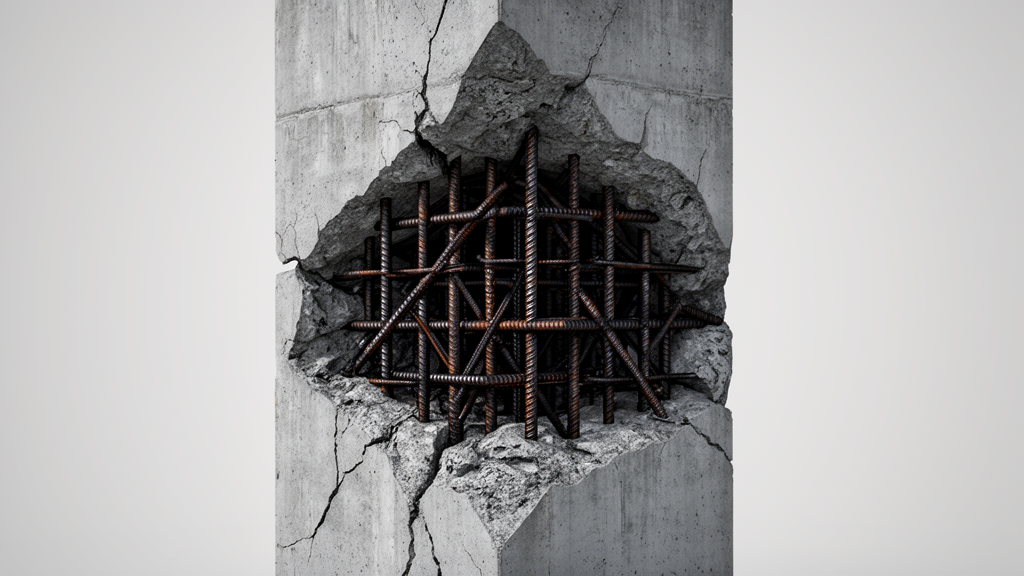
Finite element simulations have identified that reinforced concrete columns experience a higher number of delayed collapse cases following shorter fire exposures, with structural collapse proving particularly critical for columns possessing a slenderness ratio of 28.87 or less. The findings, reported by researchers Md. Abdul Basit, Ishtiaque Ahmed, and Md. Foisal Haque in Discover Materials, evaluate the structural response, post-fire capacity, and failure behaviour of reinforced concrete columns throughout both active heating and the subsequent cooling phase.
The computational investigation was designed to address a persistent gap in structural fire research. Although earlier experimental studies had observed the overall physical response of reinforced concrete columns subjected to fire, the authors emphasized that there remained an ongoing need for numerical research. Specifically, numerical modelling was required to systematically identify the critical range of axial loads that may lead to structural collapse throughout the cooling phase and after the structure has cooled.
To replicate the physical conditions of fire exposure, the researchers simulated the effects of fire through thermal loading applied to the column surfaces exposed to fire. The finite element framework modelled heat transfer through conduction, convection, and radiation mechanisms. In parallel, the variation of concrete and steel material properties was directly incorporated into the numerical simulations with respect to temperature as heating progressed across the column.
Following the thermal loading stage, a water-cooling method was adopted to cool the reinforced concrete column models. The outcomes of the numerical modelling were systematically examined with respect to several essential structural performance indicators. These evaluated parameters included column fire resistance, failure loads under axial demands, peak temperatures attained during thermal exposure, and the detailed temperature distribution contours formed across the concrete and steel elements.
The reliability of the developed finite element model was evaluated against benchmark findings from earlier published research literature. During the heating phase, the calculated resistance of the column showed strong agreement with the results of standard furnace tests reported in previous experimental studies, confirming the consistency and accuracy of the model. The numerical modelling results were then compared for the cooling zone with a previous numerical study using a similar modelling approach, and this comparison demonstrated consistent results.
Following successful model validation, the researchers conducted a parametric study with the validated model to detect the potential critical axial load range capable of triggering structural collapse. To evaluate how structural dimensions and applied loads influence post-fire capacity, the authors systematically modelled columns with various clear cover values, load ratios, and slenderness ratios. This systematic analysis enabled the investigators to evaluate column stability under diverse loading and structural configurations.
From the parametric investigation, the study identified critical conditions governing column failure during and after cooling. It was observed that the number of cases of delayed collapse is high for shorter fires. Furthermore, the numerical modeling demonstrated that delayed collapse is particularly critical for reinforced concrete columns with a slenderness ratio of 28.87 or less, highlighting the specific structural geometry and fire conditions that present heightened collapse risks.
Subject of Research: Post-fire structural capacity and delayed collapse behaviour of reinforced concrete columns
Article Title: Numerical evaluation of post fire capacity of reinforced concrete columns
Article References: Basit, M. A., Ahmed, I., & Haque, M. F. (2026). Numerical evaluation of post fire capacity of reinforced concrete columns. Discover Materials. https://doi.org/10.1007/s43939-026-00978-9
Image Credits: AI Generated
DOI: 10.1007/s43939-026-00978-9
Keywords: reinforced concrete columns, post-fire capacity, delayed collapse, finite element modelling, thermal loading, heat transfer, conduction, convection, radiation, water-cooling method, slenderness ratio, load ratio, clear cover, axial load capacity, temperature distribution contours, structural fire resistance, furnace tests
News Source: Denise Maddox. (November 16, 2026). Shorter Fires Increase Delayed Collapse Risk in Reinforced Concrete Columns. Scienmag.