Researchers have introduced and successfully piloted a new blended-learning curriculum designed to prepare interprofessional healthcare teams for high-stakes paediatric emergencies through combined digital and virtual reality simulations. Known as the Paediatric virtual reality emergency training, or PAVIN, the program addresses the inherent clinical and logistical challenges associated with paediatric emergency care, which frequently restrict opportunities for novice teams to establish emergency competencies in traditional hospital environments.
To build a safe and repeatable learning setting, the project links preparatory digital instruction with collaborative physical and simulated environments. Paediatric emergencies unfold rapidly and require precise coordination among diverse clinical roles, creating an urgent demand for educational tools that replicate realistic clinical pressures without jeopardizing patient safety. The PAVIN program was structured specifically to introduce early-career professionals to these demanding scenarios while capturing objective data on team dynamics.
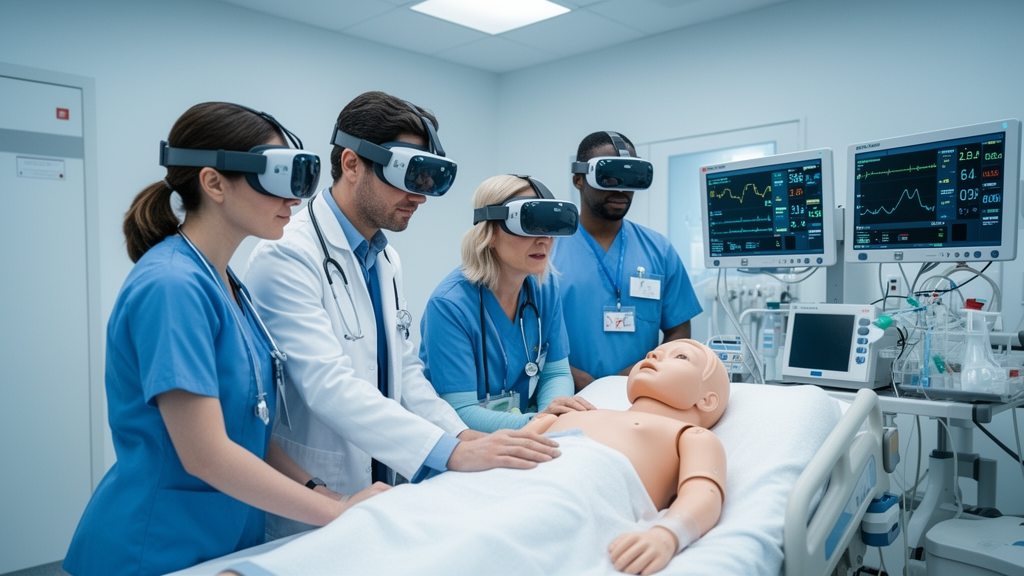
The structural framework of PAVIN incorporates three distinct and complementary educational components. First, trainees complete case-based preparatory e-learning modules that deliver foundational medical knowledge alongside instruction in essential non-technical skills, including interprofessional collaboration and structured crisis communication. Second, learners convene for dedicated on-site sessions. Third, participants transition into immersive multiplayer virtual reality scenarios where they manage simulated paediatric crises in real time.
Training within the virtual reality environment is organized around interprofessional tandems rather than isolated single-discipline learners. Working together within the interactive simulations, the tandems navigate challenging clinical situations in an environment that remains completely reproducible and free from direct clinical risk.
Initial implementation of the curriculum was assessed during an introductory pilot phase involving ten participants. Evaluation questionnaires were completed by nine of the ten trainees, representing a ninety percent response rate. Overall, respondents awarded the course a composite rating of very good, providing uniformly favorable scores across multiple self-reported evaluation measures. Participants affirmed that the blended-learning design was appropriate and judged the training highly relevant to their impending professional work.
Beyond general satisfaction, survey responses highlighted meaningful educational gains in interprofessional engagement and procedural comprehension. Trainees reported heightened interest in interprofessional education and indicated that the immersive virtual reality scenarios actively helped them internalize vital paediatric emergency protocols. Furthermore, participants observed tangible self-reported improvements in communication and teamwork with their assigned tandem partners during the simulated clinical challenges.
A central feature of the educational design is the integration of multiple feedback systems across every stage of the course. Objective mechanisms are embedded directly within the e-learning modules and the multiplayer virtual scenarios to support structured, data-driven debriefing sessions. These built-in feedback loops are reinforced by dedicated team-performance assessment instruments, specifically the virtual Team Performance Observation Tool, alongside pre-intervention and post-intervention self-assessments.
Published as an Open Educational Resource, PAVIN is openly accessible to educators seeking reproducible models for clinical emergency instruction. While the pilot phase was limited to ten participants, the authors noted that this blended framework represents a promising strategy for interprofessional healthcare education. By safely expanding access to critical training, the program may help fulfill the persistent demand for paediatric emergency courses while reinforcing patient safety principles across clinical disciplines.
Subject of Research: Blended virtual reality and e-learning training for interprofessional paediatric emergency teams
Article Title: Introducing the Open Educational Resource PAVIN: a blended-learning, interprofessional multiplayer virtual reality training in paediatric emergencies
Article References: Müller, P. A., Widder, A., Flayyih, O., Straub, C., Heinzmann, A., Stiller, B., & Köpper, H. (2026). Introducing the Open Educational Resource PAVIN: a blended-learning, interprofessional multiplayer virtual reality training in paediatric emergencies. BMC Medical Education. https://doi.org/10.1186/s12909-026-10791-w
Image Credits: AI Generated
DOI: 10.1186/s12909-026-10791-w
Keywords: PAVIN, Paediatric Emergencies, Virtual Reality Simulation, Blended Learning, Interprofessional Education, Medical Students, Nursing Students, Midwifery Students, Nursing Apprentices, Multiplayer Simulation, Emergency Care Competencies, vTPOT, Team Performance Observation Tool, Open Educational Resources, Patient Safety, Data-Driven Debriefing, Non-Technical Skills
News Source: Harold Sullivan. (November 16, 2026). Interprofessional Virtual Reality Training PAVIN Demonstrates Feasibility in Paediatric Emergency Pilot. Scienmag.