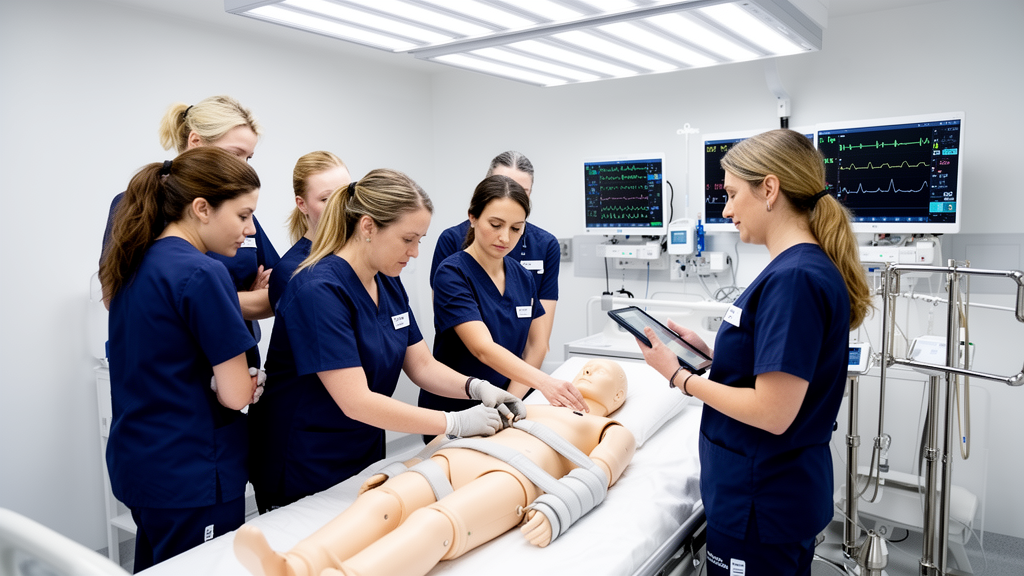
Both in-person and virtual educational programs significantly improved intensive care unit nurses’ knowledge regarding physical restraint practices immediately following instruction compared with a control group, according to a three-arm randomized clinical trial published in BMC Medical Education.
Physical restraints are employed in intensive care settings with the intention of preventing patient harm, but their application carries risks of adverse clinical outcomes. While nursing education offers a recognized pathway to improve clinical knowledge, attitudes, and practice intentions, direct evidence comparing virtual learning platforms with traditional face-to-face instruction has remained limited, prompting researchers to evaluate both approaches systematically.
The clinical trial enrolled 210 intensive care unit nurses across two hospital facilities, randomly assigning 70 participants to in-person training, 70 to virtual training, and 70 to an untreated control group. Both educational interventions were structured into five 30-minute sessions, delivered either through face-to-face instruction or via an online platform equipped with simulation videos.
Participant outcomes were evaluated at baseline, immediately following the completion of the intervention, and at a three-month follow-up. Investigators utilized validated measurement tools including the Knowledge of Physical Restraint Use instrument, the Perceptions of Restraint Use Questionnaire, and instruments structured around the Theory of Planned Behavior to evaluate nurses’ attitudes, subjective norms, perceived behavioral control, and behavioral intentions.
Immediately post-intervention, knowledge scores increased significantly in both the in-person group (standardized mean difference = 0.63, P < 0.001) and the virtual group (standardized mean difference = 0.67, P < 0.001) relative to the control cohort. However, at the three-month assessment, knowledge retention remained statistically significant only among nurses in the virtual training arm (standardized mean difference = 0.45, P = 0.03), while the in-person cohort did not maintain a statistically significant gain over control.
Conversely, in-person instruction produced greater and more sustained reductions in restraint perception scores than the virtual platform. Across all evaluated Theory of Planned Behavior constructs—encompassing attitudes, subjective norms, perceived behavioral control, and intentions—both educational modalities achieved large and lasting improvements, with statistical analysis revealing no significant differences between the two delivery formats.
Adjusting for baseline scores using analysis of covariance and reporting effect sizes as standardized mean differences, the authors concluded that both modalities effectively enhanced knowledge and behavioral determinants. Because in-person learning demonstrated superior efficacy in shifting restraint perceptions through interactive learning, the researchers suggested that blended strategies combining digital simulation with facilitated group discussion may best support sustained knowledge retention, attitude shifts, and safer restraint practices.
Furthermore, the trial was formally documented within public clinical research registries, having been registered with the Iranian Clinical Trial Registration Center under identifier IRCT20240205060913N4 on October 27, 2025.
Subject of Research: Educational methods for intensive care physical restraint use
Article Title: Comparative effects of virtual and in-person training on intensive care nurses’ knowledge, perceptions, and intentions to use physical restraints: a randomized clinical trial
Article References: Sarmadi, S., Zare-Kaseb, A., Sanaie, N., & Beigzadeh, S. (2026). Comparative effects of virtual and in-person training on intensive care nurses’ knowledge, perceptions, and intentions to use physical restraints: a randomized clinical trial. BMC Medical Education. https://doi.org/10.1186/s12909-026-10870-y
Image Credits: AI Generated
DOI: 10.1186/s12909-026-10870-y
Keywords: intensive care unit, nursing education, physical restraints, virtual training, in-person training, randomized clinical trial, Theory of Planned Behavior, Knowledge of Physical Restraint Use, Perceptions of Restraint Use, perceived behavioral control, subjective norms, patient harm prevention, simulation videos, knowledge retention, standardized mean difference, ANCOVA
News Source: Ophelia Keating. (November 16, 2026). Virtual and In-Person Training Improve ICU Nurses’ Physical Restraint Knowledge. Scienmag.