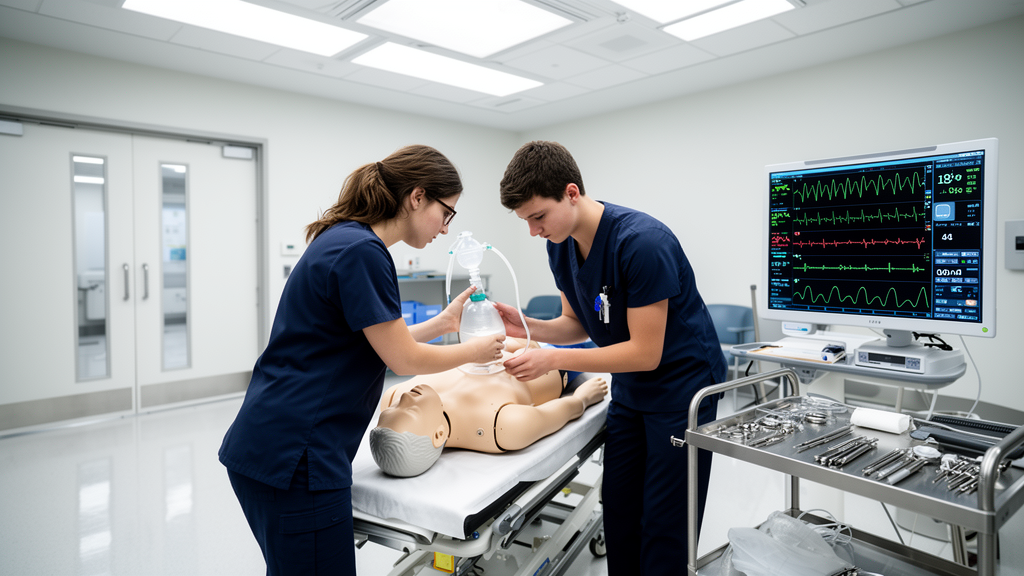
High-fidelity, scenario-based simulation effectively captures substantial improvements in emergency care competencies among general practice resident physicians completing their emergency department rotations, according to an assessment study of eighty-two residents published in BMC Medical Education. The evaluation examined the residents’ capability to direct a clinical team during cardiopulmonary resuscitation under simulated scenario conditions both upon entering and upon exiting the emergency department. While high-fidelity simulation has gained increasing use across medical education curricula, its specific capacity to assess the emergency management competencies of general practice trainees following their departmental rotations had remained under-explored.
To evaluate these competency shifts, researchers analyzed eighty-two general practice resident physicians categorized into two distinct clinical training pathways during their emergency department rotation. A resuscitation room rotation group comprised forty-five participants who spent time assigned to the dedicated resuscitation suite, while a non-resuscitation room rotation group included thirty-seven participants assigned elsewhere in the department. For each resident, evaluators recorded baseline performance upon entry to the department and re-evaluated performance upon departure. In addition to scoring simulation performance, investigators tracked the exact number of active resuscitations each physician attended throughout the rotation period.
At the start of the emergency department rotation, initial cardiopulmonary resuscitation simulation scores revealed no significant difference between the two resident groups. Residents destined for the resuscitation room track demonstrated baseline assessment scores that were statistically indistinguishable from their peers assigned to the non-resuscitation track, yielding a Cohen’s d of minus 0.01 with a 95 percent confidence interval spanning from minus 1.93 to 1.85 and a P-value of 0.97. This absence of disparity confirmed comparable baseline competency between the cohorts before departmental training began.
By the conclusion of the rotation, marked divergence emerged between the two cohorts in overall cardiopulmonary resuscitation simulation performance. Resident physicians who completed their training within the resuscitation room group attained significantly higher exit assessment scores than those in the non-resuscitation room group. This post-rotation difference between the groups reached statistical significance, characterized by a large effect size with a Cohen’s d of 3.29, a 95 percent confidence interval ranging from 8.65 to 11.32, and a P-value of less than 0.001.
Despite the post-exit disparity favoring the resuscitation room cohort, both training tracks produced statistically significant longitudinal improvements from departmental entry to exit. The resuscitation room group achieved an entry-to-exit improvement marked by a Cohen’s d of 3.93, with a 95 percent confidence interval of 17.46 to 20.36 and a P-value of less than 0.001. Meanwhile, the non-resuscitation room group also achieved significant progress between entry and exit, recording a Cohen’s d of 2.35, with a 95 percent confidence interval of 7.62 to 10.15 and a P-value of less than 0.001.
Detailed assessment across individual clinical competencies revealed significant gains across multiple operational domains when comparing entry evaluations to exit evaluations. Resident scores were significantly lower upon entering the department than upon exiting across the judgment of the patient’s condition before cardiac arrest, the implementation of rescue measures for cardiac arrest, the maintenance of uninterrupted chest compressions, the timing of defibrillation delivery, and the post-resuscitation treatment administered following the return of spontaneous circulation. Significant improvements from entry to exit were likewise observed in humanistic care, teamwork coordination, and the overall assessment metric.
In contrast to the broad gains observed in clinical decision-making, timing, and communication, certain specific mechanical and procedural skills demonstrated no statistically significant differences between entry and exit assessments. Resident performance scores showed no significant changes in airway management techniques, execution of basic chest compressions, or the mechanical components of defibrillation, specifically energy selection and defibrillation paddle position. These procedural elements remained stable across the rotation evaluations while leadership, timing, and post-arrest measures advanced.
To examine how clinical exposure influenced high-level performance, investigators conducted a receiver operating characteristic analysis correlating the recorded number of resuscitations attended with resident outcomes. The receiver operating characteristic analysis identified an optimal cut-off threshold of 8.5 attended resuscitations for predicting excellent performance on the final exit simulation assessment. This predictive threshold yielded an area under the curve of 0.785 with a P-value of less than 0.001, linking direct participation in resuscitation events with superior simulation achievement.
The study concluded that scenario-based high-fidelity simulation reliably captures the progression of emergency care competencies achieved by general practice resident physicians during emergency department rotations. By demonstrating measurable sensitivity to differing clinical rotation exposures and identifying participation thresholds, the authors concluded that high-fidelity scenario simulation serves as a valuable objective assessment tool for evaluating resident emergency readiness.
Subject of Research: High-fidelity simulation assessment of general practice resident emergency resuscitation competencies
Article Title: Application of scenario-based high-fidelity simulation in the assessment of general practice resident physicians exiting the emergency department
Article References: Wang, M., Zhang, Q., Mei, X., & Gao, Y. (2026). Application of scenario-based high-fidelity simulation in the assessment of general practice resident physicians exiting the emergency department. BMC Medical Education. https://doi.org/10.1186/s12909-026-10819-1
Image Credits: AI Generated
DOI: 10.1186/s12909-026-10819-1
Keywords: high-fidelity simulation, scenario-based simulation, general practice residents, resident physicians, emergency department rotation, cardiopulmonary resuscitation, resuscitation room, emergency competencies, clinical assessment, return of spontaneous circulation, cardiac arrest, defibrillation timing, teamwork assessment, humanistic care, ROC analysis, Cohen's d, medical education
News Source: Courtney Benton. (November 16, 2026). Simulation Captures Emergency Care Competency Improvements in General Practice Residents. Scienmag.