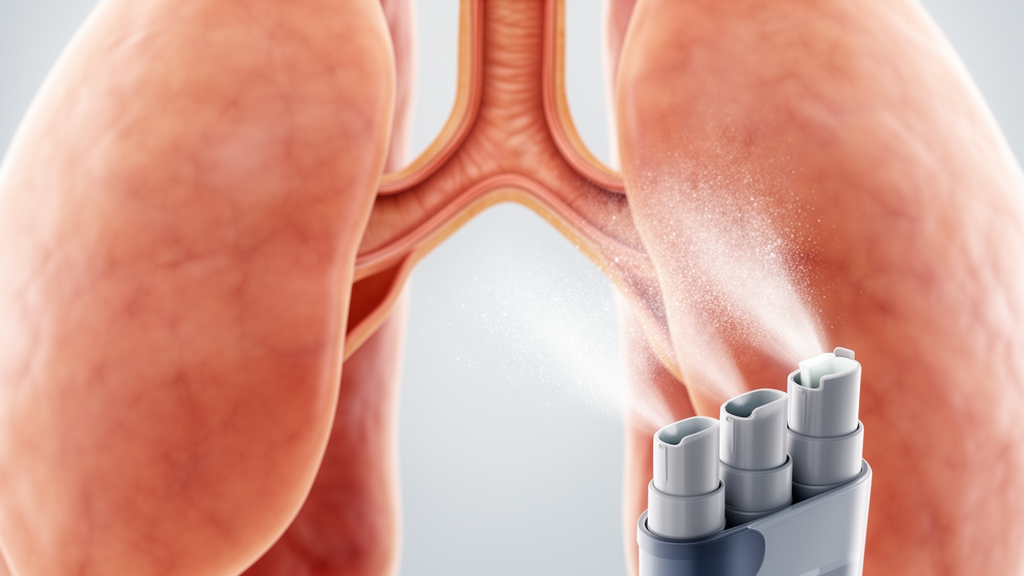
Adults with symptomatic, uncontrolled asthma who infrequently experience severe exacerbations achieved statistically significant and durable improvements in lung function alongside higher rates of clinical remission when escalated from dual maintenance therapy to a single-inhaler triple therapy regimen, according to 52-week findings from the multicenter, randomized, open-label, active-controlled PERFORM trial. Investigators evaluated outcomes among participants whose disease remained insufficiently managed on dual inhaled corticosteroid and long-acting beta2-agonist combinations, commonly designated as ICS/LABA maintenance regimens. While international guidelines established by the Global Initiative for Asthma recommend escalating individuals with uncontrolled asthma receiving medium- or high-dose ICS/LABA to triple therapy through the addition of a long-acting muscarinic antagonist, clinical practice patterns reveal that triple therapy is frequently delayed or underutilized. This implementation gap occurs despite observations that up to one-third of asthma patients receiving ICS/LABA combinations remain inadequately controlled even without experiencing frequent severe disease exacerbations. The pragmatic trial sought to establish clinical trial evidence within routine care environments for this sizeable and historically understudied patient subgroup.
Conducted across seven countries including Canada, the United States, Argentina, South Korea, Australia, Taiwan, and Japan between April 2024 and March 2026, the PERFORM study randomized 1,236 symptomatic adult participants aged 18 to 75 years who had an Asthma Control Questionnaire 6-item score of at least 1.5 at baseline. To specifically capture an understudied population that remains symptomatic without experiencing recurrent life-threatening events, trial eligibility was restricted to individuals who had experienced no more than one severe exacerbation within the preceding 12 months. Within the overall randomized cohort of 1,236 individuals, a prespecified step-up subpopulation comprising 783 participants had been actively receiving maintenance ICS/LABA therapy for at least three months prior to study entry. Investigators randomly assigned these step-up participants in an open-label, 1:1 ratio either to receive once-daily single-inhaler triple therapy consisting of fluticasone furoate, umeclidinium, and vilanterol delivered via the ELLIPTA dry powder inhaler at doses of 100/62.5/25 micrograms or 200/62.5/25 micrograms, or to continue their pre-randomization usual care non-ELLIPTA ICS/LABA dual regimen for a total duration of 52 weeks.
Pragmatic trial methodology guided the structural execution of the trial to ensure that therapeutic outcomes mirrored those encountered during routine clinical encounters rather than artificial, tightly controlled experimental conditions. Randomization was explicitly stratified by pre-randomization asthma maintenance therapy status and pre-trial inhaled corticosteroid dose levels categorized as high or low. For participants allocated to the usual care control cohort, treating physicians maintained prescribing autonomy to select or escalate non-ELLIPTA ICS/LABA regimens based entirely upon local clinical practice guidelines and regional pharmaceutical availability. Furthermore, in-person clinical consultations were deliberately restricted to four designated evaluation intervals: screening at Visit 1, baseline randomization at Visit 2, mid-study assessment at Week 24, and final evaluation at Week 52 or early study termination. The protocol consciously excluded artificial adherence reminders or intensive tracking interventions to avoid distorting normal patient behavior, and safety monitoring concluded with a structured telephone assessment conducted seven days following treatment discontinuation.
The trial’s primary effectiveness analyses were performed on the modified full analysis set 1 population utilizing a treatment policy approach to account for intercurrent occurrences such as medication discontinuation, escalation of corticosteroid dosages, or receipt of prohibited treatments. In the evaluated step-up cohort of 783 participants, baseline demographic and disease characteristics were balanced, showing a mean participant age of 50.2 years, a female representation of 68.7 percent, a current smoking proportion of 4.9 percent, and a racial composition that was 73.4 percent White and 19.2 percent Asian. At enrollment, participants in this subpopulation exhibited a mean percent predicted forced expiratory volume in one second of 83.35 percent, an average 7-item Asthma Control Questionnaire total score of 2.45, and a documented severe exacerbation history within the prior 12 months in 21.3 percent of individuals. Within this pre-treated group, prior therapy included 359 individuals receiving budesonide and formoterol and 319 individuals receiving fluticasone propionate and salmeterol.
Objective pulmonary function assessments focused on trough forced expiratory volume in one second measured pre-dose at scheduled clinical intervals to account for natural diurnal physiological variation. At the Week 24 evaluation, participants escalated to fluticasone furoate, umeclidinium, and vilanterol achieved a least squares mean increase from baseline in trough forced expiratory volume of 119 milliliters, compared with a 53-milliliter improvement observed among participants maintained on usual care dual ICS/LABA. The resulting least squares mean treatment difference of 66 milliliters favored the single-inhaler triple therapy arm with statistical significance after adjustment for multiplicity within the pre-specified hierarchical testing structure, demonstrating a 95 percent confidence interval spanning 29 to 103 milliliters and a P-value of 0.0004. Continued therapeutic exposure demonstrated durable spirometric stability through Week 52, where least squares mean improvements reached 103 milliliters with triple therapy compared to 36 milliliters with dual therapy, yielding a nominally statistically significant treatment difference of 67 milliliters with a 95 percent confidence interval of 28 to 106 milliliters and a P-value of 0.0007.
Evaluation of patient-reported disease control utilizing the validated Asthma Control Questionnaire demonstrated consistent improvements favoring escalation to triple therapy across multiple analytical approaches. In the continuous analysis of 7-item questionnaire total scores, participants assigned to fluticasone furoate, umeclidinium, and vilanterol demonstrated least squares mean score decreases of 1.26 at Week 24 and 1.37 at Week 52, compared with reductions of 1.06 and 1.21 in the usual care comparator group. These changes produced nominally statistically significant treatment differences of minus 0.20 at Week 24 with a 95 percent confidence interval of minus 0.31 to minus 0.09 and minus 0.16 at Week 52 with a 95 percent confidence interval of minus 0.27 to minus 0.05. Categorical responder analyses based on achieving at least a 0.5-point minimum clinically important improvement from baseline revealed that 77.0 percent of triple therapy recipients met this threshold at Week 24 versus 68.8 percent on dual therapy, corresponding to an adjusted odds ratio of 1.54 with a 95 percent confidence interval of 1.12 to 2.12. At Week 52, responder rates reached 75.3 percent and 70.8 percent, reflecting an adjusted odds ratio of 1.29 with a 95 percent confidence interval of 0.88 to 1.91.
A rigorous multidimensional composite endpoint was evaluated at the 52-week conclusion of the trial to determine the proportion of patients achieving full clinical remission. In alignment with established research criteria derived from the CAPTAIN trial, clinical remission required participants to meet four simultaneous objective conditions across the 52-week treatment interval: zero use of systemic oral corticosteroids since baseline, absence of any severe asthma exacerbations since baseline, well-controlled asthma symptoms defined by a 5-item Asthma Control Questionnaire total score below 1.50, and documented lung function optimization evidenced by a trough forced expiratory volume increase of at least 100 milliliters from baseline. At Week 52, clinical remission was achieved by 28.8 percent of participants receiving fluticasone furoate, umeclidinium, and vilanterol, representing 113 of 392 individuals, compared to 13.0 percent of participants receiving usual care dual therapy, representing 51 of 391 individuals. This contrast yielded a nominally statistically significant adjusted odds ratio of 2.78 favoring triple therapy, with a 95 percent confidence interval of 1.82 to 4.24 and a P-value below 0.0001.
Patient-centered functional outcomes incorporating disease-specific quality of life and socioeconomic productivity metrics demonstrated parallel therapeutic advantages following treatment escalation. Health-related quality of life, evaluated via the Asthma Quality of Life Questionnaire for individuals aged 12 years and older, revealed least squares mean improvements from baseline of 1.27 at Week 24 and 1.39 at Week 52 for triple therapy, compared to 1.06 and 1.19 for dual therapy. Both treatment groups surpassed the recognized 0.5-point minimal clinically important difference threshold, falling within the established range for moderate clinical change; however, between-group treatment differences of 0.22 at Week 24 and 0.19 at Week 52 nominally statistically significantly favored the single-inhaler triple therapy arm. Analysis of the Work Productivity and Activity Impairment instrument demonstrated nominally significant advantages for triple therapy in reducing overall daily activity impairment, with treatment differences of minus 5.02 percentage points at Week 24 and minus 3.40 percentage points at Week 52. Among the approximately 50 percent of participants engaged in formal employment or education, numerical improvements were observed favoring triple therapy across work time missed, impairment experienced while working, and overall work impairment.
Safety and tolerability monitored throughout the 52-week intervention within the modified safety analysis set revealed an overall incidence of adverse events consistent with the known pharmacologic profiles of the studied agents. The proportion of participants experiencing treatment-emergent adverse events considered related to study intervention was 3.2 percent, representing 13 of 405 individuals in the triple therapy cohort, compared with 0.8 percent, representing 3 of 378 individuals in the usual care cohort. When categorized by system organ class, the most frequently reported related events occurred within respiratory, thoracic, and mediastinal disorders, identified in 1.7 percent of triple therapy recipients and 0.8 percent of dual therapy recipients. Serious treatment-emergent adverse events were documented in 2.5 percent of participants receiving triple therapy and 2.9 percent of those continuing usual care ICS/LABA regimens, with no novel or unexpected safety signals emerging over the 52-week treatment timeline. Exploratory subpopulation analyses focusing on specific pre-study regimens demonstrated consistent advantages across outcomes for individuals previously treated with budesonide and formoterol, whereas participants transitioned from fluticasone propionate and salmeterol demonstrated numerical variability across certain responder metrics that investigators attributed to sampling variability in smaller analytical subsets.
Interpretation of the PERFORM trial findings requires contextual consideration of the pragmatic trial design, which intentionally balances real-world operational relevance against experimental laboratory precision. Because the trial operated as an open-label evaluation without blinding patients or clinic staff, knowledge of treatment assignment may have influenced subjective perceptions and patient behaviors, potentially explaining the measurable symptom improvements observed across both treatment cohorts. Additionally, the comparator cohort reflected diverse real-world prescribing decisions across multiple national jurisdictions, meaning that the trial design cannot isolate the pure pharmacologic effect of adding a long-acting muscarinic antagonist from concurrent shifts in inhaler device mechanics, drug molecule properties, or dose modifications. Nevertheless, investigators concluded that the demonstrated improvements across spirometry, validated control questionnaires, functional activity scales, and composite clinical remission support the clinical utility of stepping up to single-inhaler fluticasone furoate, umeclidinium, and vilanterol in symptomatic patients who remain uncontrolled on conventional dual therapy despite infrequent severe exacerbations.
Subject of Research: Clinical outcomes of escalating from dual ICS/LABA therapy to triple FF/UMEC/VI therapy in uncontrolled asthma
Article Title: Stepping up from ICS/LABA to FF/UMEC/VI in Patients with Uncontrolled Asthma: Outcomes from the 52-Week PERFORM Pragmatic Randomized Controlled Trial
Article References: Oppenheimer, J. J., Penz, E., Baptist, A. P., Garcia, G., Nagase, H., Poddar, A., Brown, N., Slade, D., Crawford, J., Moore, A. C., & Noorduyn, S. G. (2026). Stepping up from ICS/LABA to FF/UMEC/VI in Patients with Uncontrolled Asthma: Outcomes from the 52-Week PERFORM Pragmatic Randomized Controlled Trial. Advances in Therapy. https://doi.org/10.1007/s12325-026-03860-5
Image Credits: AI Generated
DOI: 10.1007/s12325-026-03860-5
Keywords: Asthma Control Questionnaire, Asthma Quality of Life Questionnaire, Clinical Remission, ELLIPTA Inhaler, FEV1, Fluticasone Furoate, Inhaled Corticosteroids, Long-Acting Beta2-Agonists, Long-Acting Muscarinic Antagonists, PERFORM Trial, Pragmatic Clinical Trial, Pulmonology, Respiratory Medicine, Single-Inhaler Triple Therapy, Spirometry, Trough FEV1, Umeclidinium, Uncontrolled Asthma, Vilanterol, Work Productivity and Activity Impairment
News Source: Ophelia Keating. (November 16, 2026). Triple Inhaler Therapy Improves Lung Function and Control in Uncontrolled Asthma. Scienmag.