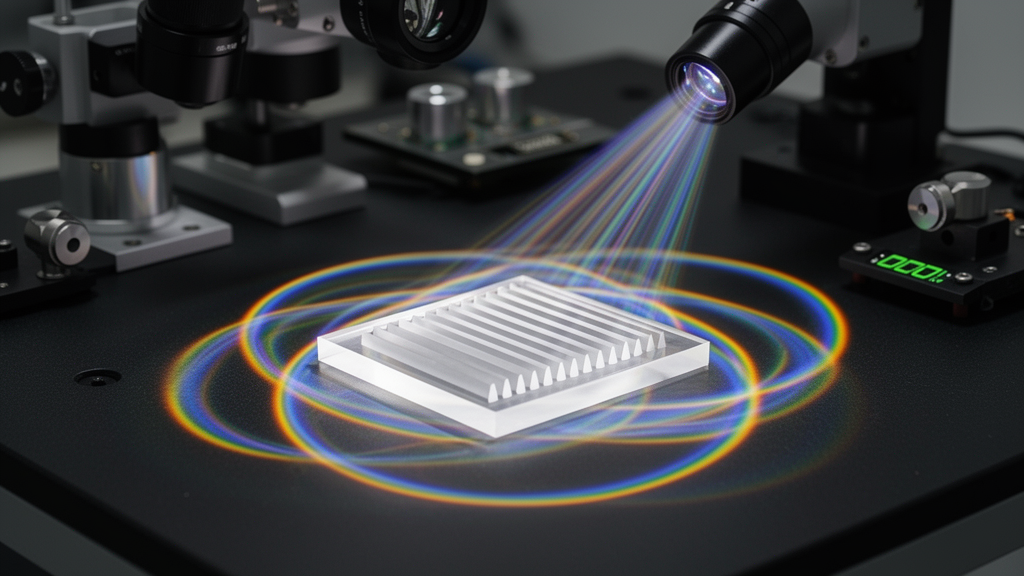
Optical engineers have designed and fabricated a two-dimensional multilevel phase grating using two-photon polymerization lithography that directs optical power into four balanced diffraction orders for space-division phase-shifting incoherent digital holography. Published in Applied Physics B by researchers Teruyoshi Nobukawa, Yasutaka Maeda, Kei Hagiwara, and Tetsuhiko Muroi, the study demonstrates a fabrication-aware diffractive element that achieves an experimentally measured total diffraction efficiency of 69.3 percent across four principal diffraction orders. By simultaneously splitting incident wavefronts into four distinct paths without relying on the sensitive zeroth diffraction order, the optical design resolves a long-standing compromise between light-gathering throughput and inter-channel intensity uniformity. The resulting micro-optical component was incorporated into an experimental imaging arrangement, where it successfully recorded four phase-shifted self-interference holograms in a single camera frame under light-emitting diode illumination, confirming that full complex-amplitude holographic retrieval and post-capture digital refocusing can be achieved reliably without mechanical phase shifters or pixelated sensor arrays.
Incoherent digital holography operates on the physical principle of self-interference, wherein light waves emitted from individual object points interfere only with themselves rather than requiring an external, highly coherent laser reference beam. Because spatial coherence is unnecessary, this modality can record three-dimensional scenes illuminated by ambient sunlight, conventional light-emitting diodes, thermal radiation, or fluorescent emissions. In such systems, a point source on a distant object emits a spherical wavefront that is split into two mutually orthogonal polarization states or divergent wavefronts with differing curvatures. When these two derived wavefronts are subsequently brought together onto an image sensor, they produce a distinct Fresnel zone interference pattern encoding both depth and lateral position. The self-interference configuration also provides unique optical characteristics, including an effectively infinite depth of field and super-resolution properties linked to unconventional Lagrange-invariant behavior. These advantages make incoherent digital holography an exceptionally attractive framework for passive three-dimensional photography, industrial inspection, and live-cell fluorescence microscopy.
Despite its theoretical capabilities, translating incoherent digital holography into dynamic environments has faced persistent signal-processing hurdles caused by the mathematical structure of recorded holograms. A raw intensity hologram captured on a detector comprises three superimposed components: an unwanted non-interferometric background bias term, the desired complex holographic signal, and an inverted twin-image conjugate term. Historically, isolating the true complex wavefront required time-division phase shifting, where multiple consecutive frames are acquired while shifting the optical phase between wavefronts in sequential steps. While effective for stationary targets, sequential acquisition introduces severe artifacts if the specimen moves or if mechanical vibrations alter the setup between frames. To achieve real-time dynamic imaging, researchers developed parallel single-shot techniques such as off-axis recording, compressive sensing, and space-division phase shifting. However, off-axis geometries sacrifice sensor spatial bandwidth, compressive sensing demands heavy computational reconstruction and object sparsity, and integrated pixelated polarizer masks restrict users to specialized sensor hardware while requiring complex demosaicing routines.
Grating-assisted space-division phase shifting provides a versatile alternative by using a diffractive optical element to split the incident field into spatially separated regions on a conventional image sensor, where distinct geometric phase shifts are introduced by segmented polarizers. However, earlier implementations suffered from intrinsic trade-offs tied to grating geometry. The team previously demonstrated a single-shot system utilizing a binary two-dimensional checkerboard phase grating, which generated four symmetrically distributed first-order diffraction beams without using the central zeroth order. While robust against fabrication variations, scalar diffraction theory dictates that a binary checkerboard profile delivers only 16.4 percent efficiency to each desired order, yielding a theoretical maximum efficiency of 65.6 percent and an experimental yield of just 59.3 percent, with remaining light lost to unused higher diffraction orders. An alternative binary one-dimensional grating configuration later raised theoretical efficiency to 86.4 percent across three diffraction orders, but its reliance on the zeroth order made it excessively vulnerable to fabrication-induced profile deviations, generating photon noise imbalances that post-processing algorithms could not restore.
To overcome these physical limitations, the researchers engineered a multilevel two-dimensional phase grating capable of concentrating incident optical power exclusively into four principal diffraction orders while suppressing the zeroth and redundant higher orders. Because an optimal multilevel phase profile cannot be deduced through closed-form analytical equations, the team deployed numerical optimization based on simulated annealing. To make the non-convex optimization computationally tractable and preserve beam symmetry, the authors exploited the grating’s structural periodicity and one-hundred-and-eighty-degree rotational symmetry. A square periodic unit cell measuring 12 micrometers by 12 micrometers was discretized into a twelve-by-twelve grid of one-micrometer subpixels. By enforcing rotational symmetry about the unit cell center, the independent design domain was reduced to twelve by six subpixels, yielding exactly 72 independent variables. The one-micrometer lateral step was chosen as a practical design constraint reflecting the spatial resolution limits and structural reproducibility of subsequent photopolymerization fabrication.
Within the optimization framework, the phase delay of each subpixel was constrained to 16 discrete levels uniformly spaced between zero and two pi radians. The objective evaluation function was formulated to minimize the squared difference between the calculated two-dimensional Fourier power spectrum and a target spectrum defined by four equal-intensity first-order peaks with zero intensity assigned to all other spatial frequencies. Executing simulated annealing across 800 iterations over approximately 4014 seconds using a desktop central processor and graphics processing unit, the algorithm progressively transformed the binary checkerboard starting condition into an intricate multilevel topology. In numerical simulations, the optimized multilevel grating achieved a calculated total diffraction efficiency of 87.2 percent across the four target orders, dividing power into individual efficiencies of 21.5, 22.1, 22.1, and 21.5 percent. Ten independent stochastic runs confirmed high computational reproducibility, averaging 86.7 plus or minus 0.4 percent total efficiency with a standard deviation among orders of just 0.25 percentage points.
Physical realization of the complex sixteen-level surface relief was executed via two-photon polymerization lithography, an advanced additive manufacturing technique that bypasses the multiple exposure, etching, and alignment steps required by conventional multilevel photolithography. A liquid drop of IP-Dip photoresist was deposited onto a 0.5-millimeter-thick glass substrate and exposed using a Nanoscribe Quantum X system equipped with a 63-power objective lens. The tightly focused femtosecond laser beam triggered localized two-photon absorption, polymerizing sub-micron volumetric pixels according to three-dimensional coordinates converted from the optimized phase profile. Following laser exposure, unpolymerized photoresist was dissolved away by immersing the sample in propylene glycol methyl ether acetate and rinsing with isopropyl alcohol. To convert the theoretical sixteen phase values into precise physical relief depths, the authors measured the optical dispersion of cured IP-Dip resin, fitting experimental data to a three-term Cauchy dispersion equation that established a refractive index of 1.549 at the 633-nanometer operating wavelength.
Micro-optical structures fabricated through two-photon polymerization invariably exhibit systematic deviations from ideal digital blueprints due to light proximity effects, abrupt transition rounding, and volumetric shrinkage during resin crosslinking and solvent evaporation. Rather than attempting to construct an elaborate multi-physics model of photoresist chemistry, the researchers devised an empirical fabrication-aware design modification strategy. By adding a uniform bias phase ranging from zero to fifteen-sixteenths of two pi in sixteen discrete increments of pi over eight radians prior to modulo two-pi phase wrapping, they generated sixteen distinct surface-height topographies. While every bias configuration possesses identical theoretical diffraction behavior in an idealized phase-only simulation, phase wrapping shifts the absolute vertical positions of subpixels and alters step discontinuities. Consequently, each variation interacts differently with smoothing and shrinkage phenomena during physical exposure and wet chemical development, allowing experimental screening for height distributions that naturally resist fabrication errors.
To identify the most resilient physical profile, the authors fabricated a test array consisting of sixteen separate 2.4-millimeter square test gratings representing each bias phase on a single two-inch glass substrate. Illuminating each test patch with a 633-nanometer helium-neon laser beam, they recorded the transmitted intensities of the zeroth order alongside the four principal diffracted orders to compute total efficiency and inter-order standard deviation. The empirical measurements revealed significant variations in beam balance across the array. The zero-bias design exhibited pronounced imbalance, yielding order efficiencies of 22.0, 13.3, 13.5, and 23.3 percent. Conversely, the configuration corresponding to a bias phase of three pi over eight radians delivered exceptional balance, with measured diffraction efficiencies of 17.2, 16.9, 17.2, and 17.7 percent. This optimized profile achieved a total four-beam efficiency of 69.0 percent, an inter-beam standard deviation of only 0.3 percent, and suppressed the zeroth-order intensity to 1.3 percent.
Selecting the three-pi-over-eight bias parameter, the team fabricated a large-area final grating measuring 12 millimeters by 12 millimeters on a two-inch glass plate. Confocal laser scanning microscopy over a 129-micrometer square window verified faithful reproduction of the periodic surface-relief structure, displaying only minor rounding at steep vertical boundaries. Optical characterization under 633-nanometer laser illumination confirmed individual principal diffraction efficiencies of 17.4, 17.2, 17.2, and 17.5 percent, combining for a total light-utilization efficiency of 69.3 percent. This performance significantly exceeded the 59.3 percent measured previously for binary checkerboard gratings. Beam coordinate measurements on a sensor placed 100 millimeters downstream showed horizontal and vertical peak separations of 2869 and 2820 camera pixels, corresponding to effective grating periods of 11.77 and 11.97 micrometers. These figures aligned closely with the 12-micrometer target period, demonstrating high spatial uniformity across the entire aperture.
The practical utility of the multilevel grating was validated in a proof-of-concept space-division incoherent digital holography apparatus imaging a standardized resolution target illuminated by an incoherent red light-emitting diode. Light passing through the target was filtered by a 633-nanometer bandpass filter with a five-nanometer bandwidth to maintain adequate temporal coherence. A linear polarizer oriented at 45 degrees launched equal orthogonal linear polarizations into a liquid-crystal lens having disparate focal lengths of 5.5 meters and infinity, producing two coaxial wavefronts with distinct spherical curvatures. After conversion to orthogonal circular polarizations by a quarter-wave plate, the beams were split into four principal diffraction paths by the multilevel grating. The four diffracted fields traversed a segmented linear polarizer with quadrant angles set at 0, 45, 90, and 135 degrees, which imparted relative geometric phase shifts of zero, pi over two, pi, and three pi over two radians before capture on a high-resolution complementary metal-oxide-semiconductor camera.
The camera recorded four spatially separated, non-overlapping self-interference holograms in a single exposure without requiring pixel-level demosaicing. Cropping each 2048-by-2048-pixel quadrant and applying standard four-step phase-shifting arithmetic completely isolated the complex hologram while suppressing the parasitic bias and twin-image conjugate noise. Reconstructing the wavefield across numerical propagation distances from minus 150 millimeters to plus 150 millimeters via the angular spectrum method demonstrated sharp focus at the nominal image plane and progressive defocusing elsewhere. Direct reconstruction from an unshifted single hologram produced heavy background glare and degraded contrast, highlighting the necessity of four-step suppression. Numerical filtering simulations further suggested that while the chosen bias phase provides robust tolerance against transition smoothing, future iterations incorporating closed-loop precompensation based on surface profile measurements could narrow the gap between simulated and experimental efficiencies, offering a generalizable blueprint for light-efficient diffractive elements in quantitative phase imaging.
Subject of Research: Multilevel phase grating fabrication for space-division incoherent digital holography
Article Title: Design and fabrication of a multilevel phase grating via two-photon polymerization lithography for space-division phase-shifting incoherent digital holography
Article References: Nobukawa, T., Maeda, Y., Hagiwara, K., & Muroi, T. (2026). Design and fabrication of a multilevel phase grating via two-photon polymerization lithography for space-division phase-shifting incoherent digital holography. Applied Physics B, 132(12), Article 120. https://doi.org/10.1007/s00340-026-08738-6
Image Credits: AI Generated
DOI: 10.1007/s00340-026-08738-6
Keywords: diffractive optics, incoherent digital holography, two-photon polymerization, phase grating, space-division phase shifting, micro-optics, simulated annealing, single-shot holography, optical efficiency, complex amplitude retrieval, numerical refocusing, surface-relief profiling, Cauchy dispersion, polarization optics, geometric phase, digital holography, additive manufacturing, laser lithography
News Source: Denise Maddox. (November 16, 2026). Optimized Multilevel Phase Grating Enhances Light Efficiency in Incoherent Digital Holography. Scienmag.