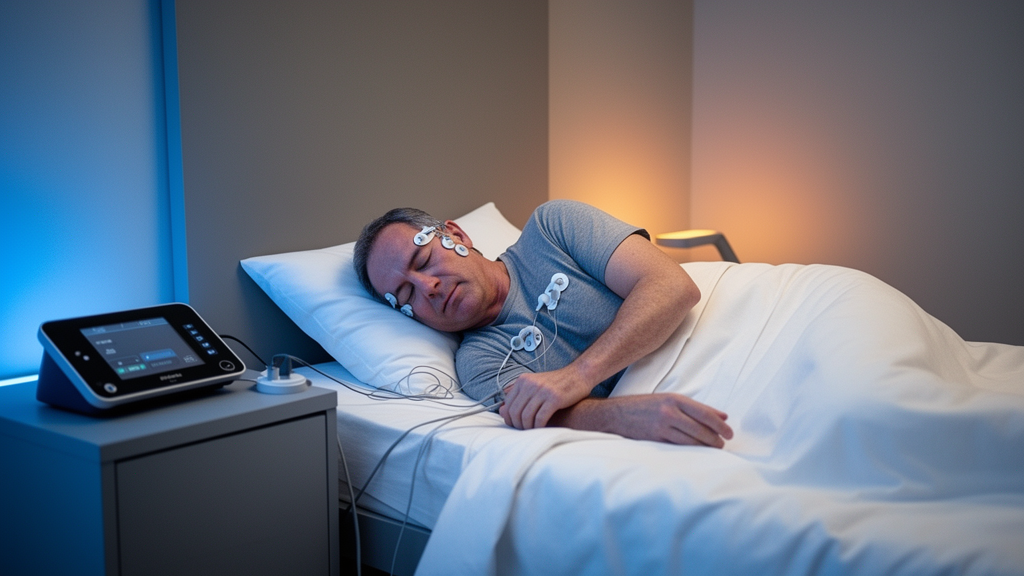
Analyzing overnight sleep patterns through variable-domain functional regression shows that the duration of stage-specific sleep bouts is significantly associated with obstructive sleep apnea severity, according to research published in Frontiers in Sleep. Evaluating polysomnographic records from the APPLES study, investigators identified that longer durations of wakefulness, stage N1, and stage N2 bouts were positively associated with higher apnea-hypopnea index values. In contrast, longer bouts of stage N3 and rapid eye movement sleep were negatively associated with disease severity, with rapid eye movement sleep displaying the most consistently negative relationship across the monitored intervals.
The apnea-hypopnea index serves as the conventional clinical metric for quantifying the severity of obstructive sleep apnea, traditionally examined alongside scalar summaries of overnight sleep architecture. Such scalar measurements typically record only the total aggregate time an individual spends within each sleep stage across an entire recording. While clinically interpretable, these cumulative summaries fail to capture the temporal organization of overnight sleep-stage transitions and can obscure meaningful stage-specific associations with disease severity. In natural sleep architecture, sleep stages persist across successive bouts of varying lengths, generating time-dependent patterns that scalar metrics cannot reflect.
Capturing the sequential duration of sleep bouts introduces a complex statistical challenge because the total number of bouts differs substantially from person to person. Because these bout sequences occur over subject-specific domains rather than a uniform timeline, conventional functional regression models—which assume a common, fixed observation interval across all study subjects—cannot be directly applied. To resolve this limitation, the authors implemented variable-domain functional regression, an analytical technique that accommodates variable-length sequences to treat stage-specific sleep bout durations across subject-specific domains as functional predictors of apnea-hypopnea index severity.
The study evaluated overnight polysomnographic recordings from a cohort of 1,103 participants enrolled in the APPLES study. The research team compared three distinct levels of sleep-stage classification granularity to test how different representations affect model performance: a five-stage system comprising wakefulness, N1, N2, N3, and REM; a three-stage system grouping sleep into wakefulness, non-REM, and REM; and a binary staging model comparing wakefulness against consolidated sleep. In stage-specific functional models, the functional sleep-stage terms remained statistically significant across all three tested granularities, with all p-values falling below 0.001.
When the investigators evaluated a joint model incorporating all five sleep stages simultaneously among a subset of 529 participants, the observed associations demonstrated distinct shifts. Within this combined multi-stage framework, only the functional terms for stage N1 and stage N3 retained statistical significance. Furthermore, the relationship between bout length and apnea severity for stage N3 changed direction across later bouts during the sleep period, illustrating dynamic overnight changes that remain hidden when sleep stages are analyzed solely in isolation or through static cumulative totals.
The analytical comparisons further demonstrated that the observed stage-specific effects became attenuated when coarser staging representations were applied, underscoring the critical necessity of preserving fine-grained sleep architecture during polysomnographic evaluations. Conducted by Md Mushfiqur Rahman and Pratim Guha Niyogi from the University of Mississippi Medical Center, the investigation represents the first reported application of variable-domain functional regression to overnight polysomnographic data in obstructive sleep apnea, confirming that accommodating individual differences in bout counts exposes stage-specific physiological associations that standard scalar summaries obscure.
The methodological distinction between cumulative scalar measurements and variable-domain functional regression addresses a longstanding limitation in polysomnographic sleep research. Conventional investigations of obstructive sleep apnea severity have primarily relied on scalar aggregates, summarizing an entire night by calculating the total time accumulated within individual stages. Although clinically accessible, this approach discards the chronological sequence and structural persistence of sleep bouts across the night. By shifting the analytical framework from static scalar totals to functional data analysis, the researchers demonstrated that tracking how long each stage persists across successive bouts uncovers physiological associations with the apnea-hypopnea index that standard aggregate measures fail to detect.
The study also highlights how analytical choices regarding classification granularity influence the detection of disease associations. Moving from fine-grained five-stage scoring to coarser three-stage or binary groupings diminished the strength of the observed relationships, indicating that aggregating distinct sleep stages can obscure clinically relevant bout dynamics. Additionally, the contrast between separate stage-specific models and the five-stage joint model demonstrates the complexity of overnight sleep architecture, showing that certain stage associations attenuate when other stages are accounted for, while stage N3 bout durations exhibit evolving, bout-dependent effects across the night.
Subject of Research: Variable-domain functional regression modeling of sleep bout durations and obstructive sleep apnea severity
Article Title: Association between stage-specific sleep bout durations and obstructive sleep apnea severity: a variable-domain functional regression approach
Article References: Rahman, M. M., & Guha Niyogi, P. (2026). Association between stage-specific sleep bout durations and obstructive sleep apnea severity: A variable-domain functional regression approach. Frontiers in Sleep, 5, 1966208. https://doi.org/10.3389/frsle.2026.1966208
Image Credits: AI Generated
DOI: 10.3389/frsle.2026.1966208
Keywords: obstructive sleep apnea, apnea-hypopnea index, variable-domain functional regression, polysomnography, sleep bout duration, sleep architecture, functional data analysis, APPLES study, sleep stage sequences, REM sleep, N1 stage, N2 stage, N3 stage, wakefulness, non-REM sleep, staging granularity
News Source: Glenn Wilkins. (November 16, 2026). Longer N3 and REM Sleep Bouts Associate With Lower Apnea Severity. Scienmag.