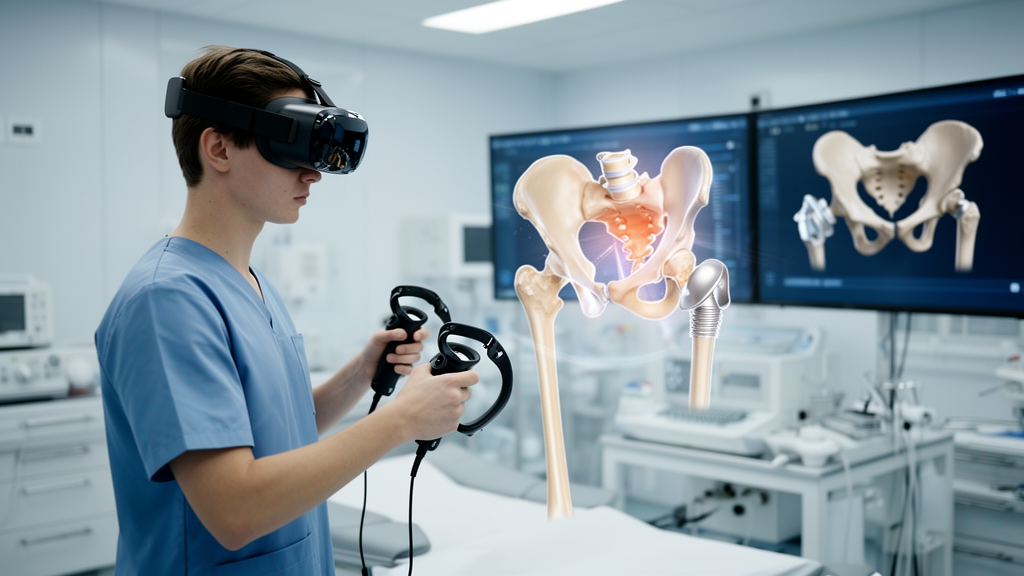
A quasi-experimental pretest–posttest study evaluating surgical training methods found that instruction using 360-degree video-based virtual reality was significantly associated with improved learning outcomes among operating room students studying total hip arthroplasty. Published in BMC Medical Education, the investigation compared the educational performance of students who received virtual reality training in addition to conventional instruction against peers who completed only standard conventional coursework. The researchers reported that participants who trained with the immersive 360-degree video format achieved substantially higher post-intervention assessment scores and demonstrated significantly greater overall learning progress than those taught through conventional online methods alone.
The educational challenge examined in the investigation stems directly from the clinical environment of total hip arthroplasty, which the authors identify as one of the most challenging procedures in orthopedic surgery. Because total hip arthroplasty involves high procedural sensitivity and carries a significant risk of infection, clinical protocols usually restrict operating room students from directly attending and observing the surgical procedure, particularly students at lower training levels. The study noted that modern instructional technologies, such as virtual reality paired with 360-degree video recording, offer a viable solution to these educational barriers by creating an immersive visual experience that closely simulates physical presence within the operating theater.
To evaluate this instructional approach, the researchers recruited 36 operating room students and assigned them equally into two distinct cohorts: an intervention virtual reality group comprising 18 students and a control group comprising 18 students. Under the study design, all 36 participating students received conventional online education covering total hip arthroplasty. In addition to this baseline online instruction, students assigned to the intervention group underwent supplementary teaching through a virtual reality-based training program featuring 360-degree video recordings of the procedure.
To measure educational gains, the researchers developed and administered a 20-item researcher-made questionnaire to evaluate student knowledge both before and after the instructional period. The assessment instrument demonstrated acceptable internal consistency reliability, registering a Cronbach’s alpha coefficient of 0.727 on the pretest assessment and an improved alpha coefficient of 0.897 on the posttest evaluation. Following data collection, the researchers analyzed the resulting assessment scores in SPSS software utilizing a combination of statistical evaluations, specifically the Wilcoxon test, the Mann–Whitney U test, the independent t-test, and Pearson correlation coefficients.
Baseline assessments conducted prior to instruction confirmed that the two student groups began the study with comparable knowledge, as pretest scores revealed no statistically significant difference between the cohorts (P = 0.383). Following completion of the instructional modules, the virtual reality cohort demonstrated a statistically significant improvement in scores, rising from a baseline mean of 7.22 ± 2.90 on the pretest to 12.83 ± 3.47 on the posttest (P < 0.001). Conversely, operating room students in the control cohort who received only conventional online education did not exhibit a statistically significant improvement, moving from a pretest score of 6.00 ± 3.22 to a posttest score of 6.72 ± 3.18 (P = 0.057).
Direct post-intervention statistical comparisons between the two groups further confirmed the disparity in educational outcomes. Posttest scores were significantly higher in the virtual reality group than in the control group, with an independent t-test demonstrating a significant difference of t(34) = 5.512 (P < 0.001) and a substantial effect size of d = 1.89. In addition, an analysis of progress using the Mann–Whitney U test demonstrated that overall improvement was significantly greater among students utilizing virtual reality (U = 75.5, P = 0.004). Statistical evaluation also identified a significant pretest–posttest correlation within the control group (r = 0.613, P = 0.007), whereas no significant correlation was detected in the virtual reality cohort (r = 0.18, P = 0.944). Based on these quantitative findings, the researchers concluded that the 360-degree virtual reality intervention was significantly associated with improved learning outcomes, suggesting that the technology may be considered a valuable complementary tool in surgical education.
Subject of Research: Effect of 360-degree virtual reality video teaching on operating room students' learning in total hip arthroplasty
Article Title: Comparing the effect of 360° video-based virtual reality teaching and conventional teaching on operating room students’ learning in total hip arthroplasty: a quasi-experimental study
Article References: Tayebi nezhad, S., Zare, N. V., Mousavi, B., Hoseini, S. M., Amiri Tehranizadeh, A., Shahpari, O., & Sotoude, D. (2026). Comparing the effect of 360° video-based virtual reality teaching and conventional teaching on operating room students’ learning in total hip arthroplasty: a quasi-experimental study. BMC Medical Education. https://doi.org/10.1186/s12909-026-10799-2
Image Credits: AI Generated
DOI: 10.1186/s12909-026-10799-2
Keywords: virtual reality, 360-degree video, total hip arthroplasty, operating room students, surgical education, quasi-experimental study, pretest-posttest design, conventional teaching, online education, medical education, orthopedic surgery, learning outcomes, questionnaire assessment, independent t-test, Mann-Whitney U test, educational technology
News Source: Courtney Benton. (November 16, 2026). Virtual Reality 360-Degree Video Boosts Learning in Total Hip Arthroplasty Training. Scienmag.