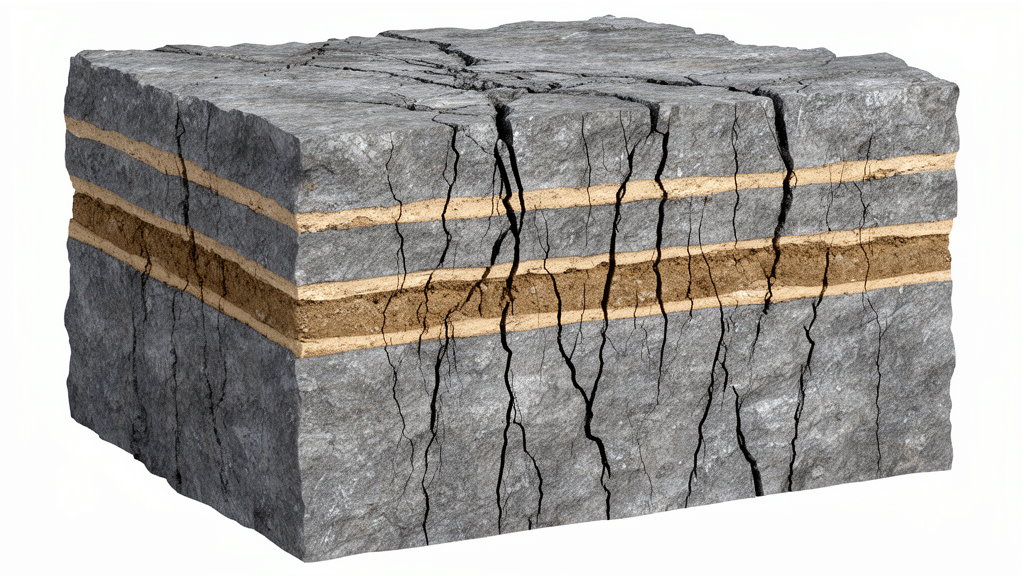
Increasing the number of weak interlayers in layered rock masses substantially reduces their overall mechanical competence, causing measurable declines in uniaxial compressive strength and elastic modulus alongside notable increases in peak strain. In a macro–micro investigation published in Geomechanics and Geophysics for Geo-Energy and Geo-Resources, researchers Yijun Guo, Jucai Chang, and Lianghuan Yan examined how varying quantities of weak structural seams alter the mechanical behavior, deformation characteristics, and progressive fracturing of rock formations. The findings demonstrate that both the quantity and spatial configuration of weak interlayers fundamentally govern how layered rock masses respond to compressive loads, offering essential insights for stability evaluation in natural geological environments.
Although natural rock formations frequently contain multiple weak interlayers embedded within harder host strata, previous geomechanical research has largely centered on single-layer systems. However, multilayer configurations in natural formations remain less studied. To bridge this knowledge gap, the research team prepared engineered composite rock specimens containing different numbers of weak interlayers. By systematically varying the quantity of these embedded layers, the study evaluated the progressive fracture process and transition toward macroscopic failure.
To capture the complete fracture process across multiple observation scales, the authors combined experimental laboratory diagnostics with discrete element numerical modeling. The multi-method testing approach integrated acoustic emission monitoring, digital image correlation, and two-dimensional particle flow code simulations using PFC2D. Acoustic emission monitoring served to track internal microcracking and characterize cracking stress thresholds as specimens underwent compressive deformation. Concurrently, digital image correlation techniques captured the full-field evolution of surface strains across the composite faces. Complementing these physical measurements, the PFC2D numerical simulations enabled direct observation of microscopic crack propagation paths and the dynamic reorganization of internal contact force chains throughout the loading sequence.
The mechanical test results revealed consistent quantitative correlations between the quantity of weak interlayers and the primary deformation parameters of the composite rock specimens. As the number of weak interlayers increased, the measured uniaxial compressive strength exhibited a continuous decline, accompanied by a corresponding decrease in the elastic modulus of the rock masses. In contrast, the peak strain recorded at maximum load increased systematically with the number of weak interlayers. This inverse relationship highlights that introducing additional weak structural interfaces degrades the overall stiffness and load-bearing capacity of the rock mass.
A key contribution of the acoustic emission analysis was the identification of characteristic cracking stresses, particularly the crack damage stress threshold across varying interlayer quantities. The experimental data revealed that crack damage stress decreased steadily as the number of weak interlayers increased, reflecting an earlier onset of severe internal damage under applied mechanical load. The crack damage stress constituted a critical threshold for predicting specimen instability and evaluating failure risk in multilayered rock masses.
Detailed observation of crack propagation mechanisms showed that initial failure was heavily localized by internal structural geometry. At the crack damage stress threshold, tensile cracks preferentially initiated in the intact rock layers situated between bilateral weak interlayers, a structural configuration designated as RBWI. As compressive stress escalated toward peak levels, these tensile cracks propagated outward, cutting through the adjacent weak interlayers to induce macroscopic structural failure. Furthermore, the overall fracture density within the specimens rose progressively with the number of weak interlayers, demonstrating that additional structural discontinuities multiply internal crack networks throughout the composite volume.
The investigation also identified distinct spatial distributions and fracture modes that were strictly segregated by layer lithology. Shear fractures were predominantly horizontal in orientation and remained heavily concentrated within the weak interlayers themselves, accommodating localized shearing displacement along the weaker material planes. Conversely, tensile fractures developed almost exclusively within the intact rock layers, where they maintained a remarkably stable spatial orientation of thirty degrees from the vertical loading axis. This geometric dichotomy underscores how the contrasting material properties of intact rock and weak seams guide distinct failure mechanisms across layered rock systems.
To explain the mechanical origin of preferential tensile cracking, the authors combined PFC2D numerical modeling with theoretical stress analyses of interlayer boundaries. The numerical simulations quantitatively demonstrated that narrower RBWI widths amplify local stress concentrations, making tensile crack initiation significantly more probable within the constrained rock zones. In addition, the team derived analytical stress equations for rock with bilateral weak interlayers and rock with unilateral weak interlayers, known as RUWI. These analytical equations revealed significant differences in the distribution of shear forces and horizontal stresses at the interfaces bounding RBWI and RUWI units. Together, these theoretical and numerical insights clarify how structural geometry controls stress concentration, crack evolution, and ultimate collapse in rock masses with multiple weak interlayers.
Subject of Research: Mechanical behavior and progressive fracture of rock masses with multiple weak interlayers
Article Title: Macro–micro study on the structural effects of weak interlayer quantity on rock mechanical behavior
Article References: Guo, Y., Chang, J., & Yan, L. (2026). Macro–micro study on the structural effects of weak interlayer quantity on rock mechanical behavior. Geomechanics and Geophysics for Geo-Energy and Geo-Resources. https://doi.org/10.1007/s40948-026-01280-x
Image Credits: AI Generated
DOI: 10.1007/s40948-026-01280-x
Keywords: rock mechanics, weak interlayers, uniaxial compressive strength, elastic modulus, peak strain, acoustic emission, digital image correlation, PFC2D, crack damage stress, tensile fractures, shear fractures, force-chain evolution, surface strain field, fracture density, stress concentration, layered rock masses, bilateral weak interlayers, unilateral weak interlayers
News Source: Denise Maddox. (November 15, 2026). Increasing Weak Interlayers Reduces Rock Compressive Strength and Increases Fracture Density. Scienmag.