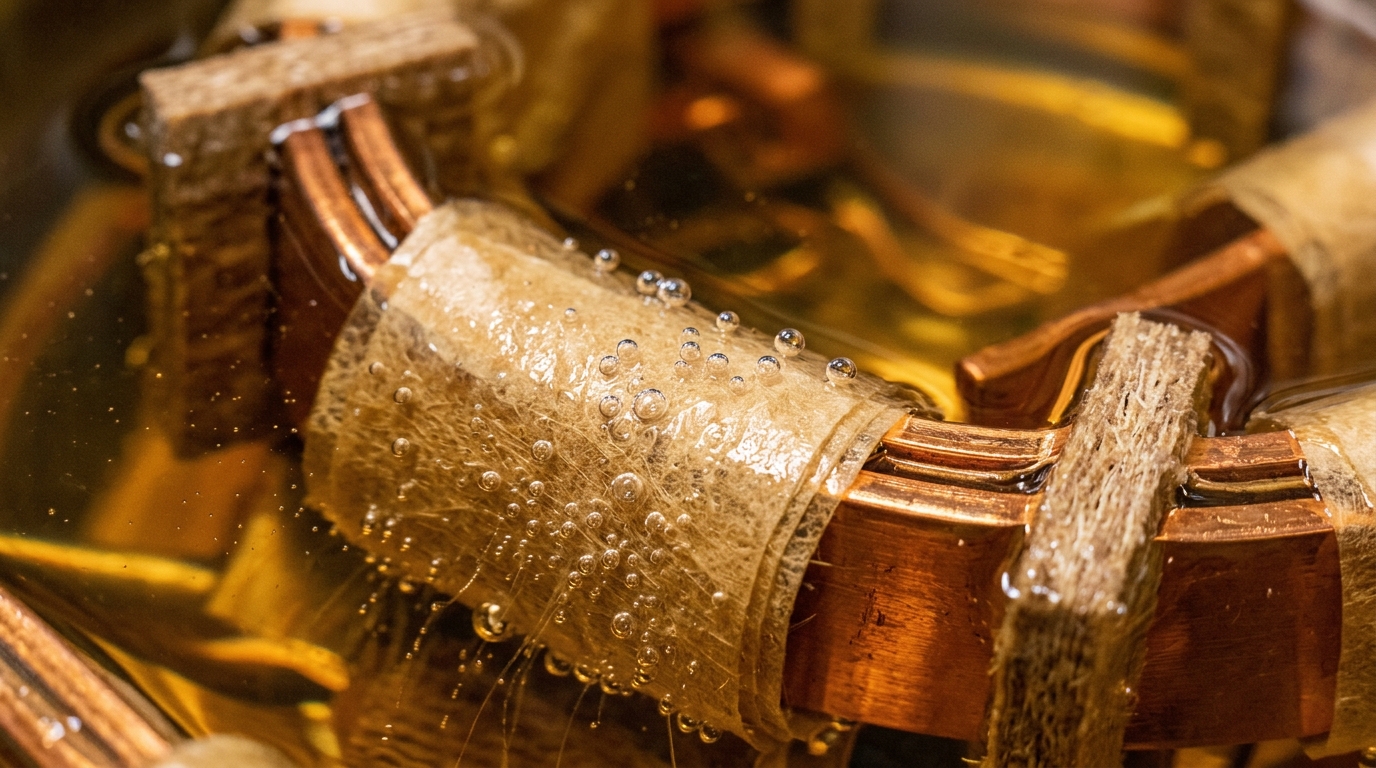
Experiments examining single-layer oil-impregnated paper specimens have revealed that elevated dissolved gas levels and alternating-current electric fields significantly reduce the temperature required for thermally induced bubble initiation during rapid heating. Because bubble formation within oil-paper insulation directly undermines the short-term dielectric reliability of oil-immersed power transformers experiencing sudden thermal surges, clarifying how these environmental and operational parameters interact represents an essential problem in electrical insulation research. The laboratory investigation demonstrated that increasing dissolved gas concentration reduces bubble inception temperatures, exhibiting an especially pronounced influence when insulating paper moisture levels are kept low.
To evaluate these interacting dynamics under controlled conditions, the researchers constructed an experimental apparatus centered around a sealed heating chamber containing single-layer paper specimens impregnated with insulating oil. The research protocol specifically managed both the initial moisture content of the paper samples and the gas concentrations dissolved in the surrounding medium. During thermal loading, the testing apparatus allowed the investigators to adjust external chamber pressure and apply an alternating-current electric field independently, isolating the contribution of each parameter during rapid temperature escalation.
Tracking the exact threshold of bubble onset required a dual-method diagnostic approach combining optical observation with direct thermal monitoring. The experimental team determined the bubble initiation temperature by utilizing calibrated paper-temperature measurement techniques in tandem with continuous optical surveillance focused on the specimen surface inside the sealed enclosure.
The empirical results revealed a clear inverse relationship between dissolved gas levels and thermal bubble inception thresholds. When the gas concentration was systematically increased from 280 to 7000 μL · L−1, the measured bubble initiation temperature decreased across the test specimens. Furthermore, this temperature reduction proved substantially stronger in specimens prepared under low-moisture conditions, demonstrating that moisture and dissolved gas interact nonlinearly when determining the temperature at which bubbles first separate from the solid insulation matrix.
Investigating the influence of external pressure demonstrated that bubble initiation is not governed by water vapor pressure acting alone. Under conditions characterized by low moisture and high dissolved gas concentrations, the normalized deviation ratio denoted as rw/rg reached 2.73. This measured pressure response indicated that the inception process aligned far more closely with the free gas pressure relation than with pure water vapor dynamics. Conversely, across all other evaluated experimental conditions, the normalized deviation ratio rw/rg remained strictly below unity, highlighting a distinct shift in governing physical behavior depending on specific gas and moisture ratios.
Superimposing an alternating-current electric field produced an additional downward shift in the bubble initiation threshold within the investigated non-discharge range. For the driest evaluated specimen, which possessed an initial paper moisture content of W1 = 1.29%, the maximum reduction in bubble initiation temperature (Tinc) attributable to the electric field reached approximately 20 ℃. However, this field-driven reduction became considerably weaker as the paper moisture content was increased, indicating that high moisture levels blunt the relative impact of electric stress on initial bubble formation.
Overall, the experimental findings demonstrate that thermally induced bubble initiation in oil-paper insulation is fundamentally governed by a dynamic thermodynamic balance between multi-component internal gas pressure and opposing external resistance. By detailing how gas concentration, moisture fractions, external chamber pressure, and non-discharge electric fields jointly determine bubble inception thresholds, the study establishes an empirical baseline for analyzing bubble initiation risks in oil-immersed transformers subjected to rapid temperature rise.
Subject of Research: Thermally induced bubble initiation mechanisms in transformer oil-paper insulation
Article Title: Factors affecting thermally induced bubble initiation in oil-paper insulation under rapid temperature rise
Article References: Zhou, Z., Wang, T., Chen, Z., Liang, J., Shi, Q., & Liu, J. (2026). Factors affecting thermally induced bubble initiation in oil-paper insulation under rapid temperature rise. Discover Applied Sciences. https://doi.org/10.1007/s42452-026-09889-z
Image Credits: AI Generated
DOI: 10.1007/s42452-026-09889-z
Keywords: oil-paper insulation, bubble initiation temperature, transformer insulation, dielectric reliability, rapid temperature rise, dissolved gas content, external pressure, AC electric field, oil-immersed transformers, paper moisture content, water vapor pressure, internal gas pressure, normalized deviation ratio, free gas pressure, optical observation, paper temperature measurement, thermal bubble initiation, non-discharge range
News Source: Denise Maddox. (November 14, 2026). Gas Content and Electric Fields Lower Bubble Initiation Temperatures in Transformer Insulation. Scienmag.