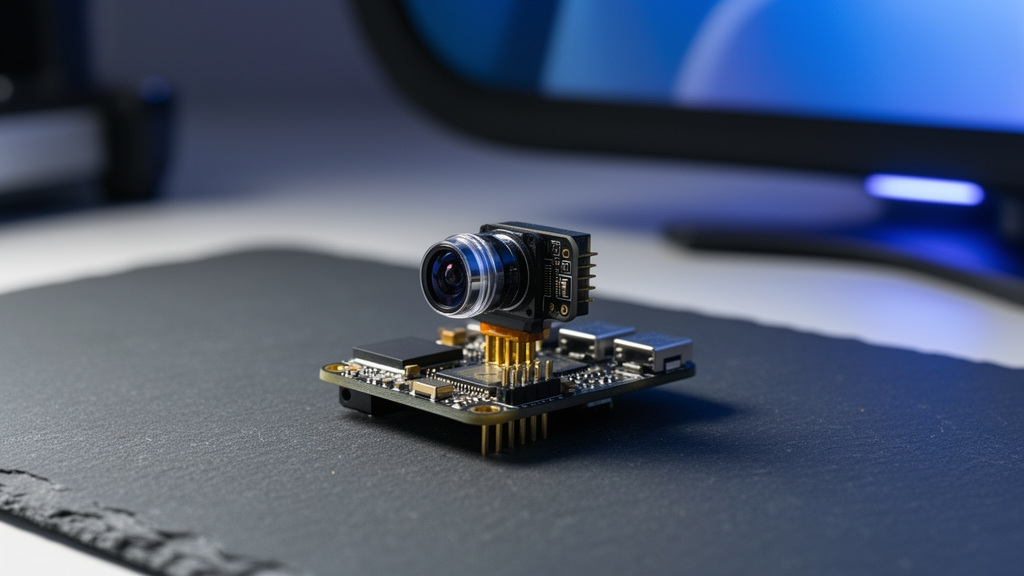
An enhanced lightweight face recognition network based on the MobileFaceNet architecture achieved an improved trade-off between recognition accuracy and computational efficiency when deployed on an embedded artificial intelligence platform, according to experimental evaluations on benchmark datasets.
The system was designed to address core challenges in embedded deployments, where existing face recognition networks often face trade-offs between accuracy and efficiency due to high model complexity, alongside issues such as significant accuracy loss and poor cross-scenario adaptability.
To overcome these performance bottlenecks, the researchers implemented a training-inference decoupled design using branch fusion, a forward inference path, and a multi-objective collaborative optimization loop that integrates triplet loss and symmetry-aware regularization. The framework also incorporates a knowledge distillation mechanism for cross-model generalization, uniting established individual techniques—including branch fusion, PReLU, triplet loss, symmetry loss, and knowledge distillation—into an integrated lightweight architecture.
In experimental evaluations using the LFW and WIDER FACE datasets, the model demonstrated a better balance between accuracy and computational overhead than several state-of-the-art lightweight benchmark networks. The overall model size remained under 10 megabytes, and the overall misrecognition rate was less than 20 percent under challenging test conditions characterized by low confidence thresholds or significant variations in illumination and occlusion. In typical operational settings, the detection threshold could be adjusted to reach lower misrecognition rates while preserving a reasonable rejection rate.
Application tests further indicated that the overall memory footprint across different model configurations remained under 200 megabytes, with inference time measuring under 200 milliseconds when the input image size was less than 11 pixels. The authors reported that the unified design framework successfully maintained recognition performance while reducing computational complexity, resource usage, and memory requirements in resource-constrained embedded environments.
Addressing the broader context of embedded artificial intelligence, the study emphasizes that the deployment of conventional recognition networks has consistently encountered severe performance barriers. Although lightweight visual processing has demonstrated significant potential across diverse domains as artificial intelligence expands, existing lightweight implementations frequently suffer from marked accuracy degradation alongside inadequate cross-scenario adaptability. When deployed directly onto embedded hardware, the elevated complexity of standard architectures impedes the simultaneous realization of high precision and rapid operational throughput. To resolve these persistent bottlenecks, the researchers structured their MobileFaceNet modification to specifically enhance four fundamental criteria: recognition accuracy, computational efficiency, environmental robustness, and practical deployment feasibility on constrained edge devices.
At the structural level, the investigation distinguishes its methodology from superficial architectural adjustments by formulating a comprehensive design paradigm centered on training-inference decoupling. The operational architecture constructs a dedicated forward inference path while relegating complex supervision to a multi-objective collaborative training loop. Within this optimization cycle, triplet loss functions alongside symmetry-aware regularization, often designated as symmetry loss, while a dedicated knowledge distillation mechanism facilitates robust cross-model generalization. The authors note that while individual constituent methods—notably parametric activation through PReLU, branch fusion, triplet loss, symmetry loss, and knowledge distillation—are already established techniques within computer vision, their synergistic synthesis into a unified framework represents a distinct systematic design paradigm that minimizes computational complexity and hardware resource consumption without compromising foundational recognition performance.
The empirical validation conducted on the LFW and WIDER FACE benchmarks highlights the system’s resilience under adverse imaging environments. During rigorous stress assessments involving low confidence thresholds, substantial facial occlusion, and severe lighting fluctuations, the architecture restricted its overall misrecognition rate to under 20 percent. Furthermore, the researchers observed that operational deployments do not require static operating parameters; rather, system operators can tune the operational confidence threshold to suppress misrecognition to substantially lower levels while preserving an acceptable rejection rate.
Hardware efficiency metrics gathered across diverse model configurations further substantiated the model’s suitability for practical edge implementation. Beyond maintaining an overall physical storage footprint below 10 megabytes, the network restricted its complete runtime memory consumption to less than 200 megabytes during practical application testing. When processing input imagery with dimensions under 11 pixels, inference execution was completed within 200 milliseconds. By demonstrating an improved trade-off between recognition accuracy and model complexity relative to existing lightweight benchmarks, the researchers concluded that their unified framework delivers the computational efficiency, reduced resource consumption, and practical viability necessary for demanding, resource-constrained embedded artificial intelligence platforms.
Subject of Research: Lightweight face recognition network optimization for embedded AI platforms
Article Title: Lightweight face recognition network design and performance optimization based on embedded AI platform
Article References: Han, Z., Peng, H., & Ma, X. (2026). Lightweight face recognition network design and performance optimization based on embedded AI platform. Discover Applied Sciences. https://doi.org/10.1007/s42452-026-09639-1
Image Credits: AI Generated
DOI: 10.1007/s42452-026-09639-1
Keywords: face recognition, embedded AI, MobileFaceNet, branch fusion, knowledge distillation, computer vision, model optimization, triplet loss, Lightweight, face, recognition, network
News Source: Denise Maddox. (November 14, 2026). Optimized Lightweight Face Recognition Network Improves Performance on Embedded AI Platforms. Scienmag.