Biomedical engineering researchers have demonstrated a vendor-independent integration architecture for surgical operating theaters, using a dedicated university testbed and clinical operational logs to verify time-synchronized communication across diverse operating room instruments. Reporting in the International Journal of Computer Assisted Radiology and Surgery as a Short Communication, the team presented an integration framework known as the Smart Cyber Operating Theater, or SCOT, driven by an interface and middleware platform called OPeLiNK. Rather than evaluating clinical outcome measures or surgical efficacy, the study focused on establishing the technical architecture, communication protocols, and log-based reliability necessary to unite previously isolated medical instruments into an interactive cyber-physical system.
Modern surgical suites increasingly rely on complex diagnostic and therapeutic technology, ranging from intraoperative magnetic resonance imaging scanners and robotic manipulators to endoscopic cameras and electrosurgical energy devices. In conventional settings, these devices function primarily as standalone systems that store parameters locally or present information without shared temporal alignment. Anesthesia monitoring systems and specialized surgical video recorders often capture isolated streams, but vital time-series values—such as instantaneous settings from cautery knives—remain unrecorded on unified networks. Because intraoperative data streams have historically lacked standardized synchronization, surgical teams could not systematically correlate intraoperative judgments or machine parameters with long-term clinical metrics, leaving scarce infrastructure for continuous, data-driven surgical process improvement.
To overcome this fragmentation, the researchers adapted principles from industrial Internet of Things frameworks and cyber-physical systems, where interconnected sensors, robots, and computational algorithms monitor physical processes and generate feedback. The core integration architecture, OPeLiNK, relies on the Open Resource interface for the Network industrial middleware, an interface initially designed to provide uniform communication protocols and data abstraction across diverse industrial factory automation robots regardless of manufacturer. Within the surgical architecture, device-specific software modules known as providers function as specialized drivers, absorbing idiosyncratic communication differences across medical instruments and allowing higher-level software applications to access standardized telemetry without altering their core configuration when hardware changes.
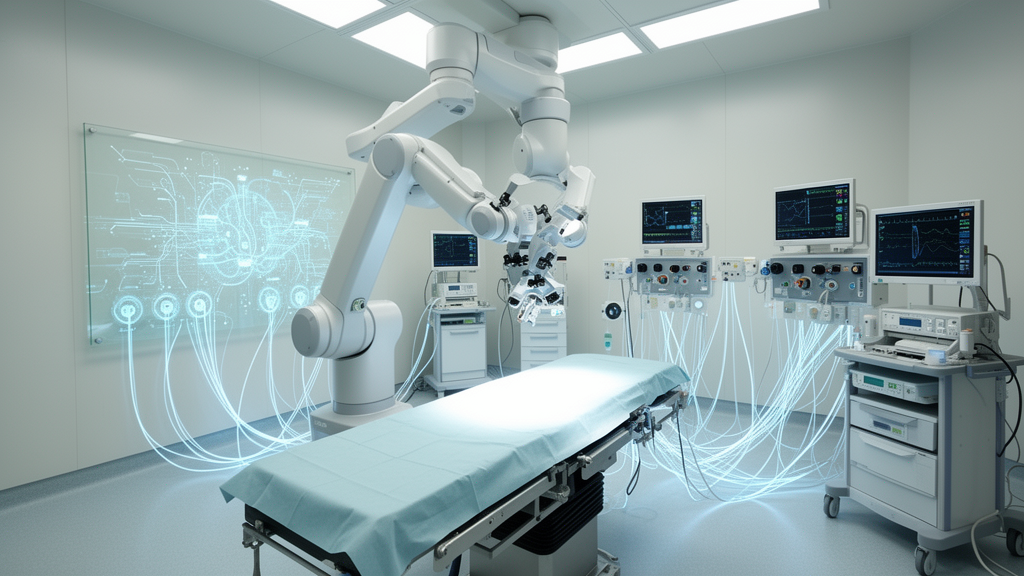
Evaluating communication protocols, interconnectivity, and system failure responses directly in an active hospital operating suite presents substantial ethical and logistical barriers, as experimental testing cannot disrupt scheduled patient care. To resolve this challenge, the team established a dedicated university SCOT testbed in 2016 at the Institute of Advanced Biomedical Sciences within Tokyo Women’s Medical University. Constructed as an experimental suite measuring 6.7 by 6.0 meters, the facility replicates authentic clinical infrastructure, incorporating specialized operating room air conditioning, medical gas lines, medical power feeds, and electromagnetic shielding designed to house an intraoperative magnetic resonance imaging unit alongside ceiling-mounted 3D displays and an intraoperative OPeLiNK server.
Within this controlled laboratory environment, the research team connected 38 medical devices primarily configured for the surgical resection of malignant brain tumors to the OPeLiNK system. The testbed accommodated heterogeneous hardware interfaces, connecting instruments across local area network Ethernet lines, universal serial bus interfaces, direct video outputs, and legacy RS-232C serial communication cables linked through serial-to-Ethernet converters. Operating on an intraoperative server running Windows 10 Pro powered by an Intel Xeon 3.5 GHz processor with 16 gigabytes of system memory, the platform enabled investigators to evaluate communication validation, verify data structure accuracy, test error countermeasures, and observe software behavior during forced terminations, non-standard messaging, and automated system restarts.
The testbed also served as an active integration environment for emerging robotic surgical devices designed specifically around networked interfaces. Engineers evaluated risk management protocols and mechanical performance for three proprietary systems: an experimental robotic operating table built for direct OPeLiNK interoperability, an operator support platform termed CockpitS that utilizes dual supportive mechanical arms, and a robotic surgical microscope featuring spatial position and posture control guided by real-time navigation feeds. Large stationary diagnostic devices that could not be easily transported into the physical testbed room were evaluated through manufacturer laptops equipped with the OPeLiNK environment, confirming data handshakes prior to hospital deployment.
To demonstrate application-level utility, the investigators designed the Surgical Strategy Desk, an operational software suite that pulls time-synchronized streams from the central data server over a closed local network. Displayed on a large multi-source visualization monitor, the interface aggregates live feeds to assist operating surgeons, assistants, circulating nurses, anesthesiologists, and consulting remote experts simultaneously. In demonstrated simulated and demo evaluations, the desk displayed interconnected device statuses, allowing operators to drag and drop panels, cue synchronized historical playback across all devices, automatically tag significant neurophysiological monitoring events, and superimpose navigation coordinates, nerve function telemetry, and rapid tissue diagnostic markers directly over intraoperative magnetic resonance scans.
Beyond laboratory evaluations, the SCOT architecture was translated into differentiated clinical configurations across academic medical centers to evaluate real-world system deployments. A Basic SCOT installation was established at Hiroshima University Hospital, utilizing intraoperative magnetic resonance imaging alongside OPeLiNK-connectable devices primarily for orthopedic bone tumor resections while preparing for future application layers. At Shinshu University Hospital, a Standard SCOT configuration initiated neurosurgical clinical trials in 2018, connecting more than 20 Internet of Things medical instruments to a centralized display and completing over 40 surgical cases involving pituitary lesions and gliomas.
The flagship installation, designated HyperSCOT, was deployed clinically in 2019 at Tokyo Women’s Medical University Hospital to integrate advanced robotics, intraoperative modalities, and emerging artificial intelligence tools. Within HyperSCOT, the network manages data streams during complex neurosurgeries, including high-intensity focused ultrasound systems, intraoperative flow cytometry readouts, real-time surgical navigation markers, awake surgery cognitive assessments, and evoked potential waveforms from intraoperative neurophysiological monitors. De-identified digital operational logs collected across more than 437 glioma surgeries performed in this clinical room provided the empirical foundation for verifying the system’s ongoing operational reliability.
Operational reliability was strictly defined across the collected integration logs by evaluating whether each surgical session fulfilled four simultaneous technical criteria: establishing physical and logical connections with all required operating room devices, verifying successful data packet reception, maintaining continuous visualization on application-level displays, and achieving unified time synchronization across disparate data clocks. By anchoring the central data server as the authoritative management standard time, the middleware successfully stamped incoming numerical values, waveforms, text records, and image sequences into vendor-neutral standard data sets suitable for synchronized multi-source playback and automated archiving.
Addressing international interoperability and cybersecurity challenges formed an essential component of the platform’s architectural assessment. While standard medical interoperability initiatives such as the German OR.net project formulated service-oriented device connectivity standards based on IEEE 11073 and web service profiles, OPeLiNK avoided mandating a single network protocol, instead collaborating with OR.net to develop dedicated translation software connecting IEEE 11073 service-oriented device connectivity standards directly with ORiN middleware. To mitigate network vulnerability risks outlined in standards like NIST SP800-171, engineers integrated an intelligent network switcher equipped with whitelisting capabilities in the clinical suite, configured to automatically sever communication channels whenever transmitted data packets deviate from established baseline operational patterns.
The investigators emphasized that this Short Communication was explicitly bounded to technical integration architecture, communication validation, and log-based operational reliability rather than the measurement of therapeutic efficacy, procedural speed, or patient survival outcomes. Quantifying long-term clinical impacts and treatment improvements will require extended observational studies and deeper integration with hospital-wide electronic medical record warehouses to link intraoperative data records with postoperative recovery and survival metrics. Nevertheless, establishing robust, time-synchronized multi-source data integration through dedicated testbed validation provides the essential cyber-physical foundation required for future autonomous surgical assistance, real-time machine learning risk prediction, and standardized surgical data analysis.
Subject of Research: Cyber-physical operating theater device integration and operational reliability testing
Article Title: Advancing cyber-physical systems in surgery through a smart cyber operating theater testbed for medical device integration and clinical translation
Article References: Yoshimitsu, K., Masamune, K., Okamoto, J., Tamura, M., & Muragaki, Y. (2026). Advancing cyber-physical systems in surgery through a smart cyber operating theater testbed for medical device integration and clinical translation. International Journal of Computer Assisted Radiology and Surgery. https://doi.org/10.1007/s11548-026-03793-y
Image Credits: AI Generated
DOI: 10.1007/s11548-026-03793-y
Keywords: Smart Cyber Operating Theater, OPeLiNK, cyber-physical systems, medical device integration, operating room technology, ORiN middleware, time synchronization, HyperSCOT, intraoperative MRI, surgical robotics, Surgical Strategy Desk, Tokyo Women's Medical University, glioma surgery, IEEE 11073 SDC, medical informatics, interoperability testbed, operational reliability, clinical engineering
News Source: Ophelia Keating. (November 14, 2026). Smart Cyber Operating Theater Testbed Integrates Surgical Devices Using OPeLiNK Architecture. Scienmag.