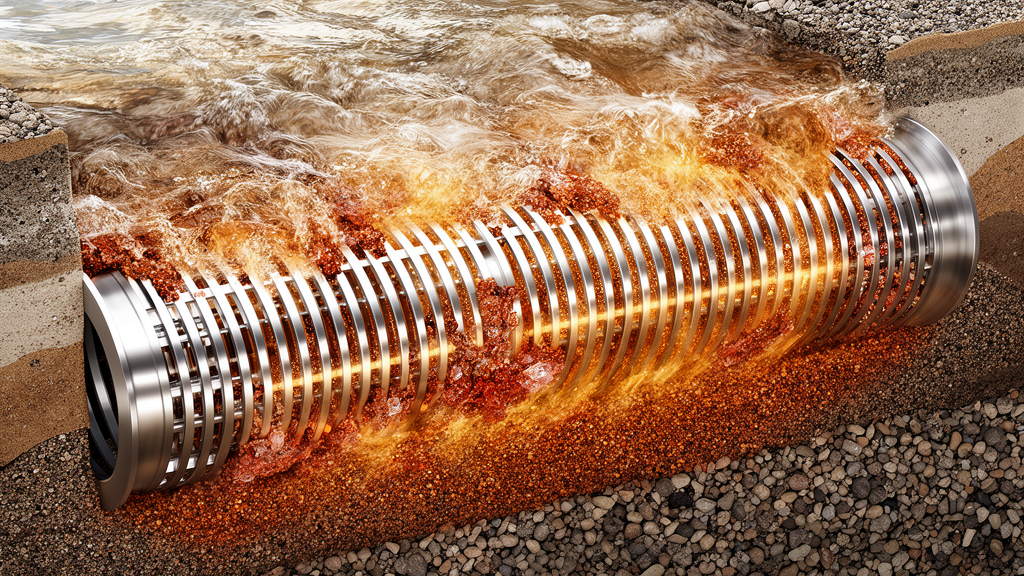
Laboratory tank experiments evaluating ground water heat pump systems demonstrate that elevated injection water temperatures and accelerated flow velocities markedly increase biological clogging along well screen slots. Researchers investigating the physical and biological mechanisms that impede injection wells found that the deposition of iron-oxidation biofouling onto slotted steel pipe screens escalates significantly when warmer water enters the subsurface environment. Across controlled experimental trials, raising the injected water temperature boosted the accumulated mass of biofouling by up to 2.7 times, while increasing the groundwater flow velocity produced an increase of up to 1.6 times. These findings offer quantitative confirmation of how thermal extraction and hydrogeological movement jointly govern microbial proliferation in geothermal energy infrastructure.
Groundwater heat pump installations operate as open-loop systems that extract groundwater directly to exchange thermal energy before discharging the water back into an aquifer or lake. While European standards establish seasonal performance factor targets between 3.5 and 4.0 for these systems—roughly 1.5 times higher than closed-loop ground-coupled configurations—operational reliability remains constrained by severe clogging in pumping and injection wells. Blockages that accumulate across well-screen openings and in the surrounding porous matrix restrict hydraulic conductivity, leading to steep shifts in operational water levels. Operational reports indicate that injection wells suffer more severe degradation than pumping wells because thermal alteration and elevated dissolved oxygen concentrations transform the water chemistry and stimulate microbial activity.
Well clogging encompasses physical settling of suspended solids, chemical precipitation of mineral phases like calcium carbonates or phosphates, and biological fouling triggered by bacterial communities adapting to altered geochemical conditions. Among these mechanisms, biological clogging represents the most unpredictable factor in geothermal system planning. Field investigations in Sapporo, Japan, established that long-term operation of groundwater heat pump wells over five years caused persistent water-level rises and reduced local permeability, with microbiome analyses revealing an abundance of iron-oxidizing bacteria, including members of the genus Ferriphaselus. When iron-rich groundwater encounters steel well screens and elevated dissolved oxygen, these microorganisms rapidly multiply and generate metabolic residues that agglomerate into viscous deposits.
To isolate the specific triggers of this biological obstruction, the research team extracted groundwater from permeable coarse sediment layers at depths between 36 and 60 meters on the Hokkaido University campus. The extracted groundwater exhibited an iron concentration of 4.9 milligrams per liter, exceeding the Japanese drinking water quality benchmark of 0.3 milligrams per liter by sixteen times. In initial pre-immersion beaker trials maintained at 12 degrees Celsius, researchers compared the microbial activation induced by carbon steel gas pipe plates against wire-wound stainless steel plates and untreated controls over a 72-hour period. The presence of carbon steel caused dissolved iron concentrations to climb from an adjusted baseline of 0.3 milligrams per liter to 30.3 milligrams per liter and elevated chromaticity measurements to 1380, whereas stainless steel produced far lower changes and unplated waters showed none.
Following the static pre-immersion tests, the investigators designed a dynamic laboratory flume to simulate flow conditions within an injection well screen. The apparatus consisted of a 1.95-meter-long acrylic tank filled with groundwater, tilted downward at a 16-degree gradient on the upstream end to ensure uniform flow without downstream air entrainment. Ambient laboratory temperature was held at a continuous 12 degrees Celsius. Groundwater was continuously pumped into the bottom of the tank to establish horizontal background movement, while an injection port located above slotted screen plates introduced aerated water treated by a chiller and immersion heater. This injected stream replicated field conditions where water descending during system cycles entrains air, elevating dissolved oxygen levels from an ambient 1 milligram per liter to a near-saturated 9 milligrams per liter.
The experimental protocol monitored fouling accumulations across slotted steel gas pipe plates featuring 100-by-8-millimeter slots with approximately 10 percent open area. Over an initial progression spanning seven days at a fixed flow velocity of 1 meter per day and an injection temperature of 12 degrees Celsius, fouling weight increased from 4.9 grams on the first day to 9.2 grams on day two, 23.3 grams on day three, and 63.9 grams by day seven. A linear regression model fitted to the time series yielded a slope of 10.29 grams per day and a determination coefficient of 0.987, demonstrating steady deposit growth. Comparative testing under identical four-day parameters confirmed high experimental reproducibility, recording an average weight accumulation of 36.1 grams with a variability of only 4.0 percent across repeated trials.
Screen material comparisons within the dynamic flume corroborated the trends identified in the static beaker tests. Slotted carbon steel plates accumulated five times more mass than wire-wound stainless steel screens under equivalent four-day exposures, with stainless steel plates recording an average mass gain of 7.2 grams. Visual inspection of the stainless steel screens revealed reddish-brown deposits localized within screen slits, confirming that while biological fouling still occurs on inert metals, solid-phase iron derived from carbon steel provides an aggressive primary catalyst that accelerates bacterial colonization and subsequent floc development in ferruginous groundwater.
Systematic evaluation of coupled environmental variables across eight distinct experimental combinations revealed strong dependencies on both injection temperature and horizontal flow velocity. Test temperatures of 7, 12, 14.5, and 17 degrees Celsius were evaluated alongside flow velocities of 1 meter per day and 0.1 meter per day. Under both velocity regimes, elevating the injection temperature produced substantial increases in biofouling mass, with the highest temperature yielding up to 2.7 times the accumulation observed at 7 degrees Celsius. Similarly, faster flow through the screen slots consistently produced greater fouling accumulation than slow flow across all tested temperatures, expanding mass by up to 1.6 times due to an enhanced convective supply of metabolic substrates.
Spatial differences in biofouling between upstream and downstream plates highlighted how hydrodynamic interactions modulate microbial growth. In the 1 meter per day test regime, downstream plates consistently accumulated greater deposit mass than upstream plates, culminating in an 11.9-gram or 30 percent difference at an injection temperature of 17 degrees Celsius. Fluid modeling within the flume indicated that background groundwater movement opposed and decelerated the injected flow on the upstream side, whereas on the downstream side, injected water aligned with ambient flow, amplifying slot velocity and substrate replenishment. At the reduced flow rate of 0.1 meter per day, however, flow induced by the central injection dominated the system, leaving the difference between upstream and downstream accumulation negligible.
To model the thermal kinetics of biological screen clogging, researchers applied the Arrhenius equation to calculate apparent activation energies based on the rate of biofouling mass increase. The analysis produced apparent activation energies of 62.6 kilojoules per mole under a flow velocity of 1 meter per day and 54.5 kilojoules per mole under 0.1 meter per day, with strong coefficients of determination reaching 0.94 and 0.95, respectively. These values align closely with published activation energy ranges of 39 to 88 kilojoules per mole documented for microbial iron oxidation under low-temperature conditions. While the laboratory flume successfully isolated the mechanical and thermal drivers of biological clogging, the authors noted that future investigations must examine broader flow spectra, sandy porous matrices, and isolated bacterial isolates to establish comprehensive predictive frameworks for well maintenance.
The experimental setup was calibrated to mirror the hydraulic conditions of a full-scale injection well. The constant injection rate of 1.2 liters per minute in the laboratory tank corresponds to the flow rate per unit surface area when injecting approximately 100 liters per minute into a 200-millimeter diameter well with a 16.5-meter screen. This scaling ensures that the observed biofouling dynamics reflect the physical constraints of real-world groundwater heat pump operations. The researchers specifically selected steel gas pipe screens for the primary trials because field studies in Japan have identified these cost-effective materials as particularly susceptible to biological clogging. Unlike expensive stainless steel alternatives, steel gas pipes provide a solid-phase iron surface that actively triggers the proliferation of iron-oxidizing bacteria, making them a critical focus for understanding operational failures in open-loop systems.
The study’s findings carry specific implications for the maintenance and design of geothermal infrastructure. The authors emphasize that the observed relationships between temperature, flow velocity, and clogging mass are derived from a specific site in Sapporo, where the groundwater contains a distinct microbial community and high iron concentrations. Consequently, the quantitative results may vary in different geological settings with varying water chemistry or bacterial populations. The researchers caution that while the Arrhenius equation effectively models the temperature dependence of clogging in this specific low-temperature environment, generalizing these parameters to other sites requires further data accumulation. The methodology, however, is designed to be replicable, allowing engineers to apply similar experimental frameworks to assess clogging risks during the design phase of new systems.
Future research directions identified by the team focus on expanding the scope of these laboratory simulations. The current experiments tested only two flow velocity patterns, which allowed the team to observe the trend that faster flows increase clogging but did not fully quantify the relationship across a broader spectrum. Subsequent studies will investigate a wider range of flow velocities to map clogging levels more precisely. Additionally, the team plans to conduct experiments using sand-filled tanks to better simulate well-bore clogging in the surrounding soil pores, rather than focusing solely on screen-slot obstruction. Isolating specific bacterial species, such as Ferriphaselus, will also be essential to elucidate how different microbial strains respond to temperature changes, ultimately providing a more comprehensive predictive framework for managing biological clogging in groundwater heat pump systems.
Subject of Research: Biological screen-slot clogging in geothermal injection wells
Article Title: Temperature and flow velocity dependency of biological screen-slot clogging in injection wells
Article References: Okihara, S., Sakata, Y., Nagano, K., & Sato, H. (2025). Temperature and flow velocity dependency of biological screen-slot clogging in injection wells. Geothermal Energy, 13(1), Article 41. https://doi.org/10.1186/s40517-025-00365-2
Image Credits: AI Generated
DOI: 10.1186/s40517-025-00365-2
Keywords: groundwater heat pumps, injection wells, biological clogging, well screens, iron-oxidizing bacteria, biofouling, flow velocity, water temperature, geothermal energy, Arrhenius equation, activation energy, steel gas pipe, stainless steel, dissolved oxygen, floc formation, aquifer management, hydrogeology, thermal extraction
News Source: Denise Maddox. (November 14, 2026). Warmer Injected Water and Faster Flow Accelerate Well Screen Clogging. Scienmag.