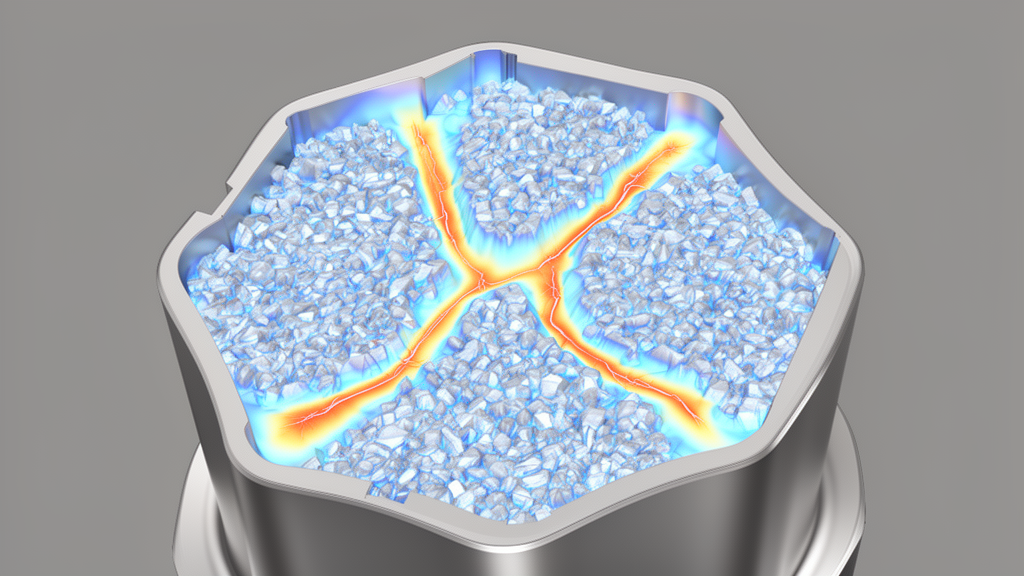
A newly developed three-dimensional computational framework predicts subsurface metal deformation and crack formation near structural notches approximately six times faster than conventional nonlinear simulations, according to research from Concordia University. Developed by Ayhan Ince, a professor in the Department of Mechanical, Industrial and Aerospace Engineering at Concordia’s Gina Cody School of Engineering and Computer Science, the framework completed calculations for a notched steel bar in 4.5 minutes, compared with 28 minutes for a detailed nonlinear simulation that accounts for permanent deformation.
Small geometric features such as holes in vehicle axles or grooves in aircraft components frequently act as high-stress concentrations where damage initiates under repeated forces. While these geometric features might appear minor, components undergo complex service conditions where pulling, bending, twisting, and compression occur simultaneously over thousands or millions of cycles. Although damage and crack propagation are governed by how deformation develops across the surrounding volume of metal near these critical transitions, accurately tracking internal stress has long posed a significant technical hurdle.
For decades, fatigue engineering has relied on simplified analytical methods designed to estimate how materials respond at stress concentration points like holes and grooves. However, those traditional engineering approximations are restricted to predicting conditions directly at the surface. In contrast, full nonlinear computer simulations can capture the internal behavior of the surrounding volume, but they require considerable computational resources, creating substantial bottlenecks when evaluating extensive load histories, alternative material choices, or multiple design iterations.
To overcome these limitations, Ince combined several mechanics models into a unified framework that calculates force distributions and volumetric plastic deformation ahead of notches under general multiaxial loading that varies over time. Because full nonlinear simulations demand escalating computational effort as component scale and loading conditions grow more complex, the framework is anticipated to offer even greater efficiency gains for large structures. The authors note that the advance could accelerate durability evaluations and assist engineers in optimizing component designs across aerospace and automotive manufacturing.
Daniel Kujawski, a mechanical engineering researcher at Western Michigan University who was not involved in the investigation, described the work as an important contribution to advanced notch analysis. Kujawski observed that the framework provides a potential bridge connecting single-point surface calculations with volumetric damage evaluations throughout the surrounding material. This integrative capability could ultimately assist engineers in identifying potential crack initiation sites and estimating overall component lifespan.
Despite the computational speedup, the study’s scope remains focused on initial numerical demonstrations, evaluating one steel material and a single notched geometry under three distinct loading patterns. Ince emphasized that while the methodology addresses longstanding field prediction challenges in computational mechanics, additional research is required before broad deployment. The researchers plan to test other materials and geometric configurations alongside physical experimental validation to confirm how reliably the framework applies to operational engineering components.
The modeling framework builds on nearly two decades of engineering groundwork that began during Ince’s work in the vehicle industry, including durability assessments of axles, suspension components, and structural supports at General Dynamics Land Systems-Canada. Ince developed the initial analytical foundation during his doctoral research completed in 2012 at the University of Waterloo under the supervision of study coauthor Grzegorz Glinka. The latest findings, published in the journal Theoretical and Applied Fracture Mechanics, document the continued evolution of those multiaxial stress-strain prediction methods.
Subject of Research: Three-dimensional computational modeling for predicting subsurface metal fatigue around notches under multiaxial loading
Article Title: Concordia professor tackles decades-old engineering challenge with new 3D modeling framework
Article References: Concordia professor tackles decades-old engineering challenge with new 3D modeling framework. Original publication (Bibliographic details unavailable.)
Image Credits: AI Generated
DOI: Not provided
Keywords: computational mechanics, fatigue engineering, three-dimensional modeling, notch analysis, multiaxial loading, stress-strain prediction, nonlinear simulation, crack formation, structural durability, automotive manufacturing, aerospace engineering, elastic-plastic deformation, notched steel bar, Concordia University, Theoretical and Applied Fracture Mechanics, Ayhan Ince, subsurface damage
News Source: Denise Maddox. (November 14, 2026). New 3D Modeling Framework Predicts Subsurface Metal Fatigue Six Times Faster. Scienmag.