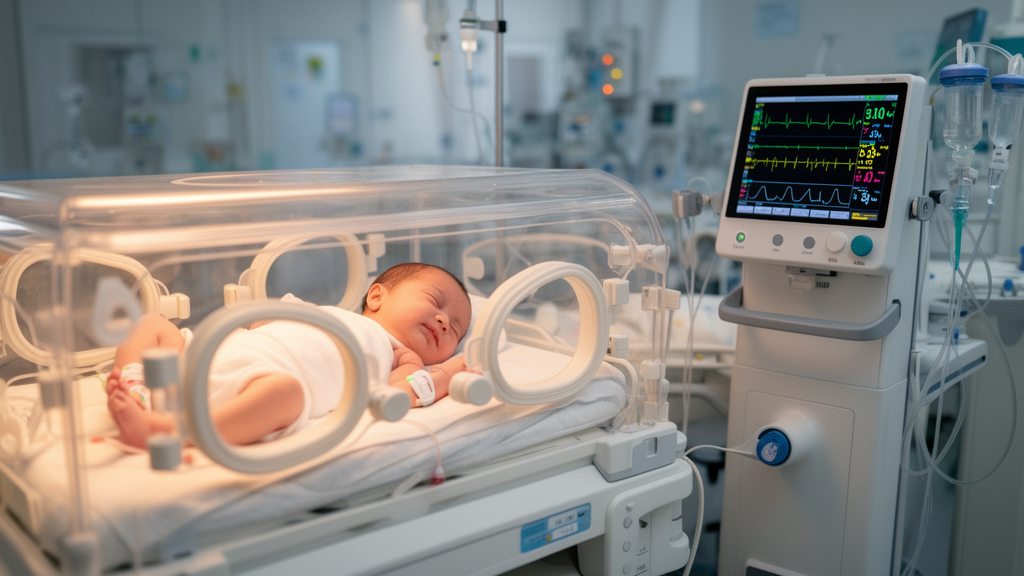
The trial examined how minor modifications to set oxygen saturation boundaries within automated fraction of inspired oxygen controllers affect overall arterial oxygen saturation exposures during routine neonatal care.
Conducted as a single-center investigation, the study evaluated ten very low birth weight infants who entered the protocol at a median age of 14 days, with an interquartile range of 13 to 18 days, and an initial median birth weight of 820 grams, with an interquartile range of 673 to 943 grams.
Participating infants remained in the trial for durations ranging between 9 and 30 days, during which automated saturation targets were systematically rotated every 12 hours between standard, narrow, and higher settings across a total of 431 individual 12-hour evaluation epochs.
The primary outcomes tracked by the researchers were the proportion of time infants maintained oxygen saturation within their intended target boundaries alongside time spent at saturation extremes, defined as levels at or below 80 percent and levels exceeding 98 percent while receiving supplemental oxygen.
Target ranges were predefined by postmenstrual age, specifying an intended saturation band of 88 to 93 percent for infants under 29 weeks postmenstrual age and 90 to 95 percent for older infants, while additional saturation thresholds above and below target limits were also monitored.
Overall baseline oxygen demand throughout the evaluation remained relatively modest, characterized by a median fraction of inspired oxygen of 0.24 with an interquartile range of 0.22 to 0.30, and the infants maintained a median of 80 percent of their time within the intended target range, with an interquartile range of 68 to 87 percent.
While differences in overall time spent inside the intended target band were not statistically significant across the three experimental settings, shifting to the higher setting reduced the percentage of time infants experienced saturation at or below 80 percent and increased time spent above 98 percent, whereas the narrow setting showed no difference in exposure compared to standard targeting.
Beyond the primary thresholds of oxygen saturation at or below 80 percent and above 98 percent with supplemental oxygen, the investigators evaluated additional descriptive levels of oxygen saturation above and below the target range. Across the 431 evaluated twelve-hour epochs, these descriptive observations of hypoxemia and hyperoxemia proved consistent with the two primary saturation extremes.
However, shifting the programmed target range upward by just one point exerted a marked impact by substantially decreasing hypoxemia while concurrently increasing hyperoxemia.
The investigation was conducted as a single-center randomized crossover study registered with ClinicalTrials.gov under the public identifier NCT06207994.
The collaborative research was conducted by investigators affiliated with several academic and clinical institutions in Czechia, including the Department of Biomedical Technology within the Faculty of Biomedical Engineering at the Czech Technical University in Prague, the Neonatal Unit in the Department of Obstetrics and Gynecology at the Second Faculty of Medicine of Motol and Homolka University Hospital, and the Department of Pathological Physiology at the First Faculty of Medicine of Charles University. The study was authored by Jana Dornakova, Tom Bachman, Radim Brabec, Ekaterina Orlova, Jan Janota, and corresponding author Jakub Rafl.
Published as a brief research report in the neonatology section of Frontiers in Pediatrics, the study underwent formal peer evaluation following submission on August 18, 2026, and was accepted on October 23, 2026.
Subject of Research: Oxygen saturation target ranges in automated neonatal oxygen control
Article Title: Effect of small changes in set oxygen saturation target range during routine use of automated FiO2 control: a randomized physiological study
Article References: Dornakova, J., Bachman, T., Brabec, R., Orlova, E., Janota, J., & Rafl, J. (2026). Effect of small changes in set oxygen saturation target range during routine use of automated FiO2 control: a randomized physiological study. Frontiers in Pediatrics, 14, Article 1971581. https://doi.org/10.3389/fped.2026.1971581
Image Credits: AI Generated
DOI: 10.3389/fped.2026.1971581
Keywords: automated FiO2 control, oxygen saturation targeting, pulse oximetry, very low birth weight infants, preterm infants, hyperoxemia, hypoxemia, neonatal respiratory support, crossover study, SpO2 target ranges, supplemental oxygen, physiological monitoring, neonatology, fraction of inspired oxygen, oxygen exposure, clinical oxygen control
News Source: Harold Sullivan. (November 14, 2026). Higher Automated Oxygen Target Range Reduces Infant Hypoxemia but Increases Hyperoxemia. Scienmag.