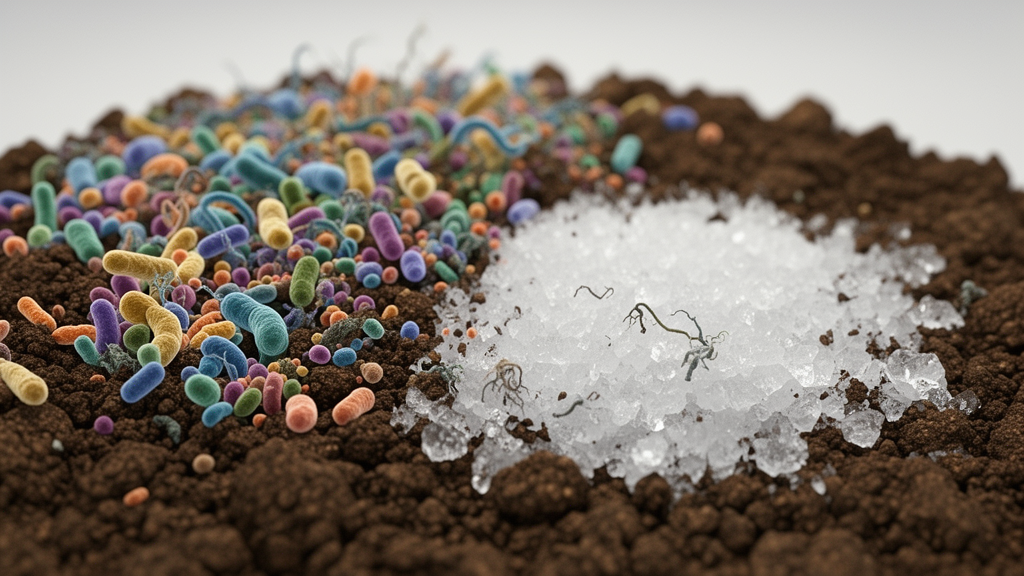
Under salt stress conditions, substrate composition influences shifts in microbial community richness and diversity across different substrate formulations. Although the broader mechanisms governing microbial communities and rice growth under salt stress have been widely reported in earlier scientific literature, evaluating these response mechanisms under a single soil condition presents notable analytical limitations. In this controlled study, the research team demonstrated that the richness and diversity of microbial communities in certain growing substrates declined significantly under salt exposure, whereas other substrate mixtures maintained stable community metrics. Specifically, under salt stress, microbial richness and diversity in pure river sand (S1) and in a substrate mixture composed of river sand, laterite, and peat soil at a four-to-three-to-three ratio (S4) were significantly reduced compared with their respective non-salt control groups. In contrast, substrate mixtures S2 and S5 exhibited no significant changes in microbial richness or diversity under salt stress when compared to their untreated controls.
To overcome the experimental limitations associated with assessing salt responses in a single soil type, the authors designed a bucket experiment incorporating six distinct substrate formulations designated as S1 through S6. The substrates evaluated in the study included S1 containing pure river sand, S2 containing river sand, laterite, and peat moss in an eight-to-one-to-one volumetric ratio, S3 containing river sand, laterite, and peat moss in a six-to-two-to-two ratio, and S4 containing river sand, laterite, and peat moss in a four-to-three-to-three ratio. The remaining two substrate treatments were S5, containing laterite and peat moss mixed in an equal one-to-one ratio, and S6, which consisted exclusively of laterite. Across the entire trial, each experimental bucket held the exact same volume of substrate and received an identical mass of sodium chloride, with fresh water irrigation applied to parallel buckets to serve as untreated experimental controls.
Analysis of the soil microbial colonies revealed distinct differences in the sensitivity and adaptability of specific bacterial taxa across the varying substrate conditions following salt application. In particular, the bacterial phylum Bacteroidota demonstrated divergent abundance patterns depending on the physical and nutritional substrate environment. The relative abundance of Bacteroidota increased following salt treatment in the pure river sand substrate S1, as well as in the composite sand-laterite-peat substrates S2 and S4. Conversely, in the S5 substrate, which consisted of laterite and peat soil in a one-to-one ratio, the relative abundance of Bacteroidota decreased following salt treatment. In addition, the researchers found that substrate mixtures offering moderate nutrient availability and pore structure, specifically S2 and S4, were more beneficial to the bacterial genus Niastella under salt stress conditions than the other tested substrate formulations.
In the S1 substrate consisting of pure river sand, salt stress significantly increased the relative abundance of phenotypes classified as stress tolerant. The bacterial taxa Ellin6067 and MND1 contributed more to the stress-tolerant phenotypes.
The results of this study provide a basis for optimizing farmland soil microecology and achieving stress-resistant rice cultivation.
Subject of Research: Soil substrate impacts on microbial communities and rice yield under salt stress
Article Title: Responses of microbial colonies, rice growth, and yield performance to salt stress under different substrate conditions
Article References: Zhou, H., Feng, N., & Zheng, D. (2026). Responses of microbial colonies, rice growth, and yield performance to salt stress under different substrate conditions. Frontiers in Microbiology, 17, Article 1602476. https://doi.org/10.3389/fmicb.2026.1602476
Image Credits: AI Generated
DOI: 10.3389/fmicb.2026.1602476
Keywords: rice, salt stress, microbial communities, soil substrates, river sand, laterite, peat moss, Bacteroidota, Niastella, Ellin6067, MND1, thousand seed weight, setting rate, soil pH, organic matter, stress tolerance, saline agriculture
News Source: Morgan Morrow. (November 14, 2026). Salt Stress Reduces Soil Microbial Diversity in Specific Tested Substrates. Scienmag.