Traditional cochlear implant systems remain among the most successful neural prostheses for restoring hearing in individuals experiencing severe to profound sensorineural deafness through electrical stimulation of the auditory nerve, yet conventional devices remain constrained by external processors, transdermal energy coupling, and restricted fidelity across complex acoustic environments. A comprehensive narrative review conducted by researcher Xiang Yao from the College of Information Science and Technology at Beijing University of Technology and published in Frontiers in Neuroscience reveals that modern research has transitioned beyond traditional functional substitution toward functional enhancement and biological fusion. However, despite rapid engineering developments across smart electrodes, machine learning, and novel transduction mechanisms, the vast majority of cutting-edge paradigms remain confined to preclinical investigation, laboratory prototypes, and early animal testing, lacking established proof of broad clinical efficacy.
To rigorously evaluate the state of the field, the author applied the narrative review transparent reporting framework outlined by SANRA across literature indexed in PubMed, Scopus, and PubScholar published between January 2010 and August 2026. Using targeted Boolean search formulas addressing cochlear prostheses, neural interfaces, biomaterials, deep learning, optogenetics, and biocompatibility, the initial identification yielded 7,628 records, which was reduced to 6,910 following deduplication. Title and abstract screening excluded 6,812 non-topic or non-peer-reviewed items, leaving 98 candidate articles for exhaustive full-text evaluation. Forty-three articles were excluded because they addressed algorithmic concepts detached from hardware coupling, presented purely speculative viewpoints lacking experimental data, examined issues beyond cochlear implant hardware boundaries, or consisted of non-peer-reviewed preprints. The resulting synthesis centers on fifty-five core investigations categorized into biological hybridization interfaces, fully implantable architectures, artificial intelligence signal processing, optical stimulation, bionic mechanical sensing, and existing focused reviews.
A critical focus of the synthesis concerns the biological and structural evolution of the cochlear electrode interface, which has progressively transitioned from passive mechanical conductors to dynamic, biologically active assemblies designed to mitigate insertion trauma and suppress pathological tissue responses. Physical array innovations challenge historical assumptions regarding insertion depth, demonstrating that shorter arrays can offer exceptional performance in specific anatomical contexts, especially through perimodiolar positioning that reduces stimulation thresholds. Concurrently, flexible electrode designs featuring locally reduced cross-sectional areas adapt closely to cochlear anatomy to minimize intracochlear trauma. Advanced diagnostic integration has yielded prototypes with onboard hydrogen peroxide sensors capable of monitoring local inflammatory cascades in real time, as well as micro-optical assemblies that facilitate direct visual navigation during surgical insertion, transforming traditional blind surgical placement into a precise, sensor-guided procedure.
To overcome the physical channel count restrictions imposed by the finite number of physical intracochlear contacts, investigators have increasingly deployed computational model-driven multi-objective optimization to execute focused electrical stimulation. By dynamically shaping the currents delivered across adjacent electrodes, these systems generate more concentrated, energy-efficient electrical fields that establish virtual channels, effectively multiplying the functional spectral resolution beyond physical contact counts. Alongside electrical field optimization, biological interface engineering has advanced from passive biocompatibility toward active tissue regulation. Implantation-induced inflammation and progressive fibrous encapsulation present severe ongoing challenges that elevate electrical impedance, compromise residual hearing, and deteriorate the electrode-neural interface. Mitigating these responses has spurred multi-tiered defensive and regenerative strategies targeting both acute and chronic cellular events.
Defensive biological strategies include anti-fouling barriers utilizing zwitterionic hydrogels, alongside active pharmacological intervention using dexamethasone-eluting electrode arrays and degradable polymer coatings composed of polylactic-co-glycolic acid or polycaprolactone. To surmount the pharmacokinetic constraints of uniform drug dispersion, researchers have engineered biphasic release systems, dual-action formulations combining fast- and slow-clearing matrices, and water-soluble salt channels to fine-tune eluting kinetics. To resolve the finite loading volume of surface coatings, prototype in-situ hydrogel reservoirs have been designed with percutaneous puncture ports, theoretically enabling lifelong, on-demand drug replenishment for chronic inflammation control. Advancing toward active regeneration, researchers have functionalized arrays with brain-derived neurotrophic factor, cell-adhesion peptides, and adipose-derived stem cell hydrogels to promote auditory neuron survival, culminating in conductive hydrogels loaded with neural stem cells that aim to bridge electrical charge transfer and cellular repair in animal models.
In signal processing and neural coding, traditional strategies face persistent performance deficits in multi-talker noise, reverberation, and musical pitch perception. Underlying computational models have evolved through two-path nonlinear architectures that mirror basilar membrane frequency responses, non-subsampled wavelet transforms that minimize information loss via translation invariance, and spectral feature extraction integrating temporal fine structure cues. At the silicon level, asynchronous event-driven encoding chips capture fine temporal details while operating under strict ultra-low-power budgets. Concurrently, deep learning models—such as compact temporal convolutional networks with multi-head self-attention and dual-branch U-Net architectures incorporating lateral inhibition—demonstrate marked speech enhancement and noise suppression in simulated low signal-to-noise ratio acoustic conditions.
Despite impressive computational achievements, the clinical translation of artificial intelligence in speech processing remains constrained by substantial operational hurdles. Deep neural networks evaluated in offline datasets or simulated acoustic benchmarks exhibit significant performance divergence when implemented in real-world processors, where real-time inference latency and milliwatt-level power budgets restrict complex edge deployment. Furthermore, individual neural survival patterns and variable electrode-neuron distances produce substantial patient heterogeneity. Recent personalized strategies endeavor to counteract this by applying excitatory control models that dynamically adapt stimulation profiles to neural excitability, inactivating poorly functioning channels through focused threshold mapping, and implementing time-domain strategies that incorporate neuronal refractory period masking models. Comparative investigations indicate that while end-to-end deep learning architectures optimize speech comprehension, modular front-end processing yields higher subjective fidelity during music appreciation.
Replicating cochlear mechanics at the acoustic source has driven the development of bionic sensing architectures that replace external microphones with artificial hair cells and synthetic basilar membranes. Utilizing the intrinsic electromechanical properties of piezoelectric polymers like polyvinylidene fluoride, artificial hair cell prototypes achieve direct acoustic-to-electric signal conversion without requiring external power, covering the frequency range of human hearing while demonstrating baseline biocompatibility. Structural bionic designs have simulated the spatial frequency mapping of the cochlea through circular multi-band platforms and spiral micro-structures with engineered width gradients that serve as mechanical filter banks. Nevertheless, these bionic sensors currently exist only as benchtop prototypes, facing severe translational barriers related to narrow dynamic ranges, long-term operational stability in biological fluids, and an absence of standardized encoding protocols to interface with back-end neural stimulators.
Optical cochlear implants utilizing optogenetics represent an alternative paradigm engineered to overcome the extensive spread of electrical current that restricts frequency selectivity in conventional multi-electrode arrays. By transducing spiral ganglion neurons with light-sensitive opsins, highly focused light pulses from micro-scale light-emitting diode arrays or flexible polymer waveguides can stimulate discrete neural populations with ultra-high spatial selectivity. Complementary methods exploring surface plasmon resonance seek to achieve optical activation without viral gene delivery, while protective nanoscale polyethylene oxide coatings maintain optical transmission and biocompatibility over time. However, the translation of optical cochlear implants remains restricted to in vitro and early animal models, hindered by fundamental safety barriers including viral vector immunogenicity, long-term genetic stability, micro-LED thermal dissipation risks, and the absence of optimized neural coding algorithms to translate sound into multi-channel light pulses.
The engineering quest for completely invisible, fully implantable cochlear implants aims to eliminate external head-worn speech processors and transdermal coils entirely, thereby enhancing physical safety, aesthetic satisfaction, and operational continuity. Progress in subcutaneous sensing spans micro-electro-mechanical piezoelectric sensors coupled directly to the ossicular chain, sub-tympanic micro-microphones, and exploratory recording techniques utilizing residual inner hair cell bioelectrical activity as an internal biological microphone. Power architectures focus on multi-band piezoelectric resonant harvesters driven by tympanic vibrations, optimized transcutaneous inductive charging, magnetic-free topologies compatible with magnetic resonance imaging, and memristor-based integrated sensing-and-computing circuits designed to execute spike-based stimulation under aggressive energy budgets.
Despite foundational engineering demonstrations in animal models, fully implantable systems confront formidable clinical translation bottlenecks, most notably an absolute energy deficit where self-powered harvesting mechanisms generate power several orders of magnitude below device operational requirements. Furthermore, packaging high-density micro-batteries, custom integrated circuits, and acoustic sensors within the restricted anatomical space of the temporal bone demands hermetic sealing and heat dissipation strategies that remain unproven across human lifespans. Ultimately, the narrative review underscores that genuine clinical breakthroughs will not stem from isolated engineering accomplishments, but rather from the structured convergence of materials science, microelectronics, neuroscience, and artificial intelligence into a bidirectional, bio-integrated interface verified through rigorous, phased clinical investigations.
Subject of Research: Technological progress, evidence maturity, and translational barriers across five dimensions of advanced cochlear implants
Article Title: Research progress and prospects of cochlear implant technology
Article References: Yao, X. (2026). Research progress and prospects of cochlear implant technology. Frontiers in Neuroscience, 20, Article 2002803. https://doi.org/10.3389/fnins.2026.2002803
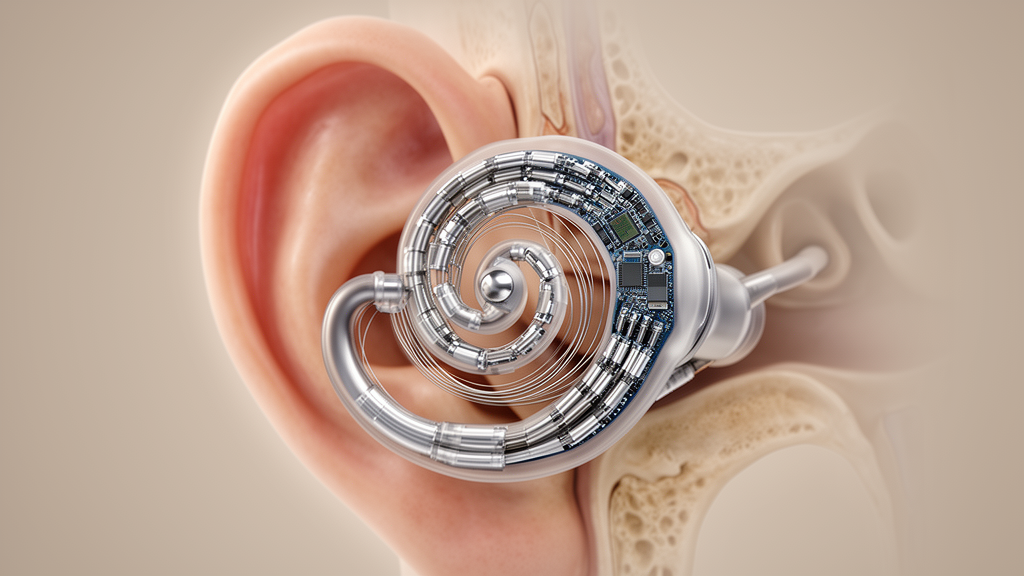
Image Credits: AI Generated
DOI: 10.3389/fnins.2026.2002803
Keywords: cochlear implants, neural prostheses, auditory nerve stimulation, electrode arrays, biohybrid interfaces, drug-eluting coatings, optogenetics, bionic sensing, piezoelectric materials, deep learning noise suppression, speech recognition, fully implantable cochlear implants, wireless power transmission, auditory physiology, basilar membrane mechanics, conductive hydrogels, narrative review, translational neuroscience
News Source: Cassandra Pierce. (November 13, 2026). Narrative Review Highlights Preclinical Progress and Clinical Barriers in Advanced Cochlear Implants. Scienmag.