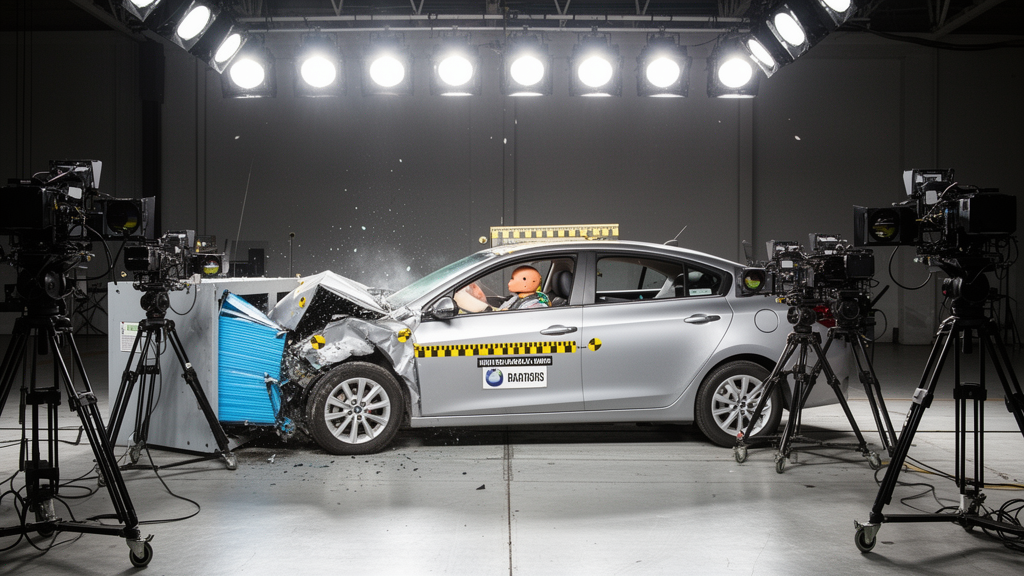
Researchers have introduced a computational framework that converts complex finite element vehicle crash models into reinforcement learning compatible surrogate environments to calibrate onboard crash-detection algorithms. However, calibrating these algorithms relies heavily on acceleration crash pulses that record vehicle deceleration during an impact. While virtual vehicle models built with the finite element method possess extensive geometric, structural, and material data to assess safety performances across numerous simulated scenarios, even well-developed models exhibit deviations when compared to real-world physical test results. These discrepancies arise from the difficulty of modeling real-world chaos and unpredicted physical uncertainties. When restraint algorithms are calibrated exclusively against virtual simulation results, these deviations can cause misclassification of crash events or delayed activation times for restraint systems, potentially compromising occupant protection during critical collision scenarios.
Virtual crash models used in finite element analysis are engineered to compute an expansive range of intricate mechanical behaviors, including multi-axis structural deformations, stress distributions, energy dissipation, and complex global vehicle kinematics involving translation, yaw, pitch, and roll. Capturing such broad physical fidelity requires detailed meshing, sophisticated material formulations, and extensive computational resources for every simulation run. Yet, for calibrating a crash-detection algorithm, the required analytical dependency narrows down to a single output parameter: the acceleration crash pulse. In conventional engineering workflows, resolving discrepancies between simulated crash pulses and physical test results would demand identifying root causes of modeling errors, manually updating high-fidelity finite element models, and re-running exhaustive simulation matrices. Such iterative re-engineering is extraordinarily time-consuming and computationally prohibitive within vehicle development schedules.
To overcome these computational bottlenecks, the study outlines a methodology establishing a closed feedback loop between physical crash tests and virtual simulations using an adaptive surrogate model. Rather than employing purely statistical machine learning or unconstrained neural networks, the proposed framework utilizes reinforcement learning interacting with a physically testable, rule-based surrogate environment. Because the surrogate environment is governed by explicit mechanical formulations and boundary conditions, structural inferences can be drawn directly from the adjusted model parameters. In this architecture, the reinforcement learning agent does not attempt to predict the crash pulse directly as a statistical output; instead, it strategically modifies the underlying physical stiffness and energy distribution parameters of the surrogate environment across successive iterations. This approach ensures that the agent maps causal relationships between localized structural parameters and observed crash pulse variations while keeping all intermediate mechanical properties fully accessible for independent engineering verification.
Constructing this reinforcement learning environment requires transforming the detailed vehicle structure into an optimally simplified, low-dimensional representation specifically targeted at frontal crash scenarios. To isolate the region of interest, the researchers partition the vehicle body into two distinct functional zones based on established crashworthiness principles: a rigid passenger compartment designed to remain undeformed, and a deformable frontal vehicle region engineered to crush and dissipate kinetic impact energy. While the passenger compartment is mathematically treated as a single rigid body, the deformable frontal zone is discretized into a structured grid of volumetric cells. Rather than adopting a uniform spatial grid that arbitrarily splits components across boundaries and complicates stiffness calculations, the researchers implement an optimized discretization scheme. In this approach, discretization occurs at the sub-assembly level, segmenting individual sub-assemblies into cells matching a target volume. Unoccupied spaces within the frontal region are designated as null cells possessing no state equations and zero initial energy capacity.
The spatial boundaries and physical characteristics of this discretized surrogate structure are derived directly by mining data from pre-processed finite element simulation models. The pre-processing architecture contains standard data matrices detailing nodal coordinates, element formulations, part designations, and material cards. The extraction algorithm isolates the spatial coordinates of nodes forming two-dimensional shell and three-dimensional solid elements, indexing their relationships within parts and sub-assemblies into comprehensive structural matrices. Simultaneously, the framework mines mechanical property definitions from simulation material cards, capturing parameters including mass density, Young’s modulus, shear modulus, bulk modulus, yield strength, ultimate strength, fracture limits, and Poisson’s ratio. Because individual volumetric cells can encompass multiple components fabricated from distinct automotive alloys or structural materials, the framework synthesizes these properties into weighted aggregate material and geometric matrices. These matrices establish each cell’s centroid, spatial bounding box coordinates, and preliminary stiffness factors, providing a grounded physical baseline that can be systematically refined during reinforcement learning iterations.
To compute how deformation energy propagates across the vehicle structure during impact, the researchers define an explicit mathematical model governing cell behavior and inter-cell interaction. The internal behavior of each active cell is modeled using hyperbolic tangent functions that govern energy absorption and transmission factors based on cumulative interacting energy. As structural deformation progresses, a cell’s capacity to absorb additional energy decreases, causing a greater fraction of interacting energy to transfer into adjacent cells in accordance with energy conservation laws. The transition rate between absorption and transmission is governed by a slope parameter determined by a linear combination of physical material factors and geometric shape factors. Furthermore, energy transfer between neighboring cells is constrained by strict mechanical boundary conditions: energy cannot flow backward along the negative longitudinal axis, empty cells transmit zero energy, and energy transfers preferentially along the principal direction of force while distributing across adjacent cells in proportion to shared cross-sectional areas and contact angles.
To translate dynamic energy propagation into observable kinematic signals, the surrogate framework links cell energy absorption to an equivalent mechanical multibody spring model. In physical crashes, onboard accelerometers record discrete deceleration values at sampling intervals determined by sensor frequencies, which can be numerically integrated to infer vehicle velocity and displacement curves. The researchers model the physical crushing zone of the vehicle as a series of discrete spring elements, where the dynamic stiffness of each cell is calculated through a cotangent function of its instantaneous energy absorption factor scaled by a calibration gain. By calculating instantaneous structural displacements at each discrete time step, the surrogate model integrates these kinematic states to yield estimated crash velocity and acceleration profiles that directly correspond to vehicle impact responses.
Operating within this physical surrogate environment, the reinforcement learning architecture formalizes state spaces, action spaces, and policy interactions. The state of the environment at any given time step is defined by a state vector containing the derived dynamic stiffness values of all active volumetric cells. The action space encompasses configurable parameters that the learning agent can strategically adjust, specifically the gain factor controlling material stiffness and individual shape stiffness coefficients assigned to each cell. Because permitting unconstrained actions across every cell in a vehicle would produce an intractable combinatorial action space, the authors enforce domain-specific constraints restricting actions to cells located within primary and secondary deformation zones. For instance, in a driver-side small overlap crash scenario, structural cells situated on the passenger side remain outside the active load path and are excluded from parameter tuning. Diminishing the action space in this manner prevents unnecessary exploratory computations and enables efficient algorithmic convergence toward viable structural configurations.
The reinforcement learning agent refines its parameter adjustment policy using a multicriteria reward function designed to evaluate curve similarity between the estimated crash signal and the reference signal. In the current implementation, the first integral of the filtered crash acceleration signal, representing vehicle velocity, serves as the primary reference curve. Because standard area integration between curves can fail to distinguish qualitatively distinct pulse shapes, the reward formulation incorporates three complementary mathematical metrics: the absolute area between curves, the Discrete Fréchet Distance, and root mean squared Euclidean error. The Discrete Fréchet Distance accounts for curve trajectory and ordering by determining the minimum coupling link length needed to traverse both curves simultaneously. The composite reward factor rewards actions producing relative reductions in these three error metrics across consecutive iterations within an episode. Training episodes are bounded by termination conditions, stopping automatically when curve similarity reaches a target, when divergence triggers an upper error threshold, or when an iteration ceiling is reached.
Discretizing the vehicle’s frontal structure produced an active surrogate environment that was trained using a Deep Deterministic Policy Gradient reinforcement learning algorithm. Across successive training episodes, the policy gradient agent learned effective parameter modification policies, steadily minimizing curve divergence and evolving the surrogate model’s crash velocity estimations until they closely matched reference finite element curves. In full product development, this framework provides a two-stage calibration pipeline: initial surrogate tuning calibrates crash-detection algorithms against broad simulation suites, while subsequent physical crash tests introduce real-world pulses to refine the surrogate model further. The updated surrogate can then re-evaluate pending crash scenarios to identify low-risk test configurations that can be reliably validated in simulation, while ongoing research addresses cell aggregation limitations, computational scaling, and non-convergent boundary conditions.
Subject of Research: Reinforcement learning surrogate modeling for calibrating automotive crash-detection algorithms against impact pulses
Article Title: Vehicle crash simulation models for reinforcement learning driven crash-detection algorithm calibration
Article References: Afraj, S., Vaculín, O., Böhmländer, D., & Hynčík, L. (2025). Vehicle crash simulation models for reinforcement learning driven crash-detection algorithm calibration. Advanced Modeling and Simulation in Engineering Sciences, 12(1), Article 17. https://doi.org/10.1186/s40323-025-00288-4
Image Credits: AI Generated
DOI: 10.1186/s40323-025-00288-4
Keywords: crash-detection algorithms, finite element method, reinforcement learning, vehicle crash simulation, passive safety systems, crash pulse estimation, Deep Deterministic Policy Gradient, airbag calibration, surrogate modeling, Discrete Fréchet Distance, energy absorption modeling, structural stiffness, frontal impact dynamics, sub-assembly discretization, multibody spring models, Root Mean Squared Euclidean Error
News Source: Denise Maddox. (November 13, 2026). Reinforcement Learning Surrogate Models Align Vehicle Crash Simulations With Impact Pulses. Scienmag.