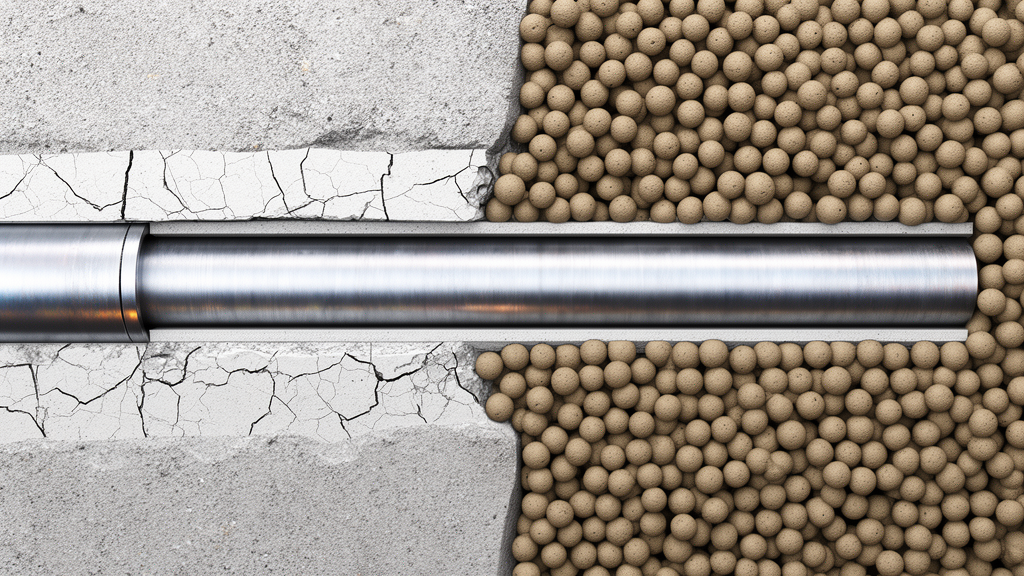
Laboratory investigations simulating operational conditions for high-temperature aquifer thermal energy storage demonstrate that cyclic heating and cooling induce debonding and micro-annulus formation along wellbore grout interfaces, whereas hydrated clay pellets maintain resilient impermeable seals. Research conducted by engineers Alexis Koulidis, Martin Bloemendal, and Philip J. Vardon evaluated the annular sealing capacity of commercially available grouts and granular clay backfill materials subjected to simulated operational cycles between 22 degrees Celsius and 90 degrees Celsius. In conventional shallow geothermal and groundwater wells, annular backfilling prevents hydraulic short-circuiting between distinct geologic aquifers separated by impermeable formations. While conventional low-temperature storage systems experience modest subsurface temperature swings, high-temperature storage introduces severe thermal expansions and contractions as water heated up to 90 degrees Celsius is injected and withdrawn. The experimental findings reveal that early-age grouts experience substantial interface breakdown under these thermal fluctuations, whereas clay pellets exhibit self-sealing characteristics that preserve hydrodynamic containment.
To capture thermal and mechanical interactions within a laboratory environment, the research team engineered a specialised experimental apparatus replicating the annular configuration of a completed well. The test cell positioned an annular cylinder of sealing material around a central model well casing made from an aluminium tube measuring 22 millimetres in outer diameter, containing an internal heating element and monitoring thermocouples. The model was mounted within a transparent plexiglass cylinder having an internal diameter of 94 millimetres, bordered above and below by restraint plates, rubber gaskets, and compacted sand layers. Thermocouples recorded temperatures at the tube surface and at radial distances of 1.5 centimetres and 3.0 centimetres within the backfill sheath. Controlled fluid ports linked to an automated syringe pump and differential pressure transducers enabled precise injectivity testing to quantify apparent transmissivity. Aluminium was specifically chosen for the casing rather than stainless steel because its lower density and reduced X-ray scattering permitted high-resolution micro-computed tomography scanning at 100-micrometre resolution across the casing-backfill boundary.
The evaluation examined three commercially available wellbore grouting formulations featuring diverse mineralogical mixtures alongside three industrial bentonite clay pellet products. Grout mixtures prepared according to manufacturer water-to-grout ratios incorporated varying proportions of cementitious phases, clay minerals, quartz, and graphite additives. Grout 3 featured a lower cementitious proportion with higher fractions of quartz and calcite. An additional modified formulation, designated Grout 1-S1, blended silica sand particles sized between 500 and 1000 micrometres at an elevated water-to-grout ratio of 2.8 to test the impact of added granular stiffness. The clay pellet selections comprised two calcium-bentonite products, one containing embedded magnetite for geophysical tracking, and a sodium-bentonite pellet product containing more than 60 percent smectite mineral content.
Mechanical baseline characterisation revealed pronounced differences in strength development and deformation mechanics across the grout formulations over standard curing intervals of 7 and 28 days under submerged conditions at 22 degrees Celsius. Uniaxial compressive strength and Brazilian splitting tensile tests showed that 7-day cured grouts possessed low compressive strength and low stiffness, deforming under load in an ideal ductile-plastic mode without sudden brittle failure. When cured for 28 days, Grouts 1 and 2 developed markedly increased peak compressive strength and elastic modulus, while Grout 3 exhibited substantially lower strength gains.
Thermal cycle testing imposed up to 11 discrete thermal cycles, driving the inner casing thermocouple to 90 degrees Celsius until radial heat conduction established a steady thermal boundary before the system was permitted to cool back down to ambient room temperatures. Grouts cured for only 7 days underwent severe plastic deformation along the heated casing interface during these cycles. Because the expanding casing forced the low-strength grout outward while the material remained plastic, subsequent cooling of the casing left an unrecovered void along the boundary. This structural damage was most pronounced adjacent to the active heating element, whereas lower sample sections exposed to diminished temperature swings showed markedly reduced gap development, confirming that thermal cycle amplitude directly drives interface failure.
Injectivity tests conducted at controlled flow rates demonstrated that this micro-annulus served as a preferential flow conduit, drastically degrading hydrodynamic containment. In tests on 7-day cured Grout 1 conducted with an injection rate of 100 millilitres per minute, fine sand particles from the overlying porous boundary layer migrated downward into the open gap, demonstrating that thermal cycling and bond rupture permitted physical particulate mobilization. Repeating the experiment at a reduced injection rate of 10 millilitres per minute prevented sand movement but confirmed the presence of a wide, unsealed aperture with minimal differential pressure build-up. In Grout 2, injectivity tests revealed an abrupt collapse in hydraulic resistance by the fifth thermal cycle, where differential pressure dropped to nearly zero. Grout 3, despite displaying lower baseline compressive strength, experienced less severe micro-annulus enlargement during early curing than Grout 2, reflecting differences in mineralogy and thermal conductivity.
Extending the grout curing period to 28 days dramatically mitigated micro-annulus development for formulations characterised by high cementitious mineral fractions. Following 28 days of underwater curing, Grouts 1 and 2 attained sufficient mechanical stiffness and shear resistance to withstand radial thermal expansion without sustaining extensive plastic yield. Subsequent micro-computed tomography imaging revealed that the interface for Grouts 1 and 2 remained predominantly intact, with void widths largely suppressed below the scanner’s 100-micrometre detection threshold. This structural preservation translated to an 80 percent reduction in apparent transmissivity compared to the 7-day specimens, although small progressive rises in transmissivity during sequential injection phases still signaled subtle sub-resolution interface degradation.
In sharp contrast to cementitious grouts, granular clay pellets exhibited remarkable resilience throughout the thermal cycles when hydrated in fresh water environments. Upon introduction into the test cell with moisture, the granular pellets underwent rapid hydration and volumetric expansion, completely filling the annular space and eliminating individual grain boundaries to form a cohesive, low-permeability mass. Micro-computed tomography scans conducted after cyclic thermal exposures confirmed the complete absence of continuous micro-annuli or debonding fissures, displaying only isolated, discontinuous micropores. Fluid injectivity tests on hydrated clay pellets produced rapid, sustained pressure increases reaching 900 millibars under flow, demonstrating that the annular barrier remained effectively impermeable. Even as thermal cycles were repeated, the clay barriers exhibited improved sealing performance over time, as prolonged thermal exposure and ongoing fluid contact facilitated continued hydration and homogeneous clay swelling against the confining casing wall.
To evaluate performance under saline subsurface regimes, the researchers replicated clay pellet experiments utilizing water containing 0.25 moles per litre of sodium chloride, representative of brackish aquifer conditions. One-dimensional swell tests established that saline water curtailed the free swelling capacity of clay pellets by approximately 64 to 85 percent relative to fresh water, with vertical swell ratios of 0.28 for pellet 1, 0.15 for pellet 2, and 0.36 for pellet 3. Despite this pronounced reduction in swelling magnitude, the confined clay pellets in the annular test apparatus preserved impermeable flow characteristics during thermal cycling. While initial apparent transmissivity values were higher in saline water than in fresh water, subsequent injection cycles showed steady transmissivity declines. When pellets were held in place for five days, continued gradual hydration reduced annular hydraulic conductivity to approximately 10 to the negative 10 metres per second, demonstrating that salt suppression of swelling does not compromise long-term wellbore isolation.
Translating laboratory apparent transmissivity values to field-scale conditions required analytical upscaling that accounted for differences in wellbore geometry and casing material mechanics. In field installations, typical production wells feature casing diameters near 300 millimetres inside 600-millimetre boreholes, constructed with stainless steel or composite materials rather than aluminium. Thermal calculation shows that while an 11-millimetre radius aluminium casing expands radially by 0.016 millimetres between 22 and 90 degrees Celsius, an equivalent stainless steel casing expands by 0.014 millimetres under identical thermal differentials. However, a full-scale 300-millimetre steel casing undergoes approximately 13 times greater absolute linear expansion than the 22-millimetre experimental tube. Upscaling equations assuming micro-annular flow indicated that field-scale grouts would exhibit average hydraulic conductivities marginally exceeding the Netherlands regulatory threshold of 10 to the negative 9 metres per second, whereas clay pellets require no geometric upscaling due to the complete absence of micro-annuli.
The collective experimental results demonstrate that while clay pellets provide robust, thermally resilient barriers for shallow high-temperature aquifer thermal energy storage completions, standard grouts remain vulnerable to interface compromise unless carefully engineered and cured. Early exposure of incompletely cured grouts to thermal cycling causes severe permanent debonding that allows fluid transmission and sand mobilization. Extending curing to 28 days and avoiding coarse sand additives substantially reduces micro-annulus formation, although high-conductivity additives such as graphite present secondary thermal loss considerations during seasonal storage operations. Because clay pellets maintain impermeable seals even under brackish salinity and high-amplitude thermal swings, they offer an effective sealing solution for shallow storage systems. Future research implementing full-scale casing dimensions and operational downhole stress environments will further refine regulatory compliance thresholds, ensuring that seasonal subsurface thermal energy storage can expand safely without jeopardizing regional groundwater resources.
Subject of Research: Sealing integrity of borehole grouts and clay pellets under thermal cycles representative of high-temperature aquifer thermal energy storage
Article Title: Experimental assessment of sealing integrity of grouts and clay pellets under thermal cycles representative of HT-ATES operation
Article References: Koulidis, A., Bloemendal, M., & Vardon, P. J. (2026). Experimental assessment of sealing integrity of grouts and clay pellets under thermal cycles representative of HT-ATES operation. Geothermal Energy, 14(1), Article 6. https://doi.org/10.1186/s40517-026-00374-9
Image Credits: AI Generated
DOI: 10.1186/s40517-026-00374-9
Keywords: aquifer thermal energy storage, high-temperature ATES, wellbore integrity, borehole completion, annular sealing, grout debonding, micro-annulus formation, clay pellets, bentonite swelling, apparent transmissivity, hydraulic conductivity, thermal cycling, micro-computed tomography, geothermal energy storage, calcium bentonite, sodium bentonite, injectivity tests
News Source: Denise Maddox. (November 13, 2026). Thermal Cycles Debond Wellbore Grouts While Clay Pellets Maintain Subsurface Seals. Scienmag.