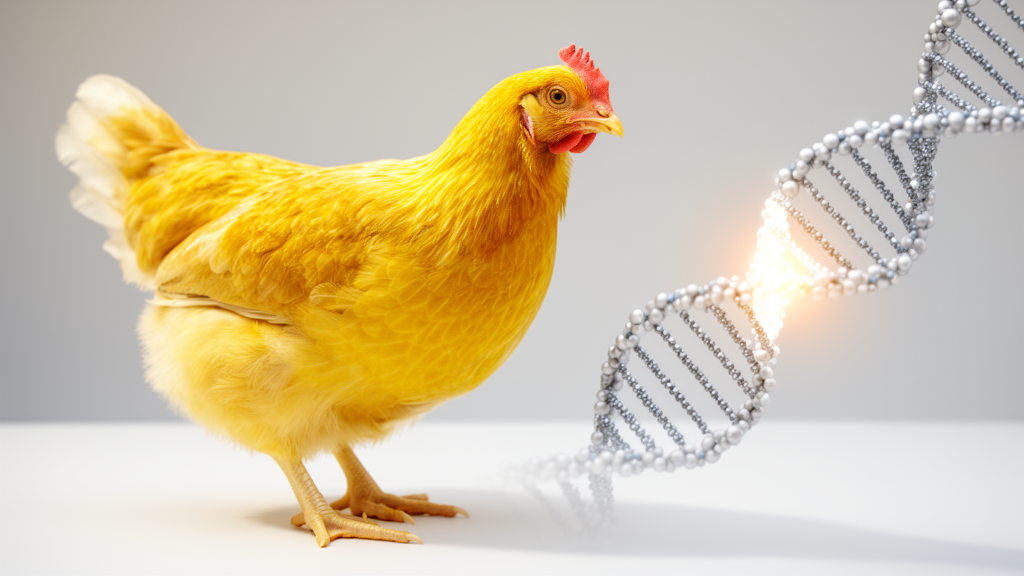
Researchers investigating the biological mechanisms underlying skin pigmentation in domestic poultry have identified a regulatory 24-base-pair insertion within the first intron of the beta, beta-carotene-9 prime, 10 prime-dioxygenase gene as a primary candidate causal mutation for yellow skin colour. The study, published in Genetics Selection Evolution, supports a model in which this non-coding structural alteration is linked to phenotypic variation by repressing transcription of the enzyme responsible for clearing dietary pigments from avian tissue. Under normal conditions in white-skinned chickens, the dioxygenase enzyme actively catalyses the asymmetric oxidative cleavage of dietary xanthophylls, including lutein and zeaxanthin, into colourless apo-10 prime-carotenoids, thereby preventing visual pigment accumulation across the dermis and epidermis. Conversely, when the expression of this critical metabolic gene is suppressed, ingested carotenoid compounds accumulate within dermal layers to yield a characteristic yellow pigmentation. By pinpointing the specific insertion sequence, the research team has resolved a molecular mystery that eluded agricultural geneticists for decades, clarifying how non-coding genomic variation directs macroscopic pigmentation.
Skin colour represents an economically important trait in chickens, where variation between populations has important implications for consumer preferences and market economics. Classical genetic investigations conducted more than a century ago established that white dermal pigmentation behaves as a completely dominant Mendelian trait over recessive yellow skin, segregating according to a classical single-locus inheritance model historically designated as the W locus. Genomic mapping work performed by Eriksson and colleagues previously demonstrated that the functional locus on chromosome 24 colocalizes with the beta-carotene dioxygenase coding sequence and revealed that yellow skin alleles originally introgressed into domestic flocks from the grey junglefowl, Gallus sonneratii. While that earlier work successfully narrowed the candidate region down to a 23.8-kilobase linkage haplotype, the precise causative DNA alteration remained completely unknown for over a decade. This unresolved genetic architecture hampered the establishment of definitive molecular diagnostic assays for commercial breeders and left the regulatory mechanism governing tissue-specific carotenoid depletion uncharacterized.
To identify the definitive genetic variants responsible for skin colour variation, the research team conducted a genome-wide association study using a mixed linear model on a cohort of 381 chickens, comprising 247 yellow-skinned and 134 white-skinned individuals. The experimental mapping cohort included 213 progeny from an experimental backcross family alongside 168 Jinghong parental hens, all genotyped on a high-density 600K single-nucleotide polymorphism array. Statistical models adjusted for sex and the first five principal components successfully controlled for background demographic stratification, yielding a highly disciplined genomic inflation factor of 0.978. The genome-wide analysis confirmed that the primary locus governing dermal pigmentation resides on chromosome 24, where lead single-nucleotide polymorphism rs313221600 reached an extreme significance threshold of P = 1.78 x 10^-18 with an estimated odds ratio of 34.4, accounting for 4.81 percent of phenotypic variance. Three additional significant loci emerged on chromosomes 4 and 11, each conferring protective effects against white colouration and collectively raising the total phenotypic variance explained to 8.18 percent.
Transcriptomic profiling of shank skin tissue comprising both epidermal and dermal layers confirmed that the dioxygenase gene acts as the primary functional effector driving the observed phenotypic divergence. High-throughput RNA sequencing of tissue collected from three homozygous white-skinned Houdan chickens and three homozygous yellow-skinned White Leghorn chickens uncovered 398 differentially expressed genes across the transcriptome. Strikingly, among all candidate loci positioned adjacent to the genome-wide association signals, only the carotene dioxygenase gene displayed significant differential expression, emerging as the single most dramatically shifted transcript across the entire dataset. White-skinned individuals exhibited an approximate 590-fold increase in transcript abundance relative to yellow-skinned counterparts, defined by a log2 fold change of 9.21 and an adjusted false discovery rate of 5.50 x 10^-129. Independent validation using quantitative real-time PCR in an expanded cohort of six birds per genotype corroborated this profound transcript disparity, recording an average log2 fold change of 10.32 with a significance value of P = 3.00 x 10^-4.
To isolate the underlying causal sequence among tightly linked polymorphisms, the authors analysed whole-genome resequencing data from 63 individual birds across six diverse avian populations, including grey junglefowl, Houdan, Jinghong, Wenchang, and White Leghorn lines. An initial targeted screen across the protein-coding exons identified nine single-nucleotide polymorphisms, yet none of these coding variants correlated reliably with skin colour across divergent breeds. Expanding the scan to a 28-kilobase regional window covering the entire gene body and the historical 23.8-kilobase linkage interval detected 287 distinct genetic variants; however, extensive linkage disequilibrium prevented the identification of any discriminatory point mutations. Recognizing that short-read sequencing frequently misses larger genomic rearrangements, the investigators compared four high-quality de novo assemblies representing both phenotypes. This structural variant screening revealed four distinct insertion-deletion candidates measuring 10 base pairs, 18 base pairs, 24 base pairs, and 598 base pairs, each displaying preliminary frequency differentiation between yellow-skinned assemblies and white-skinned reference genomes.
Subsequent allele-specific PCR assays across seven distinct populations encompassing 148 birds revealed that all four structural insertions were completely fixed in the five yellow-skinned breeds examined. In white-skinned breeds, the Houdan line lacked all four insertions, while the Wenshi-white line exhibited varying frequencies, retaining the 18-base-pair and 24-base-pair variants at an intermediate frequency of 0.5. To separate the true causal candidate from linked hitchhiking variants, the researchers genotyped 180 backcross progeny with balanced phenotypic presentation. The 18-base-pair variant failed segregation testing because 52 of 90 white-skinned birds were homozygous for the insertion allele. In contrast, the 24-base-pair insertion demonstrated near-complete co-segregation with dermal colour: 89 of 90 yellow-skinned chickens were homozygous for the insertion, whereas 86 white-skinned birds were heterozygous and four were homozygous wild-type. Genomic annotation positioned this specific 24-base-pair insertion within the first intron of the gene, situated 6,139 base pairs downstream of exon 1 and 1,578 base pairs upstream of exon 2.
Epigenomic profiling uncovered a striking correlation between the presence of the 24-base-pair intronic insertion and a profoundly repressive chromatin environment across the locus in yellow-skinned birds. Cleavage Under Targets and Tagmentation assays targeting histone H3 lysine 27 trimethylation revealed pronounced enrichment of this repressive chromatin modification across the promoter and gene body in White Leghorn skin compared to Houdan tissues. Simultaneously, assay for transposase-accessible chromatin using sequencing demonstrated a coordinated loss of open chromatin structure throughout the identical genomic region. Quantitative evaluation of normalized signal intensities across the entire gene body confirmed significantly lower chromatin accessibility in yellow-skinned chickens relative to white-skinned individuals, supported by an independent samples t-test returning a significance value of P = 0.013.
To determine whether the intronic insertion alters nuclear protein recruitment, the researchers conducted electrophoretic mobility shift assays using synthetic double-stranded DNA probes exposed to cutaneous nuclear extracts. Incubation of mutant probes bearing the 24-base-pair insertion sequence with nuclear proteins extracted from yellow-skinned tissues produced a distinct, retarded electrophoretic band that disappeared upon the addition of excess unlabelled competitor DNA. Importantly, wild-type probes lacking the sequence showed no detectable protein binding under identical assay conditions. Furthermore, nuclear extracts harvested from white-skinned Houdan chickens also formed specific complexes with the mutant probe, confirming that the cognate regulatory protein is naturally present in white-skinned tissues as well. These competitive binding assays indicated that protein binding is determined by the presence or absence of the 24-base-pair insertion sequence itself, rather than requiring phenotype-specific availability of the interacting nuclear factor.
Biochemical characterization using magnetic bead DNA pull-down assays coupled with liquid chromatography-tandem mass spectrometry resolved a prominent protein band at 40 to 50 kilodaltons, yielding 154 candidate transcription factors. Cross-referencing these candidates against known epigenetic repressors prioritised lymphoid enhancer-binding factor 1, a documented effector of Wnt signalling capable of recruiting Polycomb Repressive Complex 2 to silence target promoters. Functional validation in DF1 chicken embryo fibroblasts confirmed that small interfering RNA knockdown of LEF1 reduced endogenous messenger RNA levels by 30 to 35 percent and elicited a significant 2.5-fold de-repression of BCO2 expression. Parallel pharmacological inhibition of EZH2, the catalytic methyltransferase subunit of the Polycomb complex, using 7 micromolar GSK126 for 32 hours stimulated a 1.9-fold upregulation of dioxygenase transcription without altering EZH2 transcript abundance itself.
Despite these compelling mechanistic insights, the authors noted several key biological limitations requiring future experimental validation. Complete formal causality cannot be asserted from segregation alone, as a single yellow-skinned bird in the backcross cohort was heterozygous for the insertion, potentially reflecting incomplete penetrance, phenotypic misclassification, or modulating effects from the secondary loci identified on chromosomes 4 and 11. Additionally, antibody supershift assays were inconclusive, meaning direct physical occupancy of LEF1 at the endogenous locus in dermal tissue awaits definitive genome editing and in vivo chromatin immunoprecipitation. Nevertheless, the complete fixation of the 24-base-pair insertion across commercial and indigenous yellow-skinned lines supports its historical role during adaptive introgression and selective breeding.
Subject of Research: Genetic and epigenetic regulation of chicken skin colour by an intronic BCO2 insertion
Article Title: A regulatory 24-bp insertion at the BCO2 gene region is associated with yellow skin in chickens
Article References: Rong, L., Wu, X., Li, J., Zhou, Y., Yu, T., Nan, J., Yang, L., Wang, X., Feng, Y., & Li, S. (2026). A regulatory 24-bp insertion at the BCO2 gene region is associated with yellow skin in chickens. Genetics Selection Evolution, 58(1), Article 48. https://doi.org/10.1186/s12711-026-01067-4
Image Credits: AI Generated
DOI: 10.1186/s12711-026-01067-4
Keywords: BCO2 gene, chicken genomics, skin pigmentation, carotenoid metabolism, structural variant, LEF1 transcription factor, PRC2 repression, marker-assisted selection, regulatory, insertion, BCO2, gene
News Source: Juliet Wilcox. (November 13, 2026). Intronic BCO2 Gene Insertion Is Associated With Yellow Skin in Chickens. Scienmag.