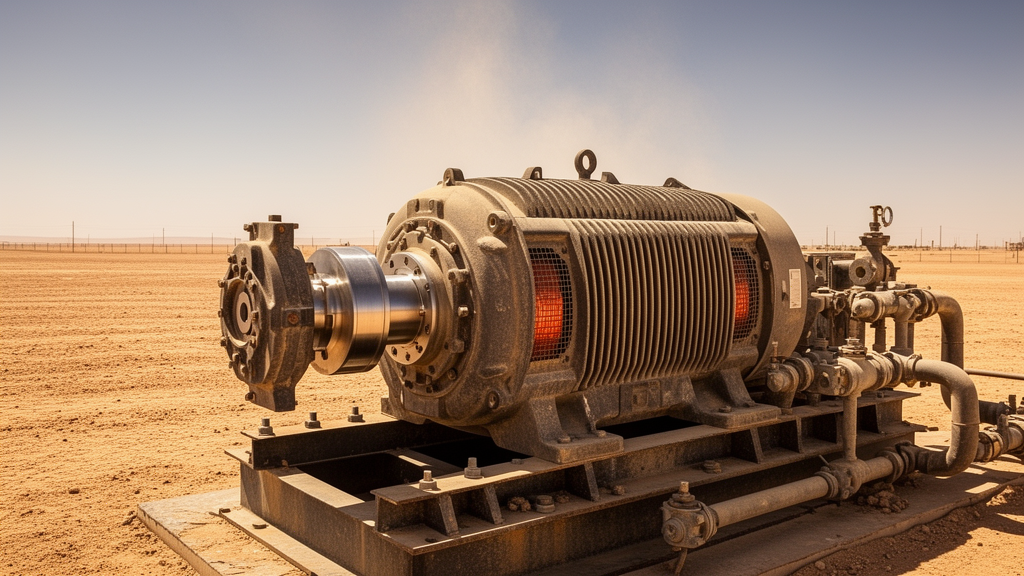
Researchers have evaluated an optimized three-phase induction motor architecture engineered to operate across extreme temperature environments typical of oil and gas installations. Utilizing finite element modeling and simulation tools, investigators Asuquo Eke, O. I. Okoro, and A. J. Onah demonstrated that systematic optimization of motor geometry alongside specialized material selections allows an induction machine to handle significant thermal stresses while improving fundamental operational metrics. According to the reported simulation outcomes, the optimized motor model achieved an efficiency increase of 7.2 percent and an enhancement in torque of 24 percent relative to the baseline machine design, establishing practical design principles for heavy industrial machinery operating under harsh field conditions.
Induction motors serve as standard electromechanical equipment across commercial and industrial facilities, converting electrical energy into mechanical power through electromagnetic induction. In oil and gas installations, these machines drive critical process units, including fluid transfer pumps handling crude oil and refined petroleum products, high-pressure gas compressors, and ventilation fans or blowers providing continuous plant cooling. The environmental conditions surrounding these installations are frequently severe, subjecting machinery to corrosive atmospheres, moisture, and broad temperature fluctuations. In such environments, conventional induction motors often encounter operational hurdles, especially when industrial processes demand substantial starting current and high initial starting torque to initiate heavy mechanical loads.
To establish the electrical and magnetic behaviors governing the induction machine, the authors formulated the underlying physics using Maxwell’s partial differential equations. The formulation addresses displacement electric fields, magnetic flux density vectors, electric field intensity, magnetic field intensity, and current density across the stator and rotor domains. Because the current within the rotor bars is induced rather than externally imposed, the numerical model incorporates magnetic vector potential and electric scalar potential relations to resolve the electromagnetic field dynamics. By coupling the magnetic vector potential with the material conductivity and applied voltage expressions, the finite element method directly computes field distributions across the active machine sections.
Thermal behavior forms a central component of the investigation, as temperature elevation within an induction motor stems directly from internal power losses balanced against heat dissipation mechanisms. The analytical framework categorizes heat generation into copper losses determined by root mean square current and AC resistance factors, iron losses comprising hysteresis and eddy current dissipation, and mechanical losses consisting of friction and windage. Heat dissipation was formulated through conduction, convection, and radiation pathways. In the thermal resistance network, total thermal resistance dictates the temperature rise as a function of total power losses, which establishes the maximum operating temperature relative to ambient environmental conditions.
Electromagnetic design calculations governed the generated voltages, magnetic fluxes, and developed torque of the machine under varying load states. The analytical equations defined the relationships connecting magnetic flux density, core permeability, winding turns, and physical radius with overall cross-sectional flux. Generated voltage per phase was determined as a function of operational frequency, turns count, and total flux. Furthermore, the developed electromagnetic torque was characterized through the interaction of machine pole pairs, supply frequency, flux, and rotor current, establishing the volumetric torque density metrics that guided the overall dimensional optimization of the rotor and stator assemblies.
Structural integrity calculations were simultaneously incorporated to evaluate mechanical strains and stresses exerted across critical structural components during continuous operation. The engineering analysis included tensile, compressive, and shear stress formulations acting upon the cross-sectional areas of the motor assembly, alongside strain evaluations based on material elasticity moduli. Specific mechanical formulas governed the shaft diameter sizing as a function of allowable shear stress and transmitted torque, alongside dynamic load ratings and load-life exponents used to estimate bearing operational life under continuous industrial mechanical loads.
The physical survivability of the motor under severe temperature conditions relies heavily on specialized material selection across magnetic, conductive, and insulating assemblies. For extreme high-temperature operating conditions, the investigation highlights the utility of ceramic insulating materials, heat-resistant conductors such as silver-plated copper, and permanent magnetic compositions like neodymium-iron-boron or samarium-cobalt that preserve magnetic properties under elevated heat. Conversely, for extreme low-temperature service, materials must avoid brittleness and mechanical contraction. The study identifies 304 and 316 stainless-steel alloys for structural resilience, aluminum for lightweight end shields and rapid heat conduction, copper for windings, and specialized insulation including polytetrafluoroethylene, polyimide, and flexible silicone materials, paired with fluorinated or silicone lubricants to mitigate mechanical wear.
Optimization of the induction motor was structured as a mathematical programming problem to balance conflicting operational targets across stator diameter, stator length, winding turn numbers, wire diameter, and rotor bar dimensions. The multi-objective optimization framework aimed to maximize motor operational efficiency and volumetric torque density while constraining overall manufacturing and material costs. The optimization bounds were constrained by maximum allowable temperature rise, core magnetic flux saturation thresholds, and maximum permissible electrical current density, preventing localized overheating or magnetic saturation under peak operational demands.
Simulations conducted in Ansys Motorcad evaluated the comparative performance between standard motor configurations and the optimized design model. The baseline motor design exhibited an efficiency of 75 percent at rated speed, producing a starting torque of 44 Newton-meters with a starting current of 28.5 amperes. Following the single objective optimization procedure, the refined motor design demonstrated an operational efficiency of 82 percent, elevated starting torque of 64 Newton-meters, and a reduced starting current of 15 amperes, with running currents maintained stably across the simulated time intervals.
Thermal and flux distribution modeling demonstrated that internal machine temperatures remained evenly distributed across both axial and radial views during simulated duty cycles. The authors observed that thermal management, including considerations for cooling heat sinks or thermal insulators alongside specialized sealing gaskets, allows the motor to maintain stable operating profiles across a temperature variance range of plus or minus 400 around standard motor temperatures, provided that material selection matches environmental demands.
Beyond general motor mechanics, industrial oil and gas facilities impose strict operational constraints that dictate machine construction and housing requirements. Induction motors deployed across production plants drive critical fluid pumps handling crude oil and refined hydrocarbons, deliver power to high-pressure gas compressors, and power ventilation blowers providing plant cooling, while induction generators support facility power systems. Operating in humid, corrosive, and combustible environments requires compliance with International Electrotechnical Commission standards. Furthermore, explosion-proof mandates from European Union Atmosphere’s Explosible directives or Underwriters Laboratories standards require robust enclosures and specialized seals to prevent flammable vapors from entering the machine. Choosing between squirrel-cage and wound-rotor designs directly reflects these demands, with wound rotors providing the high starting torque necessary for heavy industrial loads.
Computational optimization strategies in electric machinery design frequently evaluate heuristic search algorithms against standard genetic methods to improve computational speed and efficiency. Research cited in the study demonstrated the Artificial Ecosystem Optimization algorithm applied to induction motor design optimization to maximize efficiency under identical constraints against a standard Genetic Algorithm. Across twenty experimental runs, Artificial Ecosystem Optimization achieved a 1.36 percent efficiency gain compared to 1.15 percent for the Genetic Algorithm. Artificial Ecosystem Optimization also required substantially less computation time, completing in 52.84 seconds compared to 111.21 seconds for the Genetic Algorithm. These performance comparisons highlighted the computational speed and efficiency advantages of the ecosystem approach, offering useful insights for future machine optimization routines involving varied stator slot geometries.
Thermal modeling in the motor formulation incorporates specific governing equations for natural convection, forced convection, and liquid cooling mechanisms. Liquid cooling formulations quantify thermal extraction as the product of coolant mass flow rate, specific heat capacity, and fluid temperature change. Radiation dissipation supplements convective cooling by calculating heat transfer from surface emissivity, the Stefan-Boltzmann constant, exposed surface area, and the difference between absolute surface and reference temperatures raised to the fourth power.
Magnetic flux interactions and inductive coupling within the core assembly follow explicit electromagnetic equations and spatial flux distributions. Stator self-inductance is formulated using material permeability, the squared count of stator turns, cross-sectional area, and core length, with rotor inductance similarly evaluated from rotor turn numbers. Mutual inductance between the stator and rotor windings is calculated from their inductive coupling factor multiplied by the square root of the product of stator and rotor inductances. Finite element analysis of magnetic flux distributions demonstrates the concentration and spatial pathing of magnetic field lines across the magnetic circuit.
In conducting the motor simulations using Ansys Motorcad, the researchers maintained all baseline dimensional parameters constant while isolating the effects of material selection across extreme operating temperatures. This comparative modeling approach confirmed that operating currents remained stable over time, maintaining 5 amperes for the standard motor design and 10 amperes under single objective optimization. Structural design requirements also incorporated vibration dampening and acoustic noise reduction to ensure smooth, quiet operation, safeguarding against mechanical failures caused by low-temperature brittleness or high-temperature material expansion in severe oilfield environments.
Subject of Research: Design and optimization of a three-phase induction motor for extreme temperature conditions in oil and gas applications
Article Title: Design and optimization of three phase induction motor for extreme temperatures applications in oil and gas industry
Article References: Eke, A., Okoro, O. I., & Onah, A. J. (2026). Design and optimization of three phase induction motor for extreme temperatures applications in oil and gas industry. Discover Electronics, 3(1), Article 107. https://doi.org/10.1007/s44291-026-00257-0
Image Credits: AI Generated
DOI: 10.1007/s44291-026-00257-0
Keywords: induction motor, thermal management, oil and gas industry, finite element method, extreme temperatures, efficiency optimization, starting torque, motor design, stator windings, rotor bars, magnetic flux, copper losses, iron losses, Ansys Motorcad, insulation systems, electrical conductivity, thermal resistance, material selection
News Source: Denise Maddox. (November 13, 2026). Optimized Induction Motor Design Improves Efficiency for Extreme Temperature Oil Field Operations. Scienmag.