A research team has designed and constructed an eight-axis laser-assisted bioprinting workstation named Srishti, demonstrating the controlled deposition of cellular microdroplets and fine hydrogel patterns with line widths narrowed down to 78 micrometers. Described in a methodology study published in BMC Methods, the platform employs laser-induced forward transfer to deposit living cells without relying on physical nozzles or mechanical extrusion needles. Traditional biomanufacturing methods often encounter nozzle clogging, shear stress damage, and structural resolution limits dictated by mechanical orifice diameters. The newly reported system relies on a solid-state neodymium-doped yttrium aluminum garnet laser delivering focused nanosecond pulses onto an energy-absorbing donor slide, propelling precise picoliter-to-nanoliter volume bioink droplets across microscopic gaps onto target receiver substrates. Through systematic calibration of laser settings, carriage travel rates, slide separation gaps, and biopolymer rheology, the investigators achieved a thirteen-fold refinement in pattern fidelity compared to initial unoptimized trials, successfully producing structured multicellular patterns containing viable mammalian fibroblasts and embryonic cardiomyoblasts.
Additive manufacturing in biological engineering seeks to arrange biomaterials, viable cells, and biochemical factors into complex spatial architectures that emulate native living tissues. According to established manufacturing standards, additive manufacturing operates through layer-by-layer material deposition governed by computer-aided digital designs. Although non-additive techniques such as scaffold casting, cell sheet assembly, and organoid aggregation have enabled significant tissue engineering milestones, they routinely struggle to recreate intricate hierarchical vascularization, heterotypic cell arrangements, and reproducible extracellular matrix gradients. Automated bioprinting addresses these constraints by coordinating spatial deposition, material density, and cellular organization. Drop-on-demand laser-assisted printing specifically provides a non-contact mechanism where kinetic energy is generated by optical interaction rather than pneumatic or mechanical pistons. By releasing microscopic droplets without physical shear against restrictive internal nozzle walls, laser-based methods protect cell membranes from severe shear forces while offering exceptional deposition control across diverse two-dimensional and three-dimensional configurations.
The physical architecture of the Srishti workstation incorporates five motorized motion axes operating at ten-micrometer mechanical resolution and three manual positioning stages designed to adjust optical alignment and camera focus. Optical actuation is driven by a passively Q-switched neodymium-doped yttrium aluminum garnet laser emitting at a near-infrared wavelength of 1064 nanometers, with a pulse duration of 20 nanoseconds, an operating repetition rate between 2.39 kilohertz and 18 kilohertz, a single-pulse energy of 105 microjoules, and a focal fluence of 33.4 joules per square centimeter. Focused through a reflector and objective lens down to an optical spot diameter of approximately 20 micrometers, the beam interacts with an energy-absorbing donor slide held in an aluminum protective housing. The motion system permits continuous movement along the donor slide across a maximum travel range of 70 millimeters on the horizontal X-axis, 10 millimeters on the Y-axis, and 50 millimeters on the receiver vertical Z-axis. Process monitoring is handled concurrently by an infrared-sensitive camera tracking laser-donor focus and an optical high-definition camera operating at 166 frames per second with a 3-nanosecond gating unit to record droplet ejection.
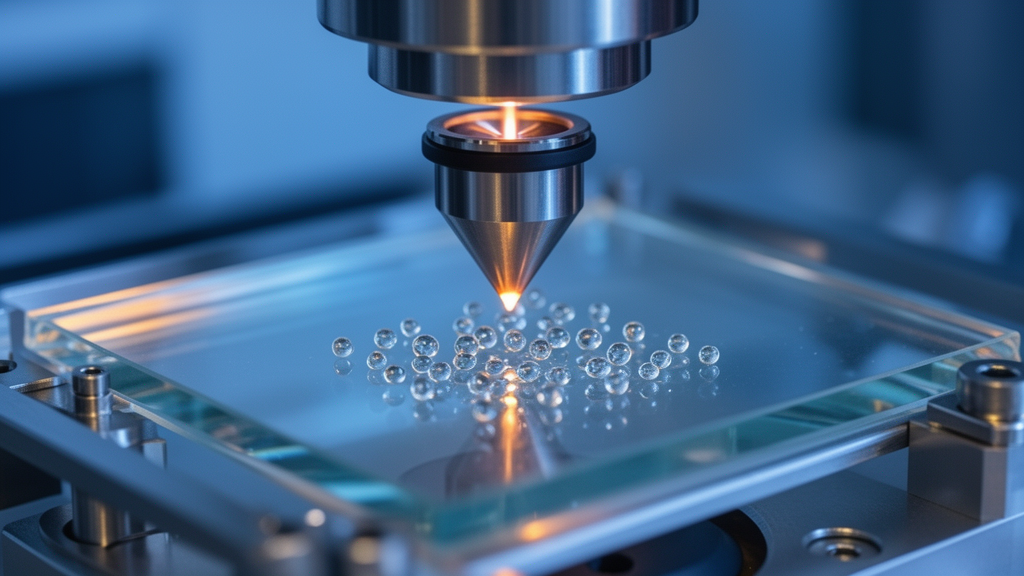
Material ejection in the Srishti system relies on direct-current sputter-coated titanium thin films serving as the energy-absorbing layer across standard 75 by 25 millimeter glass slides. The metallic layer was fabricated through direct-current reactive magnetron sputtering at 110 watts of power and an operational chamber pressure of 0.014 millibar for five minutes. Scanning electron microscopy and atomic force microscopy measurements showed that the sputtering protocol generated a uniform metallic coating with a mean film thickness of 63.5 plus or minus 5.5 nanometers, a mean grain size of 69.67 plus or minus 26.05 nanometers, and a characteristic hillock-like surface roughness showing a mean height of 2.766 nanometers. When near-infrared nanosecond pulses strike the titanium-glass interface, localized photonic absorption heats the metal and transfers thermal energy directly to the overlying bioink coating. This localized heating generates a rapidly expanding microscopic vapor bubble within the liquid film, which exerts inertial forces that propel a bioink jet across the gap toward the receiver substrate, transferring material cleanly as the stage advances along preprogrammed numerical toolpaths.
To establish baseline printing conditions, the investigators initially examined how donor translation velocity influenced metallic ablation patterns and droplet collision regimes using a one percent weight-per-volume sodium alginate bioink solution. Operating at a fixed laser repetition rate of 2.39 kilohertz, titanium-coated donor slides were moved across laser paths at speeds progressing from 10 millimeters per second to 40 millimeters per second. Microscopic inspection revealed that translation speeds below 20 millimeters per second caused continuous, overlapping ablation tracks where consecutive pulses repeatedly struck the same surface area, generating unstable material transfers and premature bubble coalescence. Increasing the velocity to 25 millimeters per second and beyond separated consecutive pulse interactions, producing distinct ablation sites and supporting consistent droplet formation. At 40 millimeters per second, discrete ablation pits formed cleanly, confirming that rapid stage translation prevents overlapping thermal damage on the donor film and guarantees that each subsequent pulse engages an unperturbed reservoir of fresh bioink.
Initial printing evaluations with pure sodium alginate and gelatin hydrogels underscored the severe impact of donor-to-receiver gap distances on pattern resolution and droplet splashing. When testing a wide five-millimeter gap at receiver translation speeds of 0.5 millimeters per second, single-layer and multi-layer patterns exhibited pronounced droplet spatter, yielding broad line widths spanning 1.2 to 1.5 millimeters. Raising sodium alginate concentrations from 0.5 percent to 2.0 percent weight-per-volume increased viscous resistance, but higher concentrations dissipated the fixed 105-microjoule pulse energy and prevented kinetic jet initiation. To suppress satellite splashing, the team fabricated custom polylactic acid slide holders using fused deposition modeling, mechanically reducing the donor-receiver separation distance to 2.0 millimeters and subsequently down to 0.5 millimeters. At a 0.5-millimeter gap, printing lines with 0.75 percent weight-per-volume sodium alginate at stage speeds of 25, 30, and 35 millimeters per second narrowed measured line widths down to 155, 133, and 112 micrometers, respectively, demonstrating a nine-fold reduction in pattern width relative to the unconfined five-millimeter gap.
Because sodium alginate provides favorable ionic crosslinking and shear-thinning behavior but lacks natural cell-adhesion ligands, the researchers developed hybrid bioink blends combining sodium alginate with thermosensitive porcine gelatin. Gelatin supplies arginine-glycine-aspartic acid peptide motifs that facilitate cellular attachment, but its rapid gelation kinetics below 29 degrees Celsius require balanced formulations to avoid premature nozzle-free clogging or high-viscosity jet arrest. Blends formulated with 0.5 percent sodium alginate and increasing ratios of gelatin were tested at coating thicknesses of 20 and 30 micrometers. Rheological characterization confirmed that all formulations displayed pronounced shear-thinning properties across shear rates from 1 to 1000 reciprocal seconds at 37 degrees Celsius. A bioink ratio containing 0.5 percent alginate and 1.5 percent gelatin, applied at a 30-micrometer coating thickness and printed at a speed of 40 millimeters per second across a 0.5-millimeter gap, achieved stable jetting without splashing, yielding uniform printed lines of 114 plus or minus 9 micrometers and well-defined multi-layer porous grid patterns showing continuous strand fusion at internal intersections.
Further optimization of higher-density blends revealed that pairing 0.75 percent weight-per-volume sodium alginate with 0.75 percent gelatin at a 30-micrometer coating thickness produced the finest resolution achieved on the platform. When translated at 40 and 45 millimeters per second across a 0.5-millimeter gap, the system produced continuous hydrogel strands measuring 78 plus or minus 8 micrometers and 80 plus or minus 10 micrometers in width, respectively. Lower printing speeds between 25 and 35 millimeters per second yielded broader line widths ranging from 113 to 143 micrometers, while higher gelatin ratios failed to transfer droplets due to excessive viscous dissipation of the incident laser energy. Three-dimensional confocal laser scanning microscopy using an eosin Y fluorescent tracer verified the multi-layer deposition capability of the Srishti platform, demonstrating that a single printed layer had an average thickness of 15.24 plus or minus 1.2 micrometers, whereas a stacked triple-layer structure achieved a consolidated thickness of 21.1 plus or minus 3.3 micrometers without layer collapse.
To validate the cytocompatibility and biological utility of the Srishti system, the authors conducted live cell patterning experiments using murine subcutaneous fibroblasts from the NCTC clone 929 cell line and embryonic rat cardiomyoblasts from the H9c2 cell line. Using a one percent sodium alginate bioink suspended with fibroblasts at a cell density of 700,000 cells per 200 microliters, optical microscopy revealed that printed droplets exhibited a uniform diameter of 58 plus or minus 6 micrometers, each encapsulating between one and three viable cells. Calcein-AM and ethidium homodimer staining performed immediately after depositing multi-layer fibroblast constructs onto Matrigel-coated receiver plates confirmed high membrane integrity and cell viability, which the authors attributed to the non-damaging 1064-nanometer laser wavelength and the absence of narrow nozzle shear stresses. Across seven days of in vitro culture, the bioprinted fibroblasts demonstrated extensive morphological spreading, progressive proliferation, and the formation of elongated cellular extensions establishing direct intercellular contacts across the hydrogel matrix.
The platform demonstrated comparable performance when printing highly sensitive H9c2 rat cardiomyoblasts, maintaining cellular viability and structural integrity throughout extended multi-day cultures. Ten-layer line constructs printed with cardiomyoblast-laden alginate onto Matrigel substrates exhibited progressive cell proliferation and elongated phenotypic extensions by day four and day six, reaching dense multicellular interconnectivity by day eight of culture. Cell density optimization showed that higher seeding concentrations accelerated confluence across the patterned domains, with intermediate densities closing acellular gaps over eight days. The authors noted that future deployments of laser-assisted bioprinting will require tight environmental regulation over humidity and ambient sterility inside the printing enclosure to counteract the rapid evaporation and drying of thin bioink layers on donor plates during extended fabrication runs.
Subject of Research: Laser-assisted 3D bioprinting of cellular hydrogel constructs
Article Title: Srishti: a custom-built laser-assisted 3D bioprinter for fabricating high-resolution biological constructs
Article References: Sekar, M. P., Subramanian, A., Sundaramurthi, D., & Sethuraman, S. (2026). Srishti: a custom-built laser-assisted 3D bioprinter for fabricating high-resolution biological constructs. BMC Methods, 3(1), Article 2. https://doi.org/10.1186/s44330-025-00051-6
Image Credits: AI Generated
DOI: 10.1186/s44330-025-00051-6
Keywords: Laser-assisted bioprinting, Tissue engineering, Srishti bioprinter, Laser-induced forward transfer, Sodium alginate, Gelatin bioink, NCTC clone 929, H9c2 cardiomyoblasts, Titanium absorbing layer, Nd:YAG laser, Drop-on-demand printing, Bioink rheology, Confocal microscopy, Cytocompatibility, Cellular microdroplets, Additive manufacturing
News Source: Gregory Coleman. (November 13, 2026). Custom Laser Bioprinter Achieves High Resolution Droplet Deposition for Cellular Constructs. Scienmag.