A computational drug discovery investigation combining chemical similarity searching, molecular docking, and microsecond-scale molecular dynamics simulations has evaluated whether modifying a sulfonamide-indole scaffold can yield viable candidate binders for the CREB-binding protein bromodomain. Researchers screened 392 structural analogs retrieved from the PubChem database against the acetyl-lysine recognition cavity of the epigenetic reader, advancing three top-scoring molecules into duplicate one-microsecond all-atom molecular dynamics trajectories and binding free energy rescoring. The atomistic simulations revealed that while one fluorinated indole analog maintained a stable trajectory matching the dynamic profile of a co-crystallized reference ligand, comparative free energy calculations ranked all three candidates below the parent structure. The investigators concluded that their findings deliver an important cautionary lesson for structure-based drug design, demonstrating that structural similarity to a known binder does not inherently confer improved affinity or paralog selectivity, while establishing that preserving an acidic sulfonamide nitrogen-hydrogen donor represents an essential requirement for stable pocket binding.
Epigenetic regulation through the post-translational modification of histone proteins plays an essential role in controlling global transcriptional architecture and preserving cellular homeostasis. Bromodomains serve as evolutionarily conserved protein modules that recognize acetylated lysine residues on histone tails, effectively acting as molecular readers that recruit transcriptional complexes to active chromatin regions. When bromodomain-mediated signaling experiences pathological dysregulation, aberrant activation frequently accelerates oncogenic transformation by driving pro-proliferative and anti-apoptotic gene expression programs. The CREB-binding protein, commonly known as CBP, alongside its paralog p300, stands out as an essential multidomain transcriptional coactivator that integrates histone acetyltransferase catalytic activity with bromodomain readout functions. Overexpression or mutational activation of CBP is frequently observed across solid tumors and hematologic malignancies, including acute myeloid leukemia, breast cancer, and prostate cancer. In prostate cancer specifically, CBP facilitates androgen receptor-driven gene expression, which exacerbates castration-resistant disease progression. Although small-molecule inhibitors have advanced into clinical trials, achieving selectivity over paralogous bromodomain families remains a difficult therapeutic challenge.
The principal difficulty complicating the development of CBP-selective therapeutics is the structural conservation shared across the human bromodomain family, particularly between CBP and members of the bromodomain and extra-terminal family, including BRD4. All bromodomains share a conserved left-handed four-helix bundle fold in which the ZA and BC loops define the acetyl-lysine cleft. Within this shared pocket, key residues reading the acetyl mark are strictly conserved across paralogs. Specifically, CBP utilizes Asn1168 to accept a hydrogen bond from an acetyl carbonyl oxygen, directly mirroring the role of Asn140 in the first bromodomain of BRD4. Furthermore, an evolutionarily conserved tyrosine residue, designated Tyr1125 in CBP and Tyr97 in BRD4, coordinates an ordered water network lining the base of the binding pocket. Because these primary anchoring residues cannot be exploited for paralog discrimination, medicinal chemists must target subtle divergent structural features positioned around the outer rim of the binding cleft.
Structural analyses reveal three primary differences along the pocket entrance that distinguish CBP from BET bromodomains. First, the hydrophobic shelf flanking the pocket entrance consists of a tryptophan-proline-phenylalanine sequence in BET proteins, known as the WPF shelf, but features a leucine-proline-phenylalanine sequence in CBP, termed the LPF shelf. Substituting leucine for the tryptophan indole reshapes the local surface and alters available aromatic contacts. Second, CBP presents a basic Arg1173 residue on the pocket rim that has no counterpart in BET bromodomains, providing a platform for cation-pi interactions with electron-rich ligand aromatics. Third, the gatekeeper residue differs significantly, presenting Val1174 in CBP compared to Ile146 in BRD4, which modulates access to the adjacent hydrophobic groove and ZA channel. These architectural distinctions framed the central research question: could peripheral substitutions on a known sulfonamide-indole scaffold shift binding preference toward the distinct CBP pocket features?
The starting point for this study was the high-resolution crystal structure of the human CBP bromodomain complexed with the sulfonamide-indole ligand YF2-23, resolved at 2.20 angstroms and cataloged under Protein Data Bank identifier 7JUO. This crystallographic ligand originated from a medicinal chemistry program that previously yielded XP-524, a dual BET and EP300 inhibitor. Pharmacological profiling of XP-524 demonstrated half-maximal inhibitory concentrations of 5.8 nanomolar against BRD4-BD1 and 1.5 nanomolar against BRD4-BD2, but a significantly weaker 116 nanomolar against CBP. Because this parental chemotype inherently favors BET bromodomains by one to two orders of magnitude, a pharmacophore derived from it cannot be presumed to confer CBP selectivity. The research team therefore investigated whether exploring structural analogs retrieved by similarity searching could identify peripheral substitutions capable of biasing the scaffold toward CBP, evaluating whether specific attachment positions could sustain stable pocket interactions.
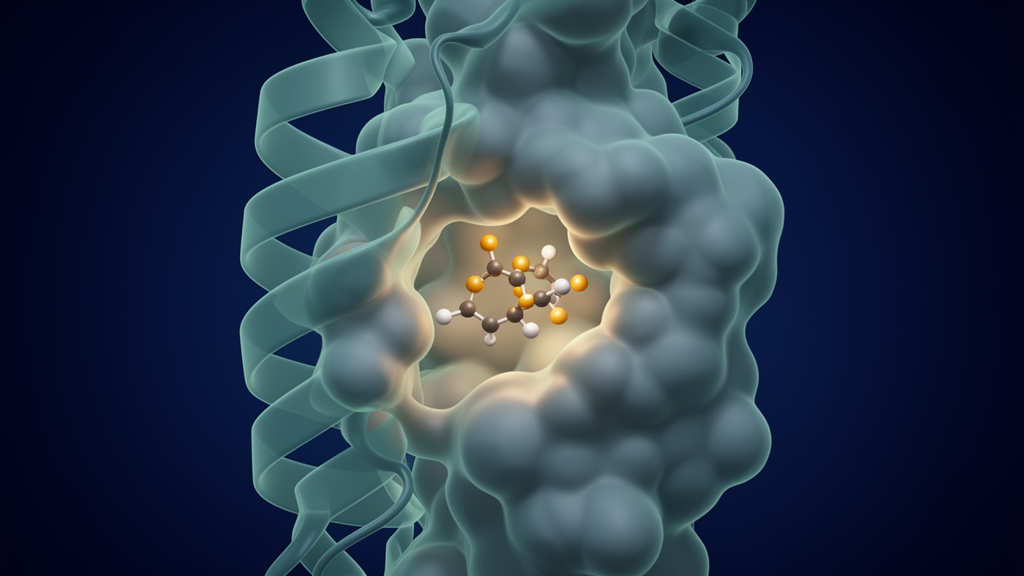
To identify potential candidates, the researchers conducted a two-dimensional structural similarity search of the PubChem Compound database using the co-crystallized YF2-23 structure as a query. Implementing PubChem’s subgraph CACTVS fingerprint with an 85 percent Tanimoto threshold retrieved 392 analog compounds that preserved the core fused bicyclic nitrogen heterocycle and sulfonamide moiety. The authors noted that this approach represented a local similarity retrieval rather than a validated pharmacophore model, as no decoy enrichment assessments were performed. Before docking the analog library, the AutoDock Vina 1.2.3 protocol was validated by redocking the co-crystallized YF2-23 ligand into the prepared receptor structure, encompassing residues 1084 through 1196. The top-scoring redocked pose achieved a heavy-atom root-mean-square deviation of 1.2 angstroms relative to the crystal coordinates, well within the two-angstrom reliability threshold and successfully reproducing key crystallographic contacts, including the sulfonamide hydrogen bond to Asp1116 and pi-stacking with Tyr1125.
High-throughput docking of the 392 PubChem analogs against the CBP bromodomain yielded predicted binding free energies ranging from minus 10.059 to minus 6.239 kilocalories per mole, with a mean of minus 8.17 and a median of minus 8.16 kilocalories per mole. The co-crystallized reference YF2-23 yielded an internal docking score of minus 9.899 kilocalories per mole. Exactly three compounds scored at or below the minus 10.0 kilocalories per mole threshold: CID135236185 at minus 10.059, CID66966190 at minus 10.009, and CID135236309 at minus 10.008 kilocalories per mole. The researchers emphasized that because the slight differences of 0.11 to 0.16 kilocalories per mole separating these compounds from the reference fall well within AutoDock Vina’s typical error margin of 1.5 to 2.0 kilocalories per mole, the docking scores could not establish superior affinity. Instead, the scoring cutoff served strictly as a computational filter to select candidate structures for dynamic simulation.
Structural examination of the three selected candidates highlighted critical chemical differences across the series. Compounds CID135236185 and CID135236309 are closely related indole-2-carboxamides sharing a 37-atom common substructure, differing only in a fluorine versus trifluoromethyl substituent on a pendant pyridine ring. Both analogs retain the acidic sulfonamide nitrogen-hydrogen donor present in YF2-23. Conversely, CID66966190 is an indazole derivative whose sulfonyl group is attached to a tertiary ring nitrogen, completely lacking an acidic sulfonamide nitrogen-hydrogen donor. Across all three candidates and the reference, the maximum shared substructure comprises only nine atoms representing the fused bicyclic core. Predicted binding modes indicated that while CID135236185 and CID135236309 formed hydrogen bonds with residues including Tyr1125, Gln1113, and Asp1116, CID66966190 relied instead on picolinamide interactions and hydrophobic contacts from a pendant ring, an arrangement that proved substantially less durable during subsequent solvated molecular dynamics.
To evaluate conformational stability, each docked complex alongside the reference ligand underwent duplicate one-microsecond all-atom molecular dynamics simulations in GROMACS 2023.4 using the CHARMM36m force field, generating two microseconds of trajectory data per system. Following equilibration, backbone root-mean-square deviations remained below 0.35 nanometers for all four complexes. Trajectory analyses identified CID135236309 as the most stable complex, displaying the lowest mean backbone deviation at 0.233 nanometers and a root-mean-square fluctuation of 0.140 nanometers, outperforming the reference ligand’s values of 0.295 and 0.168 nanometers. CID135236185 showed intermediate stability with a mean deviation of 0.259 nanometers, while CID66966190 exhibited the highest drift at 0.331 nanometers. Intermolecular hydrogen bonding revealed the molecular basis for these differences: whereas the reference maintained an average of 1.99 hydrogen bonds per frame, CID135236309 matched this with 2.04 bonds via persistent contacts with Asp1116, Asn1163, and Tyr1125. Conversely, CID66966190 averaged only 0.50 hydrogen bonds per frame, losing persistent polar interactions.
Binding free energies estimated using molecular mechanics generalized Born surface area rescoring across the final ten nanoseconds of simulation ranked all three analogs below the reference compound. The crystallographic reference YF2-23 demonstrated the strongest binding free energy at minus 37.26 kilocalories per mole, supported by favorable electrostatics and van der Waals packing. CID135236309 followed at minus 34.98 kilocalories per mole, CID135236185 recorded minus 32.97 kilocalories per mole, and CID66966190 finished lowest at minus 25.60 kilocalories per mole. The investigators noted that MM-GBSA omits configurational entropy and overestimates absolute binding magnitude, serving strictly for relative rankings rather than predicting dissociation constants. Furthermore, retrospective screening of 810 confirmed CREBBP binders in ChEMBL found no structural overlap with YF2-23, demonstrating that similarity searches sample very narrow chemical space. Because off-target screening against BET bromodomains was not performed and all predictions remain experimentally unvalidated, the authors concluded that retaining an acidic sulfonamide nitrogen-hydrogen donor represents an essential baseline for future analog design.
Subject of Research: Computational virtual screening and molecular dynamics evaluation of CBP bromodomain inhibitors
Article Title: Virtual screening and molecular dynamics identify sulfonamide indole analogs as candidate CBP bromodomain binders
Article References: Aderemi, O. E., Awuku, S., Adeyemi, R. O., Solanki, P. R., Fayinka, T. T., Olayeri, A., Adedeji, B. O., Ogunbowale, A., Manica, A. K., Monday, A. Z., Rabiu, M. O., Adekeye, J. T., Ogunlana, A. T., & Oyedele, A.-Q. K. (2026). Virtual screening and molecular dynamics identify sulfonamide indole analogs as candidate CBP bromodomain binders. Discover Chemistry, 3(1), Article 616. https://doi.org/10.1007/s44371-026-01075-9
Image Credits: AI Generated
DOI: 10.1007/s44371-026-01075-9
Keywords: CBP bromodomain, CREB-binding protein, virtual screening, molecular dynamics, MM-GBSA, sulfonamide indole, AutoDock Vina, epigenetic readers, acetyl-lysine recognition, BET bromodomains, BRD4, GROMACS, CHARMM36m, XP-524, YF2-23, PubChem similarity search, binding free energy, paralog selectivity
News Source: Bethany Barker. (November 13, 2026). Simulations Evaluate Sulfonamide Indole Analogs as Candidate CBP Bromodomain Binders. Scienmag.