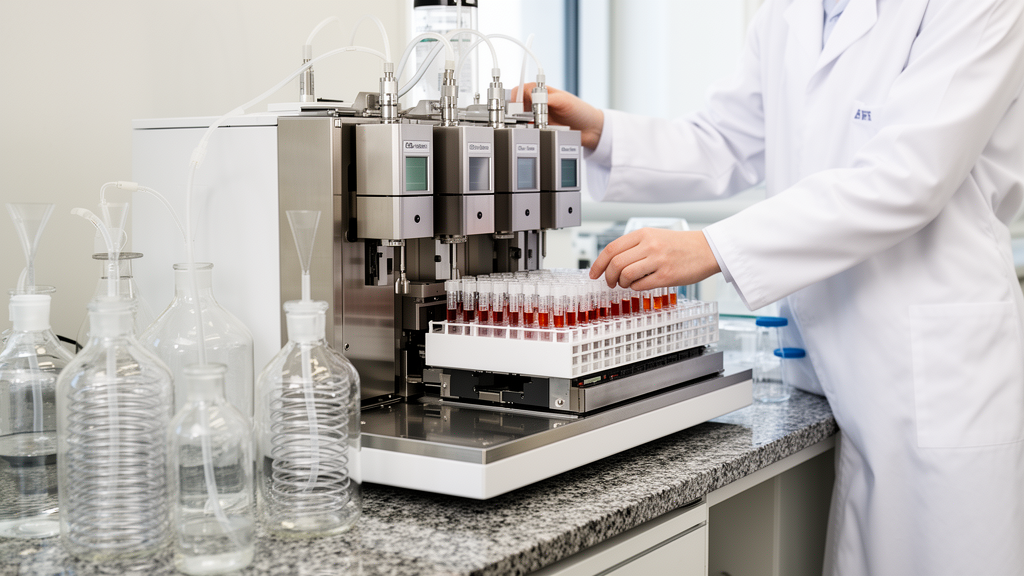
Pharmaceutical researchers have developed and validated an environmentally sustainable, stability-indicating reversed-phase high-pressure liquid chromatography method capable of simultaneously quantifying three active ingredients in combined cardiovascular medications. The analytical procedure focuses on the concurrent estimation of chlorthalidone, amlodipine, and olmesartan medoxomil in fixed-dose combination formulations. By implementing an Analytical Quality by Design framework in conjunction with green chemistry principles, the research team designed a streamlined assay that minimizes toxic chemical waste and solvent consumption while maintaining rigorous separation efficiency and analytical reliability for pharmaceutical quality testing.
The target therapeutic substances address hypertension and cardiovascular complications through distinct but complementary mechanisms. Chlorthalidone operates as a thiazide-type diuretic that promotes the relaxation and widening of blood vessels to enhance circulation, reduce blood pressure, and alleviate edema associated with heart failure and renal insufficiency. Olmesartan medoxomil serves as an antihypertensive medication that reduces the workload on the heart by dilating vascular structures. Amlodipine functions as a calcium channel blocker indicated for hypertension management and chest pain arising from coronary artery disease. Combining these agents into a single fixed-dose formulation provides substantial therapeutic utility, yet it presents notable analytical challenges during routine batch release and stability monitoring.
Conventional reversed-phase liquid chromatographic methods documented in the literature for individual or combined determinations of these active compounds frequently rely on hazardous organic solvents that generate substantial chemical waste. To address these ecological drawbacks, the investigators established an analytical strategy emphasizing sustainable alternatives, specifically employing water-based systems and bio-derived ethanol. The Analytical Quality by Design methodology offered a structured, risk-based pathway to optimize experimental parameters, systematically mitigate sources of variability, and conserve laboratory resources without sacrificing operational robustness or data integrity.
Method optimization relied on response surface methodology utilizing a central composite design executed through specialized design software. The investigators designated pump flow rate and column oven temperature as critical process parameters, evaluating their direct, quadratic, and interactive effects on critical quality attributes such as chromatographic retention time, peak asymmetry, and theoretical plate count. An experimental design matrix comprising eleven systematic runs alongside conditioning injections yielded a quadratic mathematical model. Statistical assessment revealed a design efficiency of 68.7 percent, an average predicted variance of 5.4, and variance inflation factors approximating 1.00 across model terms, confirming a stable and reliable experimental design space.
The finalized chromatographic configuration utilized a Sunniest C18 stationary phase column measuring 150 millimeters in length by 4.6 millimeters internal diameter with a 5.0-micrometer particle size. The optimized mobile phase consisted of an aqueous phase containing 0.1 percent triethylamine adjusted to pH 2.4 combined with ethanol in a 65:35 volume-to-volume ratio. Delivering this mobile phase at a flow rate of 1.5 milliliters per minute with a column oven temperature maintained at 30 degrees Celsius achieved sharp baseline resolution and desirable peak symmetry across all three active compounds. Spectrophotometric detection was conducted at a wavelength of 245 nanometers using a photodiode array detector.
Comprehensive method validation in conformance with International Council for Harmonisation Q2(R2) guidelines confirmed the operational capability of the optimized protocol. Linearity was established across a range spanning 50 percent to 150 percent of the nominal test concentration, yielding correlation coefficients exceeding 0.99 for all three analytes. Repeatability evaluations demonstrated method precision with values of 98.9 percent for chlorthalidone and 101.4 percent for both amlodipine and olmesartan medoxomil, with relative standard deviations remaining comfortably below the two percent threshold. Intermediate precision testing conducted across different days and independent analysts produced mean absolute differences below 2.0 percent, verifying between-run reproducibility.
Accuracy assessments conducted across five distinct concentration levels in triplicate yielded individual percentage recoveries between 97 percent and 103 percent, with overall mean recovery percentages falling within the narrow 98 percent to 102 percent acceptance range. The specificity of the technique was verified by analyzing blank diluent, formulated placebo matrices, and known process-related impurities for all three therapeutic substances. No co-eluting peaks or matrix interferences appeared at the retention windows of the principal drugs, and spectral analysis confirmed peak purity values greater than 0.950 under all tested conditions.
The stability-indicating capacity of the procedure was challenged through rigorous forced degradation experiments exposing the drug combination to stress factors including acid, alkali, oxidation, elevated temperature, and light. Chlorthalidone and olmesartan medoxomil experienced severe degradation under acidic conditions with 0.1 normal hydrochloric acid, losing 66.8 percent and 77.9 percent of parent content, while amlodipine exhibited moderate degradation of 6.3 percent. Alkaline exposure using sodium hydroxide produced 54.4 percent degradation in olmesartan medoxomil and 22.5 percent in amlodipine, whereas chlorthalidone demonstrated stability with only 1.2 percent degradation. Across all stress regimes, peak purity metrics remained intact without co-elution from degradation fragments.
Sample preparation procedures and solution stability were likewise systematically verified to confirm routine operational viability in laboratory environments. Filter compatibility assessments determined that filtering test solutions through 0.45-micrometer nylon filters while discarding the initial two milliliters of filtrate eliminated membrane adsorption effects, yielding assay results fully comparable to centrifuged preparations. Furthermore, stability investigations indicated that both reference standards and prepared tablet solutions remained intact and chemically stable for up to 12 hours under autosampler storage conditions maintained at 5 degrees Celsius.
Quantitative appraisal using established green analytical metrics verified the environmental credentials of the completed protocol. Assessment via the Analytical Green Metrics Score produced a value of 123.24, alongside a Green Analytical Procedure Index score of 77 and an Analytical GREEnness score of 0.81, while the sample preparation framework registered an AGREEprep score of 0.69. Together, these metrics substantiate significant reductions in solvent toxicity, waste generation, and electrical consumption, confirming that systematic Quality by Design planning can successfully align pharmaceutical analytical compliance with sustainable laboratory standards.
The investigation also established the fundamental physicochemical profiles of the three cardiovascular agents alongside specific sample handling protocols. Chlorthalidone presents as a white crystalline powder possessing a molecular weight of 338.8 grams per mole and the chemical formula C14H11ClN2O4S. Olmesartan medoxomil exhibits a molecular weight of 558.6 grams per mole with the formula C29H30N6O6, whereas amlodipine possesses a molecular weight of 567.05 grams per mole and the formula C26H31ClN2O8S. Standard preparations dissolved 40.0 milligrams of olmesartan medoxomil, 25 milligrams of chlorthalidone, and 15 milligrams of amlodipine besilate in 75 milliliters of ethanol within a 100-milliliter flask under sonication before dilution to volume. Commercial tablet assays sampled twenty crushed dosage units, transferring powder equivalent to 20.0 milligrams of olmesartan medoxomil, 12.5 milligrams of chlorthalidone, and 5 milligrams of amlodipine into a 50-milliliter flask with 20.0 milliliters of ethanol, followed by ten minutes of sonication, solvent dilution, and nylon filtration.
Selecting optimal chromatographic conditions required iterative mobile phase adjustments and stationary phase screening to resolve initial co-elution problems. Preliminary trials utilizing an ethanol and water mobile phase at a 10:90 ratio caused an olmesartan medoxomil impurity peak to merge directly with chlorthalidone. Raising the organic fraction to a 20:80 ratio yielded only minor separation improvements. Adjusting the aqueous component to pH 2.5 with orthophosphoric acid markedly enhanced peak symmetry, while incorporating one milliliter of triethylamine eliminated peak distortion for amlodipine before finalizing the 35:65 solvent proportion. Furthermore, comparative column screening tested C8, cyano, phenyl, and C18 stationary phases. The C8 and cyano packings produced inadequate retention and poor resolution, while phenyl exhibited erratic symmetry, demonstrating that C18 provided superior baseline separation.
The forced degradation protocol evaluated environmental stress susceptibilities through precise chemical and physical exposures. Acid hydrolysis treated powdered tablets with 5.0 milliliters of 0.1 normal hydrochloric acid at 80 degrees Celsius for 30 minutes before sodium hydroxide neutralization. Alkaline degradation held samples in 0.1 normal sodium hydroxide at 80 degrees Celsius for 60 minutes before acid neutralization. Oxidative stress exposed samples to a 10 percent hydrogen peroxide solution at 80 degrees Celsius for 60 minutes before quenching with sodium metabisulfite, resulting in minimal parent degradation. Solid-state thermal degradation maintained crushed powder at 80 degrees Celsius in an oven for 72 hours. Photolytic testing subjected tablets to 1.2 million lux hours accompanied by 254-nanometer ultraviolet radiation over seven days in a photostabilization chamber, which induced only minor overall degradation.
Specificity was confirmed against nine distinct synthesis impurities and degradation analogs without chromatographic interference. The method fully separated chlorthalidone from chlorthalidone related compound A and chlorthalidone dichloro analog. Olmesartan medoxomil resolved cleanly from olmesartan dimer impurity and general olmesartan related impurities, while amlodipine demonstrated baseline separation from amlodipine related compounds A, D, and F, amlodipine ethyl analog, and hydroxyethyl phthalyl amlodipine. To evaluate green chemistry compliance, the investigators applied distinct assessment frameworks: the Analytical Method Greenness Score quantified energy consumption, reagent toxicity, and solvent volume; the AGREEprep metric evaluated sample preparation steps; the AGREE score measured overall operational sustainability; and the Complex Green Analytical Procedure Index compared ecological impacts across the full testing workflow.
These stress profiles offer direct guidance for formulation scientists developing stable commercial dosage forms. Because chlorthalidone and olmesartan medoxomil exhibited profound susceptibility to acidic and basic hydrolysis, the authors emphasized implementing careful excipient selection and precise pH control in finished products. Incorporating antioxidant excipients protects formulations vulnerable to oxidative breakdown, while protective packaging and storage controls prevent light exposure and photolytic degradation during transport. Additionally, filtration saturation trials confirmed that both 0.45-micrometer nylon and PTFE/G membrane filters produced recovery values comparable to centrifuged preparations provided the initial two milliliters of filtrate are discarded.
Subject of Research: Simultaneous quantification of fixed-dose cardiovascular drugs using analytical quality by design and green liquid chromatography
Article Title: Analytical quality by design (AQbD) approach for the simultaneous quantification of FDC in a cardiovascular drug by RP-HPLC method
Article References: Thorat, V., Alave, S., & Bagul, V. (2026). Analytical quality by design (AQbD) approach for the simultaneous quantification of FDC in a cardiovascular drug by RP-HPLC method. Future Journal of Pharmaceutical Sciences, 12(1), Article 55. https://doi.org/10.1186/s43094-026-00985-w
Image Credits: AI Generated
DOI: 10.1186/s43094-026-00985-w
Keywords: reversed-phase HPLC, analytical quality by design, chlorthalidone, amlodipine, olmesartan medoxomil, central composite design, green analytical chemistry, forced degradation studies, ICH Q2(R2), fixed-dose combination, cardiovascular pharmaceuticals, method validation, chromatographic optimization, green metrics, stability-indicating assay, pharmaceutical quality control
News Source: Ophelia Keating. (November 13, 2026). Researchers Optimize Green Liquid Chromatography Method for Simultaneous Cardiovascular Drug Analysis. Scienmag.