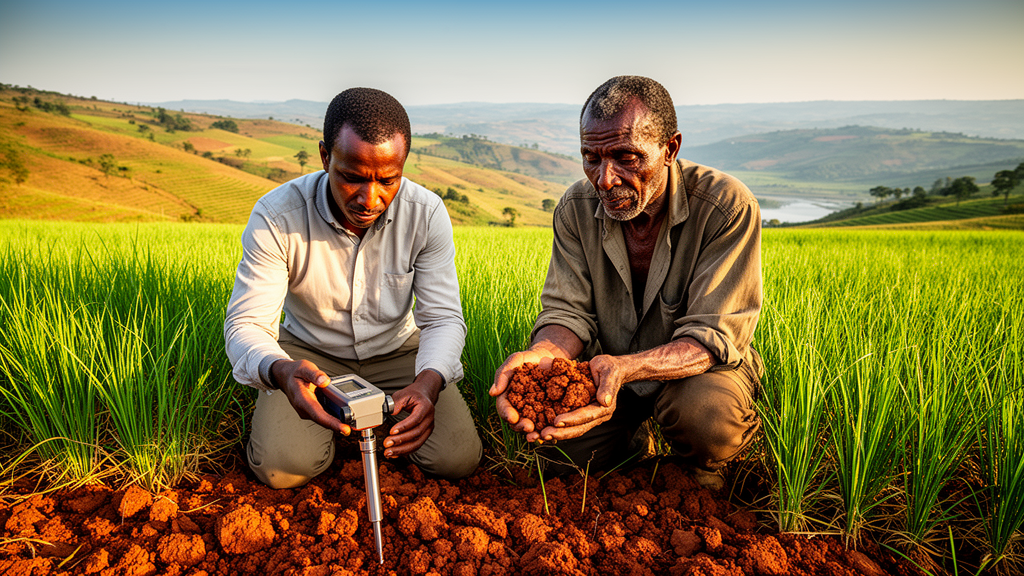
Researchers investigating agricultural land degradation in Ethiopia have linked local farmers’ qualitative judgments of soil conditions with formal laboratory measurements across the Upper Blue Nile Basin, establishing that subjective grower observations significantly correlate with empirical chemical testing while reflecting a relative severity gradient rather than absolute pH thresholds. The investigation, led by Belstie Lulie at the College of Agriculture and Environmental Sciences at Bahir Dar University, evaluated how smallholders in the region recognize, interpret, and manage acidic farmland. Although farmers demonstrated an acute awareness of crop degradation and identified key field management issues, their reliance on late-stage visible crop symptoms underscores an urgent requirement for accessible, field-level analytical testing tools to inform soil fertility interventions before severe yield losses occur.
Soil acidity represents a critical land degradation challenge across sub-Saharan Africa, where it restricts regional crop yields and places substantial pressure on food security frameworks. In Ethiopia, approximately half of all rainfed agricultural acreage experiences acidification, with roughly 12 percent categorized as strongly to extremely acidic, registering pH values below 5.5. The Upper Blue Nile Basin constitutes a vital agricultural zone within the country yet suffers from particularly acute acidification dynamics. Historical and contemporary management frameworks have predominantly relied upon top-down administrative models that prioritize standardized chemical interventions, notably lime distribution. However, these centralized strategies frequently demonstrate limited adaptability to heterogeneous local conditions, overlooking traditional management strategies cultivated by smallholders over successive generations.
To investigate the convergence of empirical pedology and local knowledge systems, the research team implemented a cross-sectional household survey throughout 2022 within the Amhara Region. The field protocol began with pre-survey reconnaissance involving a rapid rural appraisal and an initial pilot assessment encompassing 50 participants to refine investigative parameters. The team subsequently applied a multistage sampling design across three administrative districts selected specifically for their pronounced acidification profiles: Machakel, Baso Liben, and Banja. From each district, the researchers randomly selected one kebele, the smallest administrative unit in Ethiopia, identifying Debre Kelemua, Limichim, and Sankit Lidet as the primary survey localities.
Across the three selected kebeles, the research team surveyed 292 randomly chosen farming households, drawing 96 respondents from Debre Kelemua, 96 from Limichim, and 100 from Sankit Lidet. Through structured survey instruments, the investigators classified smallholders into three distinct perceptual categories based on their assessment of local soil acidity severity: high acidity, reported by 67 households; medium acidity, reported by 194 households; and low acidity, reported by 31 households. This perceptual stratification provided an operational baseline to compare qualitative rural appraisals directly against standardized pedological criteria.
Following household categorization, the team conducted stratified random soil sampling across the study area, obtaining a total of 146 composite soil samples directly from agricultural plots. This sampling strategy ensured balanced geographic and perceptual representation across the full continuum of farmer-reported acidification. In the laboratory, researchers conducted standardized chemical and physical evaluations, measuring active soil pH in water suspensions and documenting soil morphology using the standard Munsell soil color classification system. These laboratory-derived values provided the empirical benchmarks necessary to validate smallholder observations.
Analytical results revealed that farmers almost universally rely on visual, late-stage crop performance indicators rather than early subterranean changes to identify soil acidification. More than 97 percent of surveyed farmers recognized substantial yield reductions as a principal indicator of acid-damaged ground, while over 90 percent cited stunted crop growth. When evaluating the primary agronomic causes of acidification, respondents identified the absence of crop rotation, poor field management—including continuous mono-cropping and associated soil compaction—and inadequate soil reclamation practices, such as minimal lime distribution, complete removal of crop residues, and improper organic fertilizer management, as the three predominant driving factors behind land degradation.
Perceptions regarding the origins of soil acidification shifted markedly depending on the severity assigned to individual plots. Smallholders managing fields classified as highly acidic primarily attributed the problem to absent crop rotation, the complete omission of fallow intervals, and sustained deficits in general field management. Conversely, among households managing plots designated as possessing medium or low acidity, more than 50 percent cited external and inputs-based drivers, specifically intense rainfall patterns and the continuous application of synthetic mineral fertilizers, as the primary agents inducing soil acidification.
Statistical evaluation confirmed that smallholders’ subjective acidity rankings were significantly correlated with laboratory-measured soil pH, demonstrating that local observational methods track actual chemical gradients. However, laboratory assays showed that numerous plots across all groups fell into very strongly to extremely acidic classifications, exposing an important disconnect between subjective perceptions and absolute chemical status. The researchers clarified that high, medium, and low classifications assigned by farmers function as relative measures of comparative severity within an environment that is already broadly acidified, rather than precise alignments with formal pH benchmarks. Consequently, fields judged by local managers as having low acidity were frequently revealed by laboratory testing to be severely acidified in absolute terms.
Field management surveys demonstrated varied adoption of adaptive agronomic strategies among local smallholders. Farmers reported widespread use of organic soil amendments, the cultivation of bitter white lupin, and the retention of crop biomass on agricultural plots. Crop rotation was actively practiced on more than 70 percent of land classified by farmers as medium or high acidity, while approximately two-thirds of all examined holdings featured physical soil conservation structures. Organic inputs were utilized across nearly all farming units, with compost representing the most ubiquitous amendment. Manure application was concentrated heavily within medium-acidity areas, whereas green manuring using bitter white lupin was utilized predominantly on medium- to high-acidity fields.
In contrast to organic amendments, chemical remediation through agricultural lime exhibited substantial inconsistency across the surveyed population. Nearly half of the participating farmers reported that they applied no lime to their holdings, with non-application rates proving highest within the low-acidity classification cohort. Among the subset of farmers who utilized lime, application schedules deviated considerably from standardized extension targets: 13 percent applied recommended quantities once every five years, while 28 percent applied recommended rates on a three-year cycle. Within the high-acidity category, approximately 45 percent of lime-applying farmers maintained a three-year application frequency.
Synthesizing these findings, the study highlights that while smallholder communities possess substantial experiential insight into land degradation, their reliance on visible vegetative symptoms prevents proactive intervention prior to crop damage. Because farmers’ experiential ratings represent relative severity rather than absolute chemical thresholds, integrating low-cost, decentralized soil testing tools into rural advisory services is critical. The research team recommends promoting accessible field testing kits, incorporating acid-tolerant crop rotations and nitrogen-fixing trees, providing precise lime guidance, and deploying alternative legume systems through participatory research that combines indigenous agroecological insights with formal soil chemistry.
The investigation in the Upper Blue Nile Basin directly addressed long-standing divisions in Ethiopian agricultural policy, where top-down interventions have historically prioritized centralized lime application over local adaptation. Although rural farming communities maintain generations of accumulated agroecological knowledge, formal agricultural frameworks and scientific research programs have largely excluded these traditional observations. Most prior domestic research concentrated narrowly on measuring lime remediation efficacy, frequently ignoring how traditional adaptive practices compare with scientific diagnostics. By establishing how smallholder perceptions align with laboratory testing across Machakel, Baso Liben, and Banja, the research team sought to build scientific support for more inclusive and adaptable regional land management policies.
The study specifically pursued three core research objectives across the surveyed kebeles of Debre Kelemua, Limichim, and Sankit Lidet: documenting how smallholders perceive the root drivers and pervasive agricultural impacts of soil acidity, evaluating the specific management measures growers employ to counteract degradation, and bridging subjective appraisals with laboratory measurements of cultivated acreage. Before deploying the full household questionnaire across the 292 participant families, the investigators refined their field inquiries using a rapid rural appraisal and a preliminary 50-person pilot survey. These preparatory phases allowed the team to capture both environmental variations and local management traditions prior to formal composite soil sampling and chemical testing.
Beyond documenting existing practices, the researchers highlighted key biological and operational solutions to improve degraded farmlands. The team noted that smallholders can mitigate acidity by increasing organic fertilizer amendments and adopting structured crop rotations centered on acid-tolerant plants. Traditional organic methods such as spreading compost and incorporating bitter white lupin as green manure provide practical soil conditioning that aligns closely with scientific soil conservation principles. Because current lime distribution remains highly variable across acidity gradients, developing targeted guidance that aligns corrective lime rates with precise empirical testing remains a critical priority for local agricultural extension services.
To translate these findings into lasting policy improvements, the study authors outlined several targeted recommendations for regional land administration. They emphasized introducing alternative legume rotation systems and planting nitrogen-fixing trees to strengthen soil health alongside traditional organic amendments. Furthermore, fostering participatory research initiatives that actively unite farmer knowledge with empirical soil chemistry can bridge the gap between rural experience and scientific assessments. Combining affordable, decentralized testing tools with participatory agronomic programs ensures that smallholder communities receive accessible diagnostic support while actively shaping regional soil reclamation strategies.
Subject of Research: Soil acidity assessments and farmer management strategies in the Upper Blue Nile Basin
Article Title: Integrating farmer perceptions and scientific assessments: a study on soil acidity in the Upper Blue Nile Basin, Ethiopia
Article References: Integrating farmer perceptions and scientific assessments: a study on soil acidity in the Upper Blue Nile Basin, Ethiopia. Original publication (Bibliographic details unavailable.)
Image Credits: AI Generated
DOI: Not provided
Keywords: soil acidity, Upper Blue Nile Basin, Ethiopia, Bahir Dar University, soil pH, agricultural lime, bitter white lupin, crop rotation, soil management, smallholder farmers, land degradation, Amhara Region, compost, green manure, household survey, soil sampling, participatory research, Munsell soil color
News Source: Denise Maddox. (November 13, 2026). Upper Blue Nile Study Links Farmer Observations With Measured Soil Acidity. Scienmag.