A new plant biology investigation has identified transcriptional and metabolic disruptions associated with the suppression of adventitious root formation in pumpkin rootstocks grafted with watermelon scions. Adventitious root organogenesis represents an essential step for propagating grafted seedlings, yet suppression during specific scion-rootstock pairings presents a recurring obstacle in horticulture. Researchers examined the regulatory mechanisms driving root inhibition using a double-root-cutting experimental system across three defined treatments: non-grafted pumpkin, self-grafted pumpkin, and watermelon-grafted pumpkin.
Histological examinations revealed structural differences at the graft junction and hypocotyl tissue, indicating that the watermelon scion is associated with severe inhibition of cellular dedifferentiation and primordium initiation within the rootstock. While non-grafted and self-grafted pumpkin tissues initiated root primordia, the watermelon scion disrupted early cellular reorganization events required for nascent root primordium formation.
Hormonal profiling across the experimental cohorts demonstrated that watermelon-grafted pumpkin rootstocks accumulated significantly lower levels of indole-3-acetic acid and higher concentrations of trans-zeatin riboside than non-grafted and self-grafted pumpkin controls at 12 days after grafting. This imbalance disrupted the requisite auxin-to-cytokinin ratio necessary for adventitious root induction, demonstrating that abnormal phytohormone equilibrium corresponds directly with organogenic arrest.
Chemical complementation and perturbation assays validated the physiological impact of this hormonal shift on root development. Exogenous applications of indole-3-acetic acid and lovastatin successfully promoted adventitious root formation in watermelon-grafted pumpkin rootstocks. Conversely, treating self-grafted pumpkin rootstocks with 6-benzylaminopurine markedly suppressed adventitious rooting, reinforcing the role of elevated cytokinin signaling in arresting root initiation.
Metabolomic profiling identified significant abundance alterations in 32 key metabolites distributed across the tryptophan, zeatin, and flavonoid or phenylpropanoid biosynthetic pathways. Key shifted compounds included indole-3-carboxylic acid, adenine, isopentenyladenosine, quercetin, and kaempferol, indicating broader downstream biochemical adjustments taking place within the inhibited rootstock tissue.
Transcriptomic analyses highlighted a pronounced enrichment of plant hormone signal transduction pathways, marked by the systemic down-regulation of primary auxin signaling components including AUX1, AUX, ARFs, and SAUR. Concurrently, elements of the cytokinin signaling cascade, specifically AHPs and ARRs, exhibited up-regulation in the watermelon-grafted rootstock tissues.
Weighted gene co-expression network analysis further revealed specific transcription factors and functional hub genes strongly correlated with adventitious root suppression. The network identified the transcription factors CAMTA3, ILR3, and AIL6 alongside functional hub genes GH3.6, CYP735A, LOG, XTH, and Pectinesterase as core elements associated with the compromised organogenesis.
Overall, the combined molecular profiles characterize how scion-induced hormonal, transcriptional, and metabolic disruptions inhibit adventitious rooting in pumpkin rootstocks. By delineating specific regulatory hub genes and metabolic checkpoints, the findings establish candidate genetic targets aimed at improving rooting efficiency in grafted cucurbit cultivation systems.
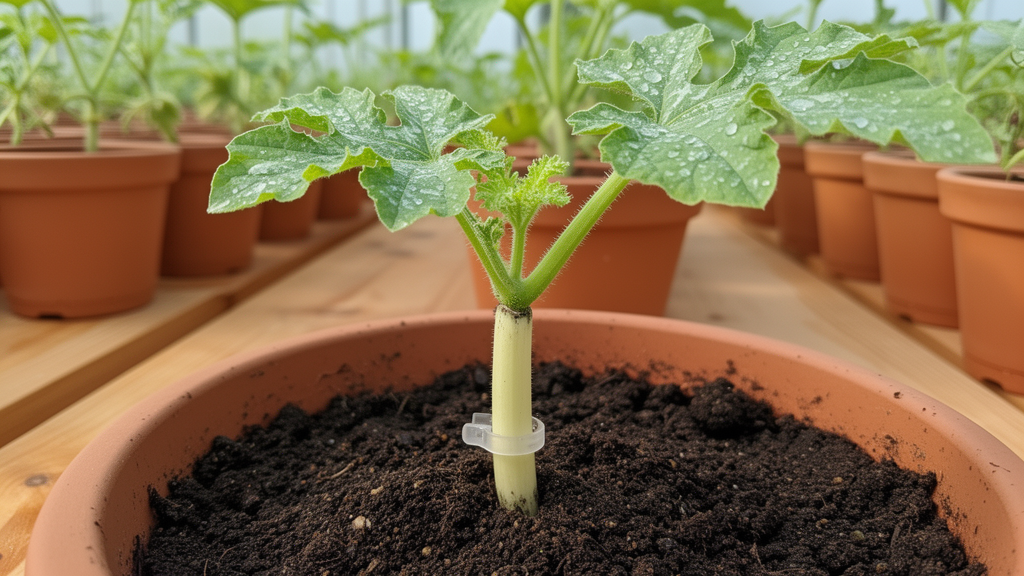
The experimental setup specifically contrasted non-grafted pumpkin (designated P), self-grafted pumpkin (P/P), and watermelon-grafted pumpkin (W/P) to isolate scion-dependent effects from the general mechanical wounding caused by grafting. By comparing these distinct configurations under identical cutting conditions, the investigators tracked how signals originating in the watermelon scion transmit downward across the graft union to alter rootstock cell fate. The histological evidence demonstrated that while pumpkin tissues grafted onto identical pumpkin rootstocks retained the capacity to dedifferentiate cells and establish primordia, the presence of the heterologous watermelon scion arrested these essential early developmental steps.
These findings provide concrete genetic and biochemical entry points for addressing propagation failure in commercial cucurbit operations. By detailing how the disruption of auxin-to-cytokinin balance coordinates with the transcriptional down-regulation of auxin response pathways and the stimulation of cytokinin signaling, the researchers outlined the molecular cascade underpinning poor root initiation. Consequently, candidate hub regulators such as GH3.6, CYP735A, LOG, and cell-wall-modifying enzymes like XTH and Pectinesterase offer defined targets for interventions designed to restore rooting competency in watermelon-pumpkin graft pairings.
Subject of Research: Molecular pathways of adventitious root inhibition in watermelon-grafted pumpkin rootstocks
Article Title: Combined transcriptomic and metabolomic profiling identifies candidate pathways associated with adventitious root inhibition by watermelon scions in pumpkin rootstocks
Article References: Song, C., Wu, C., Liu, W., Tang, Y., Wang, T., Wang, Z., Niu, L., Dong, K., Jing, Y., Mi, G., Tian, B., & Ma, K. (2026). Combined transcriptomic and metabolomic profiling identifies candidate pathways associated with adventitious root inhibition by watermelon scions in pumpkin rootstocks. BMC Plant Biology. https://doi.org/10.1186/s12870-026-10329-8
Image Credits: AI Generated
DOI: 10.1186/s12870-026-10329-8
Keywords: adventitious rooting, grafting, pumpkin rootstock, watermelon scion, plant biology, indole-3-acetic acid, trans-zeatin riboside, transcriptomics, metabolomics, hormone signaling, cellular dedifferentiation, primordium initiation, WGCNA, lovastatin, cucurbits, organogenesis, auxin
News Source: Drew Townsend. (November 13, 2026). Watermelon Scions Inhibit Adventitious Rooting in Grafted Pumpkin Rootstocks. Scienmag.