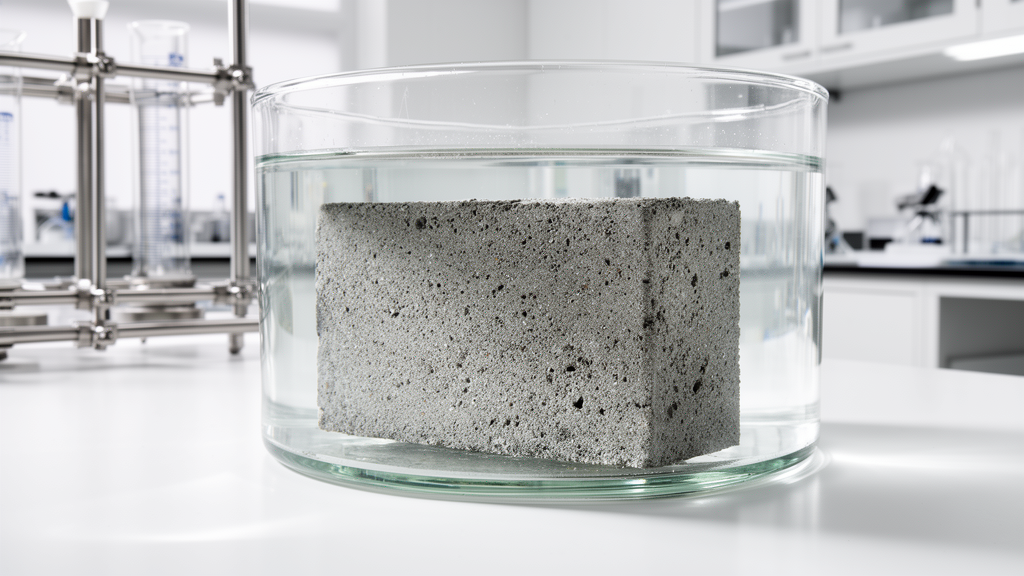
Incorporating industrial wastewater treatment sludge from the detergent industry into cement mortar can effectively immobilize hazardous heavy metals while serving as a partial cement replacement, according to a laboratory evaluation published in Discover Applied Sciences. The investigation examined the environmental safety, microstructural changes, and durability of mortar mixtures formulated with varying proportions of industrial waste.
The increasing generation of wastewater treatment sludge across the manufacturing sector poses significant environmental and waste management challenges, primarily driven by elevated heavy metal concentrations and limited safe disposal options. In response to these disposal constraints, researchers evaluated the feasibility of utilizing detergent-industry sludge to substitute between 5% and 30% of standard cement in mortar formulations.
To rigorously assess how the modified cementitious matrix behaves over time, the research team linked standard dynamic leaching procedures under NEN 7345 with non-destructive electrical measurements. This experimental setup paired dynamic leaching with electrochemical impedance spectroscopy and complex conductivity to monitor the progression of heavy metal immobilization alongside ionic transport mechanisms and microstructural alterations.
Throughout the leaching protocol, investigators quantified the release of several key heavy metals, specifically arsenic, chromium, zinc, copper, iron, and aluminum. The concentrations of these leached elemental constituents were determined using inductively coupled plasma optical emission spectrometry across different mortar formulations and exposure intervals.
The chemical analyses revealed that while the total release of heavy metals increased as a function of elapsed leaching time and higher sludge content, the measured values consistently remained below permitted regulatory thresholds. These findings demonstrate that the cementitious matrix maintains high immobilization effectiveness even as higher volumes of detergent waste are introduced into the mixture.
Complementary non-destructive electrical measurements using electrochemical impedance spectroscopy identified two distinct dielectric relaxation phenomena within the composite materials. The experimental data associated these relaxation processes with localized dielectric polarization and the internal diffusion of ions navigating the cement mortar network.
As the proportion of wastewater treatment sludge was systematically increased, the measured electrical impedance across the samples decreased, accompanied by measurable shifts in relaxation times. The authors attributed these electrical alterations directly to the progressive evolution of the pore structure and modifications in internal ionic transport properties occurring during the leaching process.
Beyond evaluating contaminant retention, the authors noted that linking dynamic leaching procedures directly to complex conductivity measurements enabled continuous characterization of pore connectivity. Because standard leaching assessments alter the internal network of cementitious materials over time, tracking dielectric responses provided non-destructive verification of how physical channels and ionic pathways evolve under environmental exposure.
The study specifically focused on mortar formulations containing replacement rates spanning from 5% up to 30% sludge, highlighting the potential for high-volume solid waste diversion in construction applications. By tracking the transport of ions alongside localized polarization effects, the experimental approach helps establish how internal porosity governs durability while ensuring heavy metals remain immobilized within the solid matrix.
Subject of Research: Evaluation of detergent wastewater sludge as a cement replacement in mortar for heavy metal immobilization
Article Title: Sustainable valorization of detergent industry wastewater treatment sludge in cement mortar for heavy metal immobilization and durability assessment
Article References: El Hafidi, E. M., Lizoul, B., Safoui, R., Mghaiouini, R., Zouitine, A., Chahid, E. G., Elfanaoui, A., El Moznine, R., Hajjaji, A., & Laasri, S. (2026). Sustainable valorization of detergent industry wastewater treatment sludge in cement mortar for heavy metal immobilization and durability assessment. Discover Applied Sciences. https://doi.org/10.1007/s42452-026-09638-2
Image Credits: AI Generated
DOI: 10.1007/s42452-026-09638-2
Keywords: cement mortar, wastewater treatment sludge, detergent industry, heavy metal immobilization, dynamic leaching, NEN 7345, electrochemical impedance spectroscopy, complex conductivity, pore structure, dielectric relaxation, ionic transport, ICP-OES, arsenic, chromium, zinc, copper, sustainable construction materials, waste valorization
News Source: Denise Maddox. (November 13, 2026). Detergent Sludge in Cement Mortar Effectively Immobilizes Heavy Metals During Leaching Tests. Scienmag.