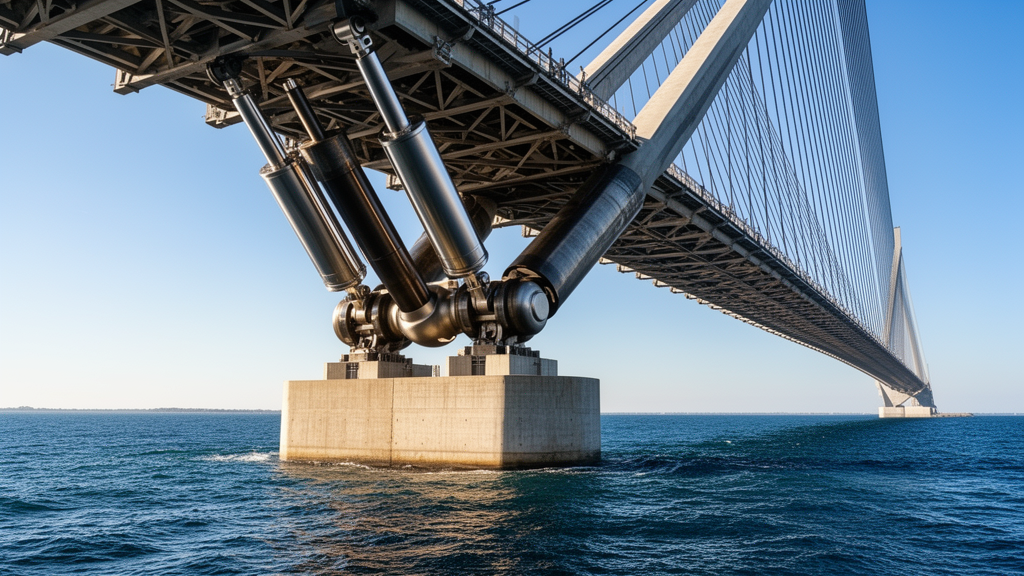
A computational investigation into long-span bridge dynamics has demonstrated that coupling support vector regression with a particle swarm optimization algorithm allows engineers to accurately model complex seismic responses and identify optimal damper parameters for cable-stayed bridges. Published in the journal Advances in Bridge Engineering, the study developed by a research team including Yuehan Sun, Yulin Zhan, Yan Huang, Junhu Shao, and colleagues addressed a long-standing challenge in earthquake engineering: determining the ideal properties of fluid dampers without incurring the prohibitive computational costs of exhaustive finite element trial calculations. By training machine learning surrogates on finite element simulation databases, the researchers captured the pronounced nonlinear dynamics of structural components during ground motion and identified precise damper configurations that minimize structural internal forces while keeping girder movements within allowable operational thresholds.
Cable-stayed bridges are widely constructed across arterial highway networks and expressways due to their structural efficiency and capacity to bridge extensive spans. However, the geographic siting of these critical transit routes frequently intersects active seismic regions, where ground vibrations can induce severe structural distress, leading to massive financial losses and catastrophic disruptions to municipal transportation networks. In cable-stayed systems, structural configurations are broadly separated into fixed assemblies and floating or semi-floating assemblies depending on the connectivity established between the bridge towers and the main girders. Floating systems, which lack rigid longitudinal constraints at the tower-girder interface, exhibit lower overall stiffness and lengthened fundamental vibration periods, characteristics that tend to generate substantial longitudinal displacements during earthquake excitation. Fixed systems possess higher overall rigidity and shorter fundamental natural periods, which restrain displacements but dramatically amplify internal stresses within the structural members.
To reconcile the conflicting demands of minimizing internal stresses while controlling displacement excursions, structural designers routinely install energy dissipation hardware between the bridge tower and girder assembly. Separating load-bearing functions from energy absorption mechanisms allows specialized damping devices to absorb and dissipate the major portion of seismic kinetic energy, shielding the primary load-bearing members from severe plastic damage. Among available structural vibration reduction mechanisms—which include viscoelastic, friction, metallic yielding, and viscous fluid designs—viscous dampers have found extensive deployment in landmark civil infrastructure projects, such as the Sutong Yangtze River Bridge, where large fluid dampers with maximum damping capacities reaching 3025 kN enhance structural damping across a 1088-meter central span. The nonlinear restoring force generated by such fluid dampers is determined by structural velocity governed by empirical force relations involving a damping coefficient and an exponential damping index.
Despite the demonstrated efficacy of viscous dampers, improper parameter specification can severely impair performance or accelerate mechanical degradation. Long-span bridges undergo continuous reciprocating motion under normal traffic loads and aerodynamic buffeting, which subjects damper internal hydraulic seals to persistent wear. Over time, seal degradation can result in hydraulic fluid leakage, depressurizing the damper cylinder and completely eliminating energy dissipation capabilities. A notable failure occurred at the San Francisco-Oakland Bay Bridge in 2013, where fluid dampers leaked just three years after installation, necessitating the total replacement of 96 large dampers at enormous expense. Consequently, selecting exact damping parameters that optimize seismic energy dissipation while managing operating forces remains an imperative engineering task that traditionally required hundreds of repetitive, computationally intensive time-history simulations.
To overcome these limitations, the research team constructed a high-fidelity three-dimensional numerical model of a representative single-tower cable-stayed bridge utilizing the commercial finite element software MIDAS. Spatial beam elements were utilized to discretize the inclined main tower, main deck beam, pier caps, transition piers, and pile groups, while spatial truss elements represented the cable stays. Master-slave kinematic constraints linked the stay cables to the deck and tower anchoring zones to enforce displacement compatibility, and elastic bearings represented the longitudinal connections between the main beam and tower. Soil-structure interaction effects along the pile foundations were incorporated using an equivalent soil spring stiffness formulated via the m-method, with pile bases modeled as fixed boundaries. Two longitudinal viscous dampers were placed between the inclined tower and the main girder to mitigate longitudinal seismic response.
Seismic input for the numerical evaluations was developed from a synthetic horizontal ground acceleration time-history curve representing a 10 percent probability of exceedance across a 50-year design reference period at the bridge site. To account for multi-directional earthquake effects, a synchronized vertical ground motion component was incorporated by scaling the horizontal acceleration record by a factor of 0.5. The structural investigation monitored specific displacement, bending moment, and shear responses across critical locations: the horizontal displacements of beam control points TH1 and TH3, alongside the bending moments generated at the tower body section and the tower base section. Initial parametric sweeps isolating the damping coefficient and the damping index revealed strong non-monotonic behavioral patterns. For damping index values between 0.2 and 0.4, beam displacements initially dropped and then slightly increased with escalating damping coefficients, while index values above 0.4 resulted in monotonic displacement decreases. Similarly, tower base moments showed a distinct decrease-then-increase pattern when the damping coefficient rose under low damping indices.
To systematically train and evaluate surrogate response surface models across the parameter space, the authors compared two experimental design methodologies: central composite design and full factorial design. Testing a central composite face-centered design with nine sample points degenerated onto a two-dimensional parameter square demonstrated severe limitations in capturing structural nonlinearity. The central composite face-centered model yielded weak coefficients of determination: 0.4257 for TH1 displacement, 0.4207 for TH3 displacement, 0.3861 for tower body moment, and an unacceptable negative coefficient of minus 0.1573 for the tower base moment, failing to describe the underlying mechanical response. In contrast, an 81-run full factorial design evaluated across nine parameter levels provided an expansive data foundation, which was divided via average point sampling into a 41-case training set and a 40-case validation set. Global polynomial regression on this dataset delivered strong fits for linear girder displacements with coefficients of determination near 0.969, but struggled with tower base moments, attaining an R-squared of only 0.7957.
To resolve the severe fitting deficits encountered with global quadratic formulations on highly nonlinear structural responses, the researchers analyzed three-dimensional spatial response surfaces and implemented two advanced modeling strategies: partitioned polynomial regression and support vector regression. While dividing the design space into manual sub-regions boosted partitioned polynomial regression coefficients of determination to 0.9726 for base moments and 0.9924 for tower body moments, the authors noted that manual geometric partitioning relies on visual inspection of 3D plots, a subjective process that becomes impossible in higher-dimensional design spaces involving three or more variables. Support vector regression, operating through kernel transformations to project nonlinear parameters into high-dimensional feature spaces, resolved these drawbacks entirely. The support vector machine surrogate achieved exceptional validation accuracy without manual space division or manual data normalization, producing coefficients of determination of 0.9928 for TH1 displacement, 0.9826 for TH3 displacement, 0.9673 for tower base moment, and 0.9946 for tower body moment.
With an accurate and computationally rapid support vector regression model established, the researchers coupled the surrogate equations with a particle swarm optimization algorithm coded in Python. Because cable-stayed bridge seismic safety evaluations focus primarily on mitigating bending moments at the critical tower base section—where internal forces are vastly greater than along the tower body—the optimization problem was formulated using a penalty function approach that fixed allowable girder displacement while minimizing tower base bending moment. The particle swarm configuration utilized a swarm size of 1000 particles, cognitive and social learning acceleration factors both set to 2.0, an inertia weight of 0.5, and a maximum termination limit of 1000 evolutionary generations, with bounded parameter searches corresponding to normalized damping variables.
The penalty function optimization revealed that tower base bending moments followed a non-monotonic curve with respect to deck displacement, initially dropping as TH3 displacement expanded before reversing upward once a critical displacement threshold was crossed. The global optimum established by the particle swarm algorithm identified an optimal damping coefficient of 4318 and a damping index of 0.38. At these precise damper settings, the single-tower cable-stayed bridge achieved a minimized tower base moment of 1,301,681.8 kN·m under the design seismic event, corresponding to a controlled TH3 beam end displacement of exactly 320 mm. The researchers concluded that combining full factorial sampling, support vector regression modeling, and particle swarm search provides a robust, highly efficient framework for damper parameter design, offering an analytical pipeline that can be readily generalized to other complex structural vibration mitigation challenges.
Subject of Research: Seismic performance optimization of cable-stayed bridge dampers using machine learning
Article Title: Research on seismic performance optimization of cable-stayed bridge dampers based on machine learning
Article References: Sun, Y., Zhan, Y., Huang, Y., Wang, Y., Shao, J., Chen, X., Ling, X., & Li, Y. (2026). Research on seismic performance optimization of cable-stayed bridge dampers based on machine learning. Advances in Bridge Engineering, 7(1), Article 4. https://doi.org/10.1186/s43251-025-00192-2
Image Credits: AI Generated
DOI: 10.1186/s43251-025-00192-2
Keywords: Cable-stayed bridge, Viscous dampers, Support vector regression, Particle swarm optimization, Seismic mitigation, Structural damping, Finite element analysis, MIDAS software, Central composite design, Full factorial design, Response surface methodology, Tower base moment, Beam end displacement, Nonlinear structural response, Earthquake engineering, Structural optimization
News Source: Denise Maddox. (November 13, 2026). Machine Learning and Particle Swarm Algorithms Optimize Cable Bridge Dampers Under Earthquakes. Scienmag.