A new hybrid deep learning framework integrating sequential image enhancement with an adaptive attention mechanism has achieved a test accuracy of 99.73 percent and an area under the receiver operating characteristic curve of 0.998 in classifying lung cancer histopathological images. Developed by researchers Piyush Bhushan Singh, Harsh Yadav, Jigyasa Awasthi, and Brijesh Kumar Chaurasia, the system combines a ResNet50 convolutional neural network backbone with a Sequential Image Enhancement Pipeline and a modified Dynamic Convolutional Block Attention Module. Tested on fifteen thousand microscopic tissue images from the publicly available Lung and Colon Histopathological Image Dataset, the computational pipeline successfully distinguished normal lung tissue from the two most prevalent forms of lung cancer, adenocarcinoma and squamous cell carcinoma. The investigation, published in Discover Imaging, demonstrated that pairing structured digital preprocessing with learnable attention scaling significantly surpassed conventional neural networks operating on raw slides, which reached a test accuracy of 93.2 percent. These findings provide experimental validation for combining multi-stage image normalization with dynamic feature recalibration in automated diagnostic workflows.
Lung cancer remains among the leading causes of cancer-related mortality across the globe, a reality heavily driven by the frequent absence of recognizable clinical symptoms during early disease stages. By the time diagnostic interventions occur, malignant growths have often advanced, severely compromising long-term patient survival rates. Definitive diagnostic confirmation relies fundamentally on the microscopic histopathological examination of excised tissue specimens, which provides vital cellular architecture necessary to identify specific malignancy subtypes. However, manual histopathological evaluation is inherently labor-intensive, subjective, and prone to diagnostic divergence among observers. The visual analysis of digitized glass slides is further complicated by inconsistencies introduced during laboratory slide preparation, including heterogeneous tissue staining, uneven illumination, optical blur, and low image contrast. These physical artifacts obscure fine cellular morphology, complicating automated computer-aided diagnosis. Standard convolutional neural networks frequently struggle with these variations, as shallow feature extractors become distracted by background staining discrepancies and miss subtle structural shifts between glandular and squamous tissue formations.
To address these persistent computer vision hurdles, the research team structured a multi-phase investigation examining how architectural depth, systematic image preprocessing, and adaptive attention mechanisms interact during feature learning. Standard convolutional architectures, including ResNet50, DenseNet121, InceptionV3, MobileNetV2, and Xception, have previously demonstrated competence in medical image classification through transfer learning with ImageNet initialization. Yet, when deployed directly on unenhanced histopathological slides, these networks exhibit bounded discriminatory power. In the team’s baseline experiments, a basic convolutional neural network trained directly on raw histological slides achieved a training accuracy of 94.1 percent and a test accuracy of 93.2 percent, displaying notable confusion between adenocarcinoma and squamous cell carcinoma classes due to overlapping morphological characteristics. Even established deep backbones without enhancement reached testing accuracies constrained between 92 percent and 97 percent. The authors identified a significant gap in the literature regarding controlled comparative trials that systematically benchmark baseline models against preprocessing-enhanced configurations and dynamic attention architectures under unified, identical experimental conditions.
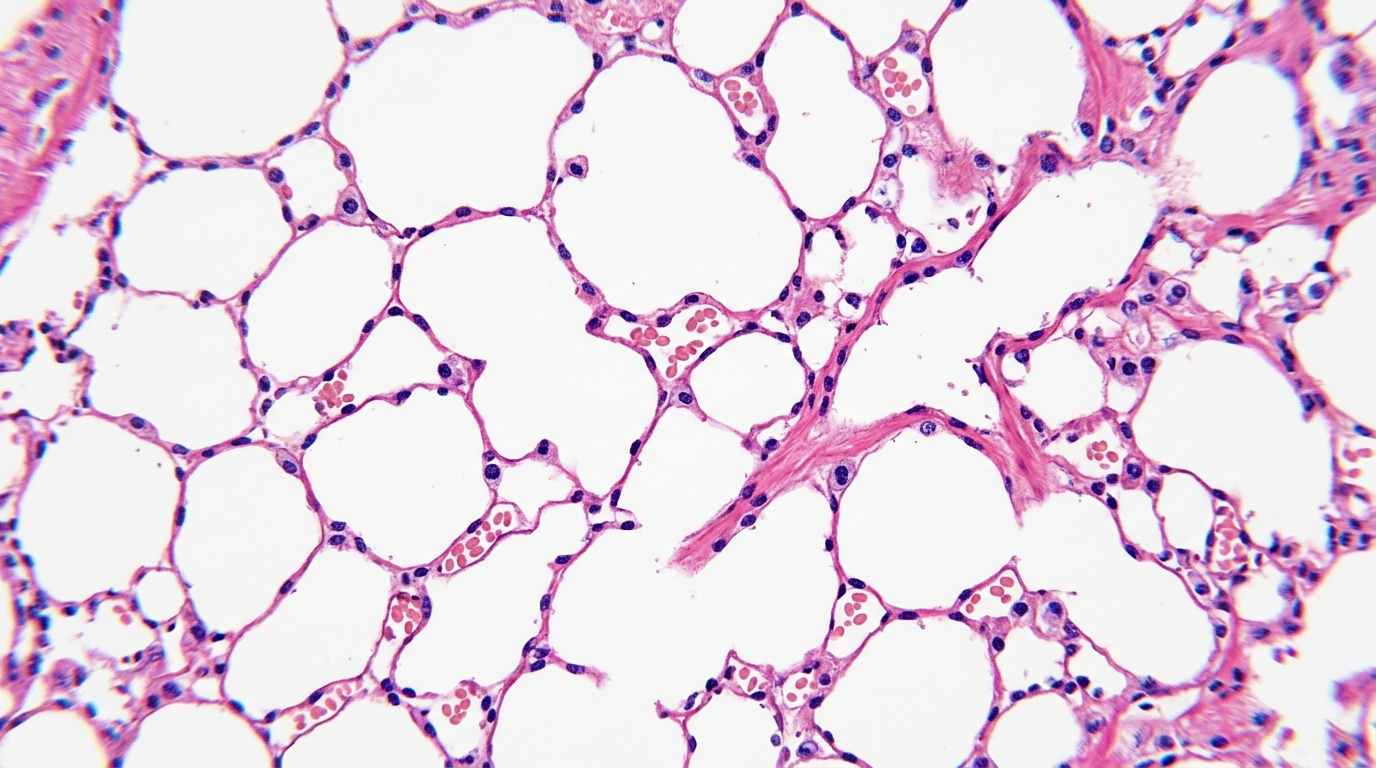
The empirical validation of the proposed diagnostic framework relied upon the benchmark LC25000 image dataset, specifically isolating fifteen thousand color histopathology images focused exclusively on pulmonary tissues. This curated collection encompasses three balanced diagnostic classes of five thousand images each: healthy lung tissue exhibiting normal alveolar structure, adenocarcinoma showing disordered gland architecture, and squamous cell carcinoma characterized by abnormal squamous differentiation. The researchers instituted a stratified sampling strategy to prevent distribution bias, partitioning the total dataset into seventy percent for model training, ten percent for validation monitoring, and twenty percent strictly reserved for independent testing. Every input slide was standardized to a uniform resolution of 224 by 224 pixels and normalized so that pixel intensity values mapped across a floating-point interval between zero and one. To combat network overfitting and improve model generalization, comprehensive data augmentation protocols were applied to the training set, incorporating random rotations within fifteen degrees, horizontal and vertical flips, scale zooming, and controlled brightness variations.
A central element of the study involved evaluating the Sequential Image Enhancement Pipeline, designed to standardize inputs and eliminate noise before features enter convolutional layers. The investigators devised five distinct sequential pipelines, designated P1 through P5, to systematically evaluate how the ordering of digital processing algorithms alters model feature extraction. These routines incorporated median blurring, Gaussian filtering, standard histogram equalization, Contrast Limited Adaptive Histogram Equalization, and morphological filtering. While pipeline P1 applied median blurring followed by histogram equalization, adaptive contrast enhancement, and morphological operations, pipeline P4 executed median blurring, morphological operations, adaptive contrast enhancement, and histogram equalization. Across all tested neural architectures, introducing structured image preprocessing yielded an immediate and consistent improvement of one to two percent in test accuracy over raw inputs. Pipeline P4 proved exceptionally capable when coupled with a ResNet50 baseline, generating a training accuracy of 99.0 percent and a test accuracy of 97.2 percent by sharpening cellular borders and improving nuclear visibility.
Building upon image enhancement, the authors introduced the Dynamic Convolutional Block Attention Module, placed immediately following the final convolutional layer of the backbone network. Traditional attention modules utilize static dual branches to apply channel-wise and spatial attention across extracted feature representations. In contrast, this dynamic implementation introduces an adaptive, learnable scaling factor designated as alpha, which dynamically recalibrates the magnitude of attention applied based on the underlying complexity of the feature map. The alpha scaling parameter is computed directly from the input feature representation through global average pooling linked to a fully connected layer governed by a sigmoid activation function. This mathematical design constrains alpha to a controlled positive range, allowing gradient backpropagation during training to optimize how strongly attention-weighted features augment the primary feature stream. By scaling the combined spatial and channel attention maps before joining them through a residual skip connection, the dynamic module sharpens diagnostic focus on dense tumor nuclei while suppressing irrelevant background stromal artifacts.
All network models were trained under rigorous and uniform optimization parameters to ensure fair experimental comparisons across baseline, enhanced, and hybrid iterations. With the exception of the scratch-trained baseline CNN, deep architectures leveraged transfer learning, initializing convolutional weights from ImageNet pretraining to exploit robust generalized representations. Network training utilized the Adam optimization algorithm alongside categorical cross-entropy loss functions, operating with a uniform mini-batch size of 32 for up to 50 epochs. An early stopping mechanism governed by a patience threshold of 10 epochs was enforced to arrest training when validation loss ceased to improve, directly preventing overfitting. Regularization was reinforced through dropout layers and L2 weight decay across network weights, while the learnable attention parameters governing the dynamic alpha factor were optimized concurrently with network weights at an adaptive learning rate of 0.00001. The consistency of these hyperparameters allowed the researchers to isolate performance variations specifically to architectural modifications and enhancement sequencing.
Experimental evaluations across the four planned testing phases clearly demonstrated the cumulative performance gains delivered by each component of the proposed system. While raw deep convolutional networks without enhancement attained testing accuracies between 92 and 97 percent, pairing these backbones with the Sequential Image Enhancement Pipeline lifted scores markedly, with an enhanced Xception model achieving 99.46 percent test accuracy. The complete proposed hybrid configuration—uniting the ResNet50 backbone, sequential enhancement preprocessing, and the alpha-scaled Dynamic CBAM—attained the highest overall performance, posting an unprecedented 99.73 percent testing accuracy. Statistical reporting across multiple independent trials confirmed high reliability, documenting a mean test accuracy of 99.73 percent with a narrow standard deviation of plus or minus 0.02 percent. Confusion matrix evaluations revealed perfect diagonal dominance with zero misclassifications for adenocarcinoma and near-flawless discrimination of squamous cell carcinoma, while the area under the receiver operating characteristic curve reached 0.998. The Wilcoxon signed-rank test confirmed that these diagnostic gains were statistically significant compared to baseline configurations.
Beyond classification metrics, the research evaluated the computational complexity and operational feasibility of deploying the proposed hybrid framework within realistic digital pathology environments. The fully configured ResNet50 architecture incorporating the sequential enhancement pipeline and the Dynamic CBAM encompasses approximately 25.2 million trainable parameters and requires 4.1 billion floating-point operations per single 224 by 224 pixel input image. Computational profiling conducted on an enterprise-grade NVIDIA Tesla T4 graphics processing unit equipped with 16 gigabytes of onboard memory recorded an average inference latency of approximately 25 milliseconds per image. Throughout inference execution, the complete pipeline maintained a modest GPU memory consumption profile of approximately 3.5 gigabytes. Because the sequential enhancement pipeline executes strictly as a deterministic image preprocessing stage, it introduces no additional trainable network weights or parameter overhead. Although the dynamic attention module inserts additional mathematical weighting operations, the resulting computational footprint remains thoroughly manageable for modern hospital graphics workstations and automated high-throughput laboratory screening workflows.
Despite the exceptional benchmark metrics reported, the investigators outlined clear operational boundaries and necessary technical milestones prior to clinical implementation. The current experimental validation was conducted exclusively upon the LC25000 benchmark dataset using a single fixed data split, meaning multi-center clinical trials and external validations across diverse laboratory cohorts remain essential. The authors noted that real-world pathology laboratories exhibit substantial domain shifts caused by distinct tissue preparation protocols, varied chemical stain reagents, and differing digital whole-slide scanner hardware. Furthermore, the present study analyzed pre-cropped image patches rather than whole slide images, which necessitate automated patch extraction algorithms and multi-resolution analysis to manage multi-gigapixel files. The researchers also emphasized that future investigations should explore multimodal data integration, merging histopathological slides with radiological scans and genomic sequencing data. Additional research avenues will prioritize explainable artificial intelligence frameworks, stain normalization techniques, and lightweight model compression architectures to support scalable, real-time diagnostic systems across diverse medical institutions.
Subject of Research: Deep learning histopathology classification for lung cancer diagnosis
Article Title: Adaptive alpha-scaled dynamic CBAM integrated into a dynamic attention-guided hybrid deep learning framework for high-precision lung cancer histopathological diagnosis
Article References: Singh, P. B., Yadav, H., Awasthi, J., & Chaurasia, B. K. (2026). Adaptive alpha-scaled dynamic CBAM integrated into a dynamic attention-guided hybrid deep learning framework for high-precision lung cancer histopathological diagnosis. Discover Imaging, 3(1), Article 12. https://doi.org/10.1007/s44352-026-00034-5
Image Credits: AI Generated
DOI: 10.1007/s44352-026-00034-5
Keywords: lung cancer diagnosis, histopathology, deep learning, ResNet50, Dynamic CBAM, attention mechanism, image enhancement, adenocarcinoma, squamous cell carcinoma, LC25000 dataset, computer-aided diagnosis, convolutional neural network, transfer learning, CLAHE, feature extraction, medical image processing, ROC-AUC
News Source: Blake Davidson. (November 13, 2026). Dynamic Attention Deep Learning Framework Reaches 99.7 Percent Accuracy in Lung Histopathology. Scienmag.