A longitudinal qualitative investigation conducted in China reveals that patients with moderate to severe obstructive sleep apnea follow a staged developmental trajectory when adapting to positive airway pressure therapy. Published in Frontiers in Medicine, the study utilized Meleis’s transition theory to systematically map how patient experiences, psychological outlooks, and support requirements evolve over their initial three months of treatment. By tracking newly diagnosed participants from treatment initiation through successive follow-up intervals, the researchers identified three distinct operational phases: an initial transition stage after one week, an adjustment stage after one month, and a transitional stabilization stage after three months. The findings demonstrate that treatment adherence is not a static compliance metric determined solely at baseline, but rather a dynamic psychosocial process where patient hurdles shift from acute physical intolerance and cognitive misunderstandings toward complex social negotiations, motivational variability, and autonomous long-term health management.
Obstructive sleep apnea is defined as a sleep-related breathing disorder characterized by recurrent episodes of upper airway collapse, complete apnea, and hypopnea throughout sleep. As noted by the study authors, this condition represents an independent risk factor for serious cardiovascular diseases, metabolic abnormalities, and impaired daytime functioning. Although positive airway pressure therapy represents the primary first-line clinical intervention proven effective in improving sleep architecture, eliminating apnea episodes, reducing symptoms, and decreasing the risks of chronic complications, long-term patient compliance remains notoriously poor across clinical settings. Prior research cited in the investigation indicates that between thirty percent and fifty percent of prescribed patients demonstrate reduced adherence or completely discontinue device use within the first month of therapy. This widespread early abandonment substantially diminishes clinical efficacy and undermines therapeutic outcomes, presenting a persistent challenge for respiratory medicine specialists and healthcare practitioners tasked with managing chronic sleep disorders.
The research team observed that previous investigations examining adherence patterns were predominantly quantitative, focusing on isolated variables such as demographic profiles, baseline clinical severity, and technical device parameters. Furthermore, the limited qualitative inquiries exploring subjective patient experiences relied primarily on cross-sectional or retrospective designs, which failed to capture the fluid changes occurring in psychological states, behaviors, and supportive requirements over time. To establish a rigorous theoretical foundation, the authors utilized transition theory, which asserts that individuals facing health-related changes experience a dynamic adjustment period shaped by transition types, personal and societal conditions, and clinical intervention models. Within this analytical framework, initiating positive airway pressure represents a classic health-illness transition. Patients must adapt to complex mechanical equipment, navigate psychological conflicts, negotiate interpersonal dynamics, and integrate daily therapeutic regimens into their personal and professional routines, requiring structured healthcare interventions that correspond directly to their evolving phase-specific challenges.
Conducted at the Sleep Medicine Department of a tertiary hospital in Shandong Province, China, between March and July 2026, the study recruited participants through purposive sampling. To be eligible, individuals were required to be at least eighteen years old, newly initiating positive airway pressure therapy, and possess a confirmed polysomnography diagnosis of moderate to severe obstructive sleep apnea with an apnea-hypopnea index of fifteen or more events per hour. Eligible participants were conscious, possessed intact cognitive and verbal communication capacities, and provided written informed consent. Individuals with histories of sleep apnea surgical interventions or severe somatic, psychiatric, or cognitive comorbidities were excluded. The final cohort comprised twelve participants, ranging in age from twenty-eight to sixty-four years, whose apnea-hypopnea index values spanned from eighteen to forty-two events per hour. As detailed in the baseline characteristics, the cohort included diverse backgrounds, encompassing enterprise staff, factory workers, teachers, coal miners, self-employed individuals, and corporate managers.
Data collection was structured around three successive rounds of semi-structured interviews conducted at one week, one month, and three months post-initiation, with each recorded interview lasting approximately thirty minutes. The research team implemented rigorous quality-control protocols to safeguard procedural validity throughout data collection and qualitative analysis. Prior to interviewing, researchers documented reflective memos to identify their own clinical preconceptions regarding sleep apnea therapy, maintaining reflexivity throughout thematic coding to minimize subjective bias. Qualitative materials were evaluated using Colaizzi’s seven-step analytical approach, with two researchers independently coding the transcripts and resolving discrepancies through collective discussion. Member checking was systematically executed by returning transcripts to participants for factual confirmation and inviting selected subjects to review the extracted thematic structure. Data saturation determined the final cohort size: no novel themes emerged after the tenth interview, and recruitment was concluded at twelve participants after confirming thematic redundancy across all three longitudinal follow-up waves without subject attrition.
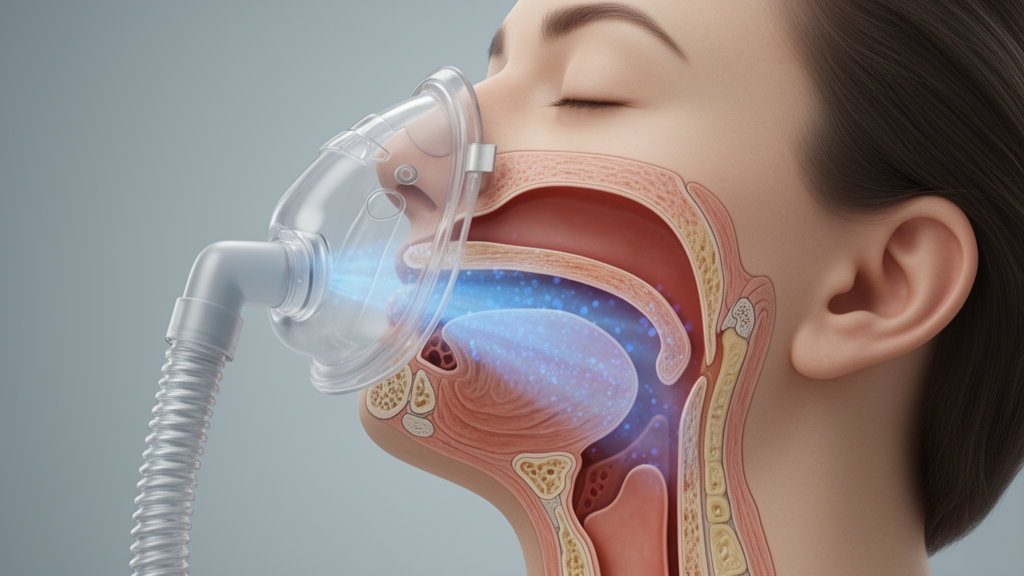
In the initial transition stage evaluated after one week of treatment, participants experienced acute physiological challenges that severely tested their tolerance of positive airway pressure. Subjects described substantial sensory discomfort, reporting that pressurized airflow felt intrusive, suffocating, or unnatural, severely disrupting nocturnal rest and undermining therapeutic confidence. Participant N3 reported struggling continuously with the airflow, describing sensations of nasal and oral blockage as if breathing were being forcefully coerced throughout the night without relaxation. Furthermore, ill-fitting or shifting masks generated significant sleep disturbances, as participant N6 recounted being repeatedly awakened when body movements triggered loud air leaks and hissing noises, resulting in sleep quality that felt markedly worse than sleeping without the apparatus. Similarly, participant N8 reported painful facial pressure and visible red indentations across the nasal bridge, noting that the claustrophobic feeling of physical restraint generated profound apprehension and resistance toward donning the mask each night.
Coupled with physical discomfort, the first week revealed pressing cognitive uncertainties and psychological barriers regarding device safety and operational principles. Lacking adequate health education, patients harbored significant misunderstandings; participant N4 voiced fears that an unexpected nocturnal machine shutdown might cause sudden suffocation, while participant N5 expressed anxiety that prolonged ventilation would cause the lungs to become lazy and permanently dependent. Participants also questioned whether daily use was mandatory, and participant N6 worried that long-term strap pressure would permanently deform facial bones. Psychologically, subjects reported bedtime repulsion, procrastination, and resentment toward perceived restrictions on personal freedom. Crucially, young and middle-aged participants experienced pronounced identity conflict and stigma. As illustrated by participant N2, donning the equipment made subjects feel uncomfortably labeled as sick patients, creating psychological resistance that hindered therapy initiation and aligned with existing clinical literature regarding disease labeling as a primary barrier to medical acceptance.
At the one-month adjustment stage, the initial novelty of treatment dissipated, shifting patient needs from learning how to operate the machine toward managing real-life conflicts and maintaining daily adherence. Participants confronted notable practical dilemmas when incorporating positive airway pressure into daily life. For instance, participant N5 described the severe inconvenience of transporting bulky hardware during business travel, coupled with concerns that operational noise would disturb others. Participant N11 experienced social embarrassment and feelings of alienation, concealing equipment from friends to avoid feeling like an outsider. Concurrently, therapeutic continuity was threatened by motivational fluctuations; once preliminary symptoms improved, some participants grew complacent and omitted nightly use. Participant N8 illustrated an unstable discontinuation-restart cycle, pausing therapy until family observations of renewed loud snoring prompted resumption. The authors noted that during this phase, adherence heavily depended on external cues, such as family supervision and financial investments in the equipment.
The adjustment phase also exposed immediate technical maintenance requirements, as prolonged operation prompted questions regarding humidifier water regulation, condensation, and sanitation schedules. Participants including N1, N7, and N9 sought explicit guidance on cleaning masks, replacing worn tubing, and maintaining mechanical components. By the three-month evaluation, participants entered the transitional stabilization stage, where therapeutic behaviors solidified and patients integrated treatment into their daily lives. Patients experienced demonstrable physiological improvements that provided powerful intrinsic motivation; participant N1 reported eliminated snoring and enhanced daytime energy, while participant N5 noted clear-headed morning alertness and improved workplace productivity. Rather than relying on subjective feelings alone, subjects sought objective clinical confirmation, with participant N8 expressing a strong desire for hospital reviews of nocturnal blood oxygenation data and residual apnea indices. Patients also sought guidance on long-term treatment planning, inquiring whether device use could be safely decreased or discontinued following clinical stabilization.
Crucially, the final stabilization phase witnessed patients evolving from passive care recipients into active health managers. Participants such as N7 and N1 demonstrated proactive health behaviors by independently regulating device usage without familial prompting, optimizing nutrition, and refining daily schedules. To support this progression, the authors recommended phased clinical interventions: initiating awake desensitization trials and graphical education explaining that devices assist rather than replace breathing during week one; implementing portable units, combined nursing-engineering maintenance, and digital data feedback via WeChat during month one; and establishing peer-support networks, monitored lifestyle interventions, and gradual pressure reductions during month three. Despite these clinical insights, the authors noted key limitations: follow-up concluded at three months without tracking extended adaptation, the sample was derived from a single center with predominantly educated urban participants, and family perspectives were omitted, indicating that future multicenter investigations are needed to establish comprehensive care protocols.
Subject of Research: Longitudinal qualitative analysis of patient adaptation needs during positive airway pressure therapy for obstructive sleep apnea
Article Title: Adaptation needs of patients with obstructive sleep apnea during positive airway pressure therapy: a longitudinal qualitative study based on transition theory
Article References: Zang, J., Zhao, W., & Gao, H. (2026). Adaptation needs of patients with obstructive sleep apnea during positive airway pressure therapy: a longitudinal qualitative study based on transition theory. Frontiers in Medicine, 13, Article 1954151. https://doi.org/10.3389/fmed.2026.1954151
Image Credits: AI Generated
DOI: 10.3389/fmed.2026.1954151
Keywords: obstructive sleep apnea, positive airway pressure, transition theory, patient adherence, qualitative research, sleep medicine, chronic disease management, respiratory therapy, Adaptation, needs, patients, obstructive
News Source: Gavin Prescott. (November 13, 2026). Study Traces Evolving Patient Adaptation Needs During Sleep Apnea Pressure Therapy. Scienmag.