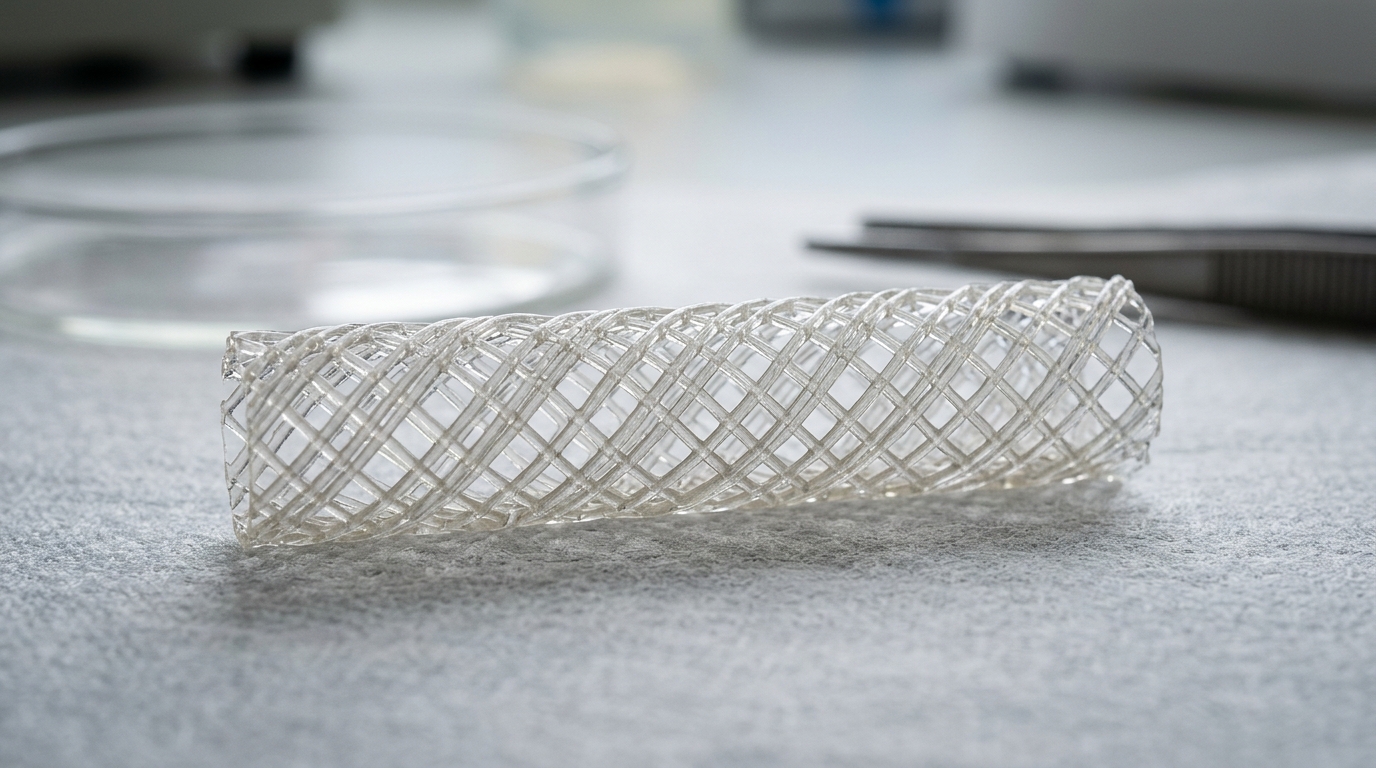
Biomedical researchers from Leibniz University Hannover and Hannover Medical School have established an additive manufacturing framework to fabricate biohybrid small-diameter vascular grafts that closely match the mechanical behavior of natural arteries while sustaining a stable, flow-aligned endothelial cell layer. Described in an experimental study published in Frontiers in Bioengineering and Biotechnology, the platform combines high-precision melt electrowriting of poly-ε-caprolactone with an adapted transluminal fibrin compression molding technique. By methodically varying structural print geometries, including winding angle, fiber diameter, and spacing, the team engineered tubular scaffolds capable of withstanding arterial burst pressures well above physiological norms. Following seven days of exposure to dynamic, pulsatile fluid shear stress reaching twenty dynes per square centimeter in a custom bioreactor, the seeded endothelial cells formed a confluent monolayer aligned in the direction of flow, demonstrating the feasibility of combining synthetic structural support with biological surface cues for vascular tissue engineering.
The clinical motivation for this manufacturing framework stems from the severe performance deficits observed in existing synthetic vascular grafts, particularly when applied to small-diameter vessels measuring less than six millimeters across. In contemporary clinical practice, approximately seventy-five percent of synthetic bypass conduits fail within three years of surgical implantation, predominantly due to the absence of a natural luminal endothelial cell lining. Without this functional biological interface, artificial conduits frequently induce blood protein adherence, platelet activation, rapid thrombosis, calcification, bacterial susceptibility, and intimal hyperplasia. Furthermore, conventional synthetic graft materials such as expanded polytetrafluoroethylene and woven polyethylene terephthalate exhibit excessive stiffness compared to native blood vessels. This compliance mismatch alters hemodynamic flow profiles, concentrates mechanical stress at anastomotic suture lines, and frequently precipitates graft occlusion, underscoring an urgent clinical demand for bioartificial conduits that reproduce both the structural compliance and bioactive properties of native vascular walls.
To overcome the architectural and material limitations inherent in conventional vascular substitutes, the research team turned to melt electrowriting, an advanced additive manufacturing method that deposits molten polymer filaments with micrometer-scale accuracy. Unlike conventional solution electrospinning, which relies on volatile organic solvents and typically yields non-woven meshes with random fiber orientation, melt electrowriting stabilizes a continuous, electrically drawn polymer jet onto a moving substrate without chemical solvents. The authors mounted a custom-built rotating print mandrel onto a commercial three-dimensional printer, enabling the automated execution of specialized numerical control toolpaths. By depositing molten polycaprolactone through micro-nozzles in an alternating zigzag pattern, the system constructed four-layer tubular scaffolds exhibiting uniform diamond-shaped pore configurations. Systematic pre-processing quality control confirmed that the absolute spacing deviation between adjacent fibers remained under four micrometers, ensuring that structural variations across the printed tubular walls did not compromise predictable mechanical performance.
The engineering team systematically evaluated the relationship between print geometry and mechanical stability by testing twelve distinct scaffold configurations using forty-five kilodalton polycaprolactone as a model polymer. Uniaxial tensile testing in both radial and longitudinal orientations revealed that the deposited winding angle dictates scaffold deformability. Stepwise adjustments from fifteen degrees up to seventy-five degrees produced a dramatic increase in radial Young’s modulus, climbing from 0.1 ± 0.1 megapascals to 8.7 ± 1.4 megapascals, accompanied by an increase in radial tensile strength from 0.2 ± 0.1 megapascals to 1.9 ± 0.3 megapascals. Conversely, longitudinal stiffness followed an inverse trajectory, decreasing steadily as winding angles steepened. Scaffolds fabricated with winding angles exceeding forty-five degrees exhibited radial mechanical approximations that matched the behavior of native porcine carotid artery controls, confirming that adjusting filament orientation effectively tunes tubular compliance to accommodate hemodynamic hoop stresses.
Subsequent architectural evaluations examined the structural effects of filament diameter and inter-fiber spacing on scaffold load-bearing capacity. Increasing the deposited fiber diameter from forty-four micrometers up to one hundred twenty-eight micrometers while keeping layer count constant generated significant reinforcement in longitudinal tensile strength and Young’s modulus, yet produced no statistically significant change in radial tensile values. In parallel investigations comparing two hundred micrometer and five hundred micrometer inter-fiber distances, reducing fiber spacing marginally elevated both radial and longitudinal modulus values without yielding statistically significant divergence between groups. Recognizing that blood vessels must predominantly withstand radial distension driven by arterial pressure waves, the investigators selected a 52.5-degree winding angle, a one hundred twenty-eight micrometer fiber diameter, and a five hundred micrometer fiber spacing as the optimal combination to achieve mechanical parity with arterial tissue while maintaining sufficient open porosity for matrix infiltration.
Armed with these optimized geometric parameters, the investigators transitioned the scaffold design from forty-five kilodalton polycaprolactone to an eighty kilodalton polymer variant to improve long-term hydrolytic degradation stability. Biomechanical characterization demonstrated that the higher molecular weight polymer preserved structural integrity while imparting enhanced elasticity. Uniaxial radial testing of pure eighty kilodalton scaffolds yielded a Young’s modulus of 1.12 ± 0.35 megapascals and a radial tensile strength of 3.89 ± 0.81 megapascals, comfortably matching the radial tensile strength benchmark of 2.45 ± 0.79 megapascals established from fresh porcine carotid artery segments. The authors emphasized that because a lower Young’s modulus corresponds to higher material elasticity, the slightly increased compliance of the long-chain polymer scaffold offers superior physiological buffering against cyclic blood pressure fluctuations compared to excessively rigid conventional prosthetic conduits.
Because the open grid architecture of melt electrowritten scaffolds is inherently permeable to fluid, the researchers integrated an adapted biological molding procedure to construct an impermeable, cell-supportive conduit wall. Placing the printed polymer scaffolds within a cylindrical molding chamber, the investigators injected a fibrin matrix solution formulated from human cryoprecipitated plasma, thrombin, factor XIII, and calcium chloride, followed by transluminal balloon compression at 0.5 bar for thirty minutes. Scanning electron microscopy confirmed that the compressed fibrin completely encapsulated the polymer filaments without structural delamination or interface voids. This biohybrid construction addressed a critical biological constraint: while hydrophobic polycaprolactone surfaces naturally impede cellular adhesion, the surrounding natural fibrin hydrogel replicates native extracellular matrix cues, creating a leak-proof structural barrier that directly promotes cell attachment and migration across the scaffold wall.
Mechanical characterization of the compressed biohybrid grafts demonstrated robust performance under rigorous pressure and suture stress challenges. Burst pressure assessments conducted using an automated peristaltic perfusion circuit revealed that forty-five kilodalton hybrid scaffolds sustained hydrostatic pressures up to 2,306 ± 336.8 millimeters of mercury, while eighty kilodalton constructs reached a mean burst pressure of 1,600.4 ± 502.85 millimeters of mercury, values substantially exceeding human physiological arterial pressures. In suture retention evaluations, the hybrid eighty kilodalton scaffolds achieved a maximum tearing force of 1.62 ± 0.29 newtons, compared to 3.23 ± 1.48 newtons for the forty-five kilodalton variant, satisfying standard surgical handling requirements. While radial tensile strength declined to 0.80 ± 0.20 megapascals following compression, longitudinal tensile strength remained steady at 1.07 ± 0.22 megapascals, closely mirroring native arterial controls measured at 1.00 ± 0.26 megapascals.
To evaluate cell adherence under hemodynamically realistic conditions, the researchers seeded the luminal surface of the hybrid scaffolds with porcine coronary artery endothelial cells within a specialized rotational bioreactor. Seeded scaffolds were maintained under alternating rotational agitation for six hours to promote uniform cellular attachment before continuous fluid perfusion commenced. The peristaltic pumping system applied physiological pulsatile flow, increasing wall shear stress incrementally from an initial baseline of 1.5 dynes per square centimeter up to a target level of twenty dynes per square centimeter, reflecting typical flow conditions within a six-millimeter vessel. The dynamic cultivation regime continued uninterrupted for seven days at thirty-seven degrees Celsius in a humidified atmosphere containing five percent carbon dioxide, while static control patches were cultured simultaneously under identical atmospheric conditions.
Immunohistochemical analysis using vascular endothelial cadherin, phalloidin, and Hoechst nuclear staining revealed the formation of a continuous, confluent endothelial monolayer across the luminal surface of the biohybrid graft. Under dynamic flow conditions, the endothelial cells displayed prominent reorganization of intracellular actin bundles and distinct morphological elongation. Quantitative image processing demonstrated that 49.38 percent of flow-conditioned endothelial cells aligned within fifteen degrees of the primary flow axis, compared to merely 10.21 percent under static cultivation conditions. Following seven days of continuous pulsatile bioreactor conditioning, tensile testing of the populated biohybrid graft indicated a radial Young’s modulus of 3.03 megapascals and a radial tensile strength of 1.56 megapascals, confirming that the cellularized construct maintained biomechanical stability closely aligned with native artery benchmarks of 3.31 megapascals and 2.45 megapascals.
To verify that the dense biohybrid wall did not impede vital nutrient transport, the researchers measured oxygen diffusion coefficients across the graft using a dual-chamber optical sensor system governed by Fick’s law. The experimental oxygen diffusion coefficient of the fibrin-coated polymer scaffold reached 5.489 × 10⁻¹⁰ ± 0.553 × 10⁻¹¹ square meters per second, exhibiting no statistically significant variance from native decellularized arterial tissue measured at 6.331 × 10⁻¹⁰ ± 1.732 × 10⁻¹⁰ square meters per second. The authors noted that while these proof-of-concept findings establish structural and mechanical feasibility, critical translational challenges remain unaddressed. The current platform does not yet incorporate vascular smooth muscle cells or fibroblasts necessary to recapitulate multi-layered vessel physiology, nor does it evaluate long-term in vivo tissue remodeling, matrix degradation kinetics, or systemic hemocompatibility. Future investigations will need to track progressive cellular infiltration and endogenous extracellular matrix synthesis under prolonged implantation to validate clinical efficacy.
Subject of Research: Biohybrid small-diameter vascular graft fabrication using melt electrowriting and dynamic endothelialization
Article Title: Mechanically stable, endothelializable vascular graft scaffolds fabricated by melt electrowriting
Article References: Krueger, J., Stadler, P., Baudisch, A., Helms, F., Heene, S., Ahrens, J., Renzelmann, J., Klingenberg, M., Wilhelmi, M., & Blume, C. (2026). Mechanically stable, endothelializable vascular graft scaffolds fabricated by melt electrowriting. Frontiers in Bioengineering and Biotechnology, 14, 1963671. https://doi.org/10.3389/fbioe.2026.1963671
Image Credits: AI Generated
DOI: 10.3389/fbioe.2026.1963671
Keywords: melt electrowriting, tissue-engineered vascular grafts, polycaprolactone, fibrin matrix, endothelialization, biomechanical characterization, pulsatile flow, shear stress, vascular tissue engineering, burst pressure, suture retention, porcine carotid artery, compression molding, additive manufacturing, endothelial alignment, oxygen diffusion, small-diameter conduits
News Source: Denise Maddox. (November 13, 2026). Melt Electrowritten Polymer Scaffolds Match Native Arterial Mechanics Under Pulsatile Flow. Scienmag.