Researchers investigating convective food dehydration have demonstrated that superimposing brief, low-duty-cycle thermal pulses onto hot-air drying can accelerate moisture removal in pineapple slices without degrading product quality. In a laboratory investigation conducted at Silpakorn University in Thailand, investigators evaluated the drying behavior of pineapple slices subjected to a base convective air temperature of sixty degrees Celsius paired with periodic heating interruptions. The experimental protocol contrasted continuous convective hot-air drying against three intermittent thermal regimes characterized by twenty-second heating bursts followed by relaxation periods lasting eight, ten, or twelve minutes. Among the tested configurations, the regime utilizing an eight-minute relaxation period achieved the most favorable balance, shortening total drying duration by twelve point five percent and raising the maximum drying rate by eighteen point one percent relative to uninterrupted drying. Concurrently, this moderate intermittency enhanced effective moisture diffusivity while preserving the optical and structural attributes of the fruit matrix under identical baseline convective conditions.
Pineapple, specifically the Pattavia cultivar of Ananas comosus, represents an economically vital tropical crop in Thailand that frequently experiences postharvest losses due to high perishability, elevated water content, and active tissue metabolism. While industrial drying is routinely employed to decrease water activity and suppress enzymatic and microbial degradation, conventional hot-air drying remains hampered by protracted processing times, substantial energy requirements, and adverse alterations in the cellular matrix. High concentrations of soluble sugars and thermal sensitivity make pineapple especially susceptible to tissue collapse, color browning, and diminished rehydration capacity during prolonged exposure to elevated temperatures. To mitigate these drawbacks, prior efforts have explored alternative methods such as microwave, infrared, vacuum, and freeze drying, yet these specialized technologies often present significant operational expenses and technical complexity. Consequently, research has increasingly focused on optimizing process configurations within conventional convective systems, using intermittent thermal interruptions that facilitate internal moisture redistribution without requiring complex or specialized drying hardware.
To evaluate this intermittent strategy systematically, the researchers constructed a custom laboratory-scale convective dryer fabricated from four-millimeter-thick acrylic sheets, providing an internal testing volume measuring twenty-five centimeters in width and fifty-five centimeters in both height and depth. The airflow subsystem employed a centrifugal fan that maintained a uniform chamber air velocity of one point zero meters per second with an experimental tolerance of plus or minus zero point one meters per second. Thermal regulation within the dehydration chamber relied on two independent electrical heating units rated at fifteen hundred watts each. A lower heating unit governed by proportional-integral-derivative control maintained a constant baseline drying air temperature of sixty degrees Celsius within a tolerance of one point five degrees Celsius. An upper heating element, connected to a digital timer relay, supplied the scheduled thermal pulses directly to the fruit layer, while a custom data acquisition system based on an Arduino Uno microcontroller recorded mass, humidity, and temperature at sixty-second intervals.
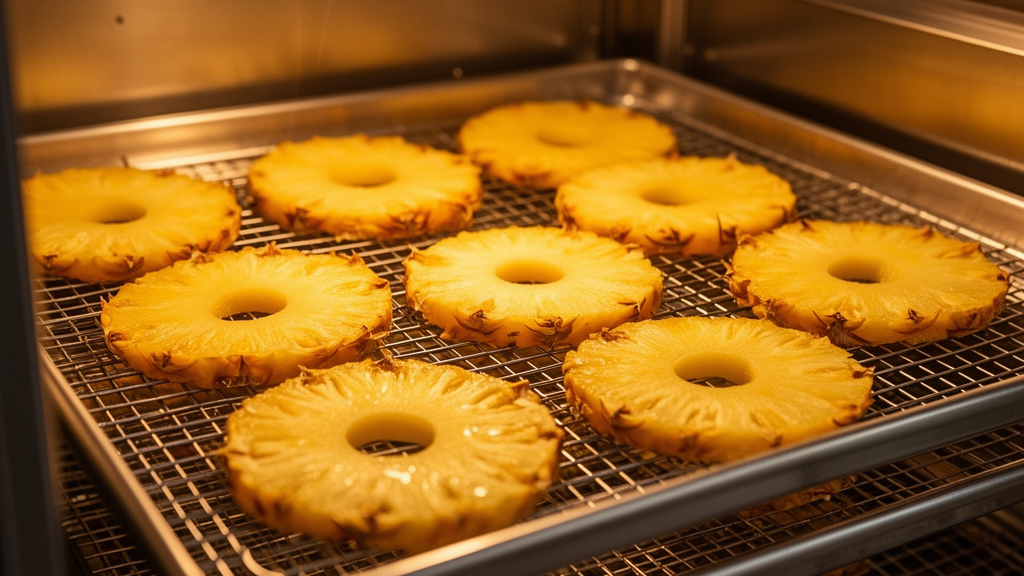
The experimental raw material comprised fresh Pattavia pineapples of uniform dimensions weighing between one point five and two point zero kilograms per fruit, procured from Pathommongkol Market in Nakhon Pathom Province, Thailand. Physical and chemical screening confirmed consistent baseline characteristics across specimens, showing a mean firmness of three point one zero newtons, an initial pH of three point six seven, and a total soluble solids concentration of fourteen point eight degrees Brix. Prior to thermal testing, the fruits were manually peeled, washed, and sliced into uniform cuboidal pieces measuring twenty millimeters in length, twenty millimeters in width, and five millimeters in thickness. For each test run, sixteen slices totaling one hundred eighty grams were arranged in a four-by-four grid on a Teflon-coated tray, with five-millimeter gaps separating adjacent pieces to promote unhindered airflow. Baseline testing determined an initial sample temperature of twenty-five degrees Celsius and an average initial moisture content of four point seven two grams of water per gram of dry solid.
The experimental methodology established four distinct operational protocols to examine how the duration of the relaxation phase influenced dehydration performance under uniform airflow and base temperature conditions. The continuous drying baseline, designated as regime TPR0, maintained steady convective airflow at sixty degrees Celsius without any auxiliary thermal pulses from the upper heater. The three intermittent regimes, designated as TPR8, TPR10, and TPR12, superimposed twenty-second heating activations from the auxiliary element followed by relaxation intervals of eight, ten, and twelve minutes, respectively. These intermittent configurations corresponded to total repeating cycle periods of five hundred, six hundred twenty, and seven hundred forty seconds, resulting in duty cycles of four point zero percent, three point two percent, and two point seven percent. Preliminary trials revealed that relaxation periods exceeding twelve minutes produced negligible divergence from continuous drying, whereas intervals below eight minutes triggered undesirable tissue darkening, establishing eight to twelve minutes as a functional operational window for convective pulse dehydration.
Analysis of dehydration kinetics demonstrated that moisture content decreased continuously across all experimental runs without exhibiting any constant-rate drying period, confirming that moisture removal remained strictly controlled by internal liquid diffusion. During active auxiliary heating pulses, inlet air temperatures temporarily climbed from the sixty-degree baseline to between sixty-seven and seventy degrees Celsius before returning to equilibrium during subsequent off periods. Mathematical fitting of thin-layer dehydration models, including the Lewis, Page, Logarithmic, and Midilli equations, demonstrated exceptional correlation with experimental observations, with all formulations yielding determination coefficients exceeding zero point nine nine six. The Midilli model achieved the highest predictive accuracy across all conditions, recording determination coefficients between zero point nine nine seven zero and zero point nine nine seven one. However, the estimated empirical constants within the Midilli formulation approached unity for the multiplicative factor and near zero for the linear term, revealing that the process conformed fundamentally to standard exponential Page-type kinetic behavior.
Evaluation of drying times revealed that the moderate intermittency condition achieved the fastest moisture extraction, reaching the termination target of zero point one zero grams of water per gram of dry solid in two hundred ten minutes. By comparison, continuous drying required two hundred forty minutes, while the ten-minute and twelve-minute relaxation regimes concluded at two hundred twenty-five and two hundred thirty-five minutes, respectively. The maximum drying rate recorded under the eight-minute relaxation schedule reached zero point zero eight five grams of water per gram of dry matter per minute, reflecting an eighteen point one percent elevation over continuous drying. Concurrently, effective moisture diffusivity estimated via Fickian diffusion equations increased from three point seven one times ten to the negative ninth square meters per second under continuous drying to four point zero four times ten to the negative ninth square meters per second under the eight-minute pulsed regime. This eight point nine percent enhancement demonstrated that cyclic heating promoted internal vapor transport without changing diffusion-driven mechanisms.
Structural and volumetric evaluations revealed notable distinctions in sample shrinkage alongside stable post-drying rehydration characteristics across all tested thermal treatments. Volumetric shrinkage among the dried pineapple slices ranged from sixty-five point eight four percent to eighty point two seven percent across the four drying configurations. Samples processed under the eight-minute intermittent regime exhibited the lowest mean shrinkage at sixty-five point eight four percent, which was statistically lower than the values observed under continuous drying and longer relaxation regimes, which hovered near eighty percent. Nevertheless, substantial replicate variability, exemplified by a standard deviation of twenty-one point eight one percent in the twelve-minute condition, underscores the presence of internal structural heterogeneity within the fruit matrix. Rehydration tests conducted in distilled water at twenty-five degrees Celsius demonstrated an initial rapid capillary water uptake over the first thirty minutes followed by diffusion-controlled saturation, with final rehydration capacity after one hundred twenty minutes showing no statistically significant variation among treatments.
Visual quality assessment confirmed that the application of intermittent thermal pulses did not intensify drying-induced discoloration beyond that generated by continuous hot-air processing at sixty degrees Celsius. Colorimetric measurements recorded in the standardized CIE L*a*b* space showed that dehydration produced substantial decreases in lightness along with marked increases in redness, characteristic of enzymatic browning, Maillard reactions, and sugar caramelization. Total color difference values relative to fresh fruit tissue ranged between twenty-three point zero eight and twenty-five point nine five across all dried batches, signifying pronounced visual darkening. Crucially, statistical comparisons revealed no significant differences in lightness, redness, yellowness, or overall color change among the continuous baseline and the three intermittent regimes, indicating that brief twenty-second temperature rises did not accelerate pigment breakdown. The cumulative thermal dose, rather than transient temperature fluctuations, governed color degradation, allowing the accelerated eight-minute intermittent regime to match the visual presentation of continuously dried pineapple.
Energy assessments indicated that the eight-minute relaxation regime achieved superior air-side thermal utilization efficiency at one point four one percent, compared with lower utilization efficiencies observed in continuous drying and extended relaxation schedules. Furthermore, calculated specific electrical energy consumption reached its lowest estimated level under the eight-minute intermittent protocol at one hundred seven point six six kilowatt-hours per kilogram of evaporated water. However, the investigators explicitly noted critical methodological boundaries: energy calculations represented first-order comparative approximations derived from air-side sensible heat transfer and nominal equipment power ratings rather than direct electrical meter measurements. Standby losses, wall dissipation, and dynamic control responses were not incorporated into the simplified thermodynamic model. The researchers concluded that while low-duty-cycle intermittency provides a practical strategy for accelerating convective drying and improving air-side thermal efficiency, comprehensive exergy analyses and direct electrical monitoring remain essential to validate total system performance in industrial fruit dehydration.
Subject of Research: Low-duty-cycle intermittent hot-air drying kinetics and quality of pineapple slices
Article Title: Enhancement of drying kinetics, quality attributes, and thermal efficiency of pineapple slices using low-duty-cycle intermittent hot-air drying
Article References: Choosri, W., & Choosri, T. (2026). Enhancement of drying kinetics, quality attributes, and thermal efficiency of pineapple slices using low-duty-cycle intermittent hot-air drying. Food Production, Processing and Nutrition, 8(1), Article 58. https://doi.org/10.1186/s43014-026-00410-y
Image Credits: AI Generated
DOI: 10.1186/s43014-026-00410-y
Keywords: pineapple drying, intermittent drying, drying kinetics, moisture diffusivity, food engineering, thermal efficiency, convective drying, food processing, Enhancement, drying, kinetics, quality
News Source: Alan Morgan. (November 13, 2026). Intermittent Hot Air Drying Accelerates Pineapple Processing and Boosts Thermal Efficiency. Scienmag.