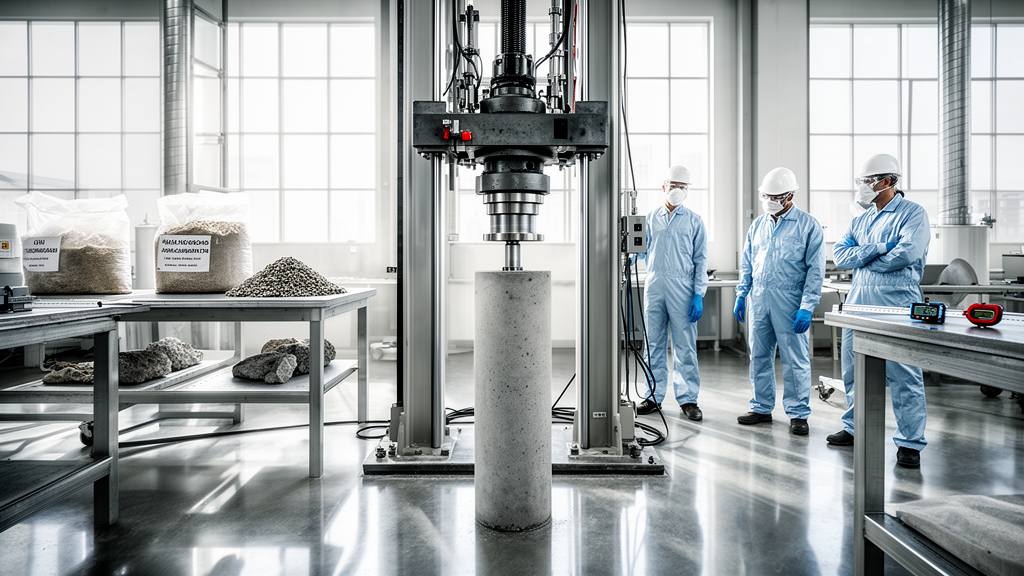
Replacing conventional concrete components with industrial, agricultural, and mineral waste streams can significantly reduce carbon dioxide emissions, embedded energy demands, and production expenditures while preserving or enhancing mechanical performance, according to an analytical review published in Discover Civil Engineering. Researchers evaluated data from thirty published experimental investigations conducted between 2007 and 2023 to determine the environmental and financial impacts of substituting cement, sand, and gravel. The analysis revealed that replacing Portland cement with waste materials reduces carbon dioxide emissions, embedded energy, and direct material costs by two to forty percent. Concurrently, substituting fine aggregate sand or coarse gravel with waste alternatives achieves reductions in emissions, embedded energy, and costs ranging from five to one hundred percent per cubic meter relative to conventional mixtures. Crucially, the synthesis identified key threshold formulations where structural performance improved: substituting five percent of cement with paper slag ash increased compressive strength by 15.22 percent, while replacing fifty percent of sand and eighty percent of gravel with marble waste elevated compressive strength by twenty-eight percent and 39.24 percent, respectively.
This research addresses the severe environmental burdens generated by worldwide construction and civil engineering activities. Concrete ranks as the most consumed substance on Earth after water, placing continuous extraction pressures on finite natural resources that are vulnerable to depletion. Globally, the construction sector accounts for approximately thirty-five percent of all carbon dioxide emissions while producing extensive solid debris, leaving forty-five to sixty-five percent of construction waste neglected in landfills. Within this footprint, the industry produces thirty percent of harmful global greenhouse gas emissions through cement consumption alone, as the cement industry is considered one of the primary sources of carbon dioxide. Cement production expands at an annual rate of 2.5 percent and represents the third largest industrial energy consumer after aluminum and steel manufacturing, consuming more energy than any other material. Globally, cement fabrication releases approximately 1,350 million tons of greenhouse gases into the atmosphere every year. Fabricating a single ton of cement requires roughly eighty units of electricity and consumes 1,500 volumes of raw materials, while random landfill disposal poses ongoing risks because certain neglected materials are flammable or chemically reactive.
Surveying prior literature, the authors highlighted that waste utilization in concrete encompasses agricultural residue, plant remains, fruit peels, recycled plastics, and glass alongside standard construction debris. Huang and colleagues conducted a bibliometric review on plastic waste in concrete, demonstrating that recycling offers environmental and health benefits over landfill dumping despite balancing functional trade-offs. In an earlier investigation, Zimbili and coworkers established that ceramic wall waste activates pozzolanic properties in clay due to high manufacturing temperatures, enhancing density, durability, compressive strength, and permeability when substituted for cement, sand, or gravel. Ulubeyli and Artir evaluated marble waste across conventional, self-compacting, and polymer concretes, finding enhancements in hardened conventional concrete tensile strength, elastic modulus, Schmidt rebound hardness, and ultrasonic pulse velocity, but no gains in polymer or self-compacting matrices. Bibliometric tracking by Ahmad and colleagues covering Scopus records from 2001 to 2021 noted that research peaked between 2016 and 2021 across 6,823 papers led by India, China, and the United States, yet unified assessments calculating embedded energy, emissions, and cost optimizations remained lacking in the published literature.
To address this analytical gap, the research team established a systematic selection strategy to examine thirty high-quality experimental studies published between 2007 and 2023. The methodology evenly divided the evidence base, allocating ten peer-reviewed papers to cement replacement, ten to fine aggregate sand replacement, and ten to coarse aggregate gravel replacement. Studies were gathered through major academic indexing platforms and databases, including Web of Science, Scopus, Elsevier ScienceDirect, Google Scholar, and SpringerLink. The systematic search query was formulated using main keywords including waste materials, partial replacement, mechanical performance, durability, compressive strength, and sustainable concrete. Eligible publications spanned peer-reviewed journals and conference proceedings that evaluated waste replacement ratios starting from five percent by weight for cement, sand, and gravel aggregates. The review period captured the technological progression of waste-modified concrete from initial benchmarks to recent techniques, while the authors excluded duplicate publications, studies failing to meet strict quality and ethical standards, and research outside the primary analytical scope.
The analytical framework modeled the reduction in carbon emissions and embedded energy per cubic meter of concrete using conversion factors from the Acorn and ALCORN methodologies. Because concrete represents a major carbon source through the energy-intensive extraction and thermal manufacturing of raw materials—which involves burning primary cement components—precise accounting of environmental indicators is essential. Reductions in embedded energy and carbon emissions were calculated by multiplying the exact weights of replaced cement, sand, or gravel by specific ALCORN conversion coefficients. For financial assessment, direct cost savings were determined based on material market prices in US dollars within the Iraqi local market. This approach enabled the team to correlate material replacement weights directly with carbon abatement, energy preservation, and commercial savings across diverse waste materials, while simultaneously examining how the substitution of gravel, sand, and cement influences concrete physical and mechanical characteristics.
In the cement replacement category, the analysis revealed substantial environmental savings, although binder efficiency limited the maximum substitution threshold to forty percent. Substituting cement with waste materials across replacement ratios from two to forty percent by weight reduced carbon dioxide emissions from 8.944 kilograms to 183.264 kilograms per cubic meter. Embedded energy decreased from 55.676 megajoules to 1140.8 megajoules, while financial savings increased from $0.967 to $19.817 per cubic meter. Mechanical testing across the compiled studies indicated that cement substitution generally reduced compressive strength, with minimal effects on other physical properties. Optimization modeling identified paper slag ash as the most effective cement substitute, producing a 15.22 percent increase in compressive strength at a five percent replacement ratio. Cow bone ash ranked as the second-best material, generating a 5.27 percent increase in compressive strength at a ten percent substitution level, whereas wood waste proved least effective, decreasing compressive strength by 8.59 percent at ten percent replacement.
Replacing natural sand with waste materials yielded substantial environmental benefits while allowing substitution levels extending from five percent to complete one hundred percent replacement. Across these replacement ratios, carbon dioxide emissions decreased from 0.205 kilograms to 4.97 kilograms per cubic meter of concrete. Embedded energy fell from 2.925 megajoules to 71.0 megajoules, and raw material cost savings expanded from $0.541 to $12.858 per cubic meter. Marble waste proved to be the optimal fine aggregate alternative, delivering a twenty-eight percent increase in compressive strength at a fifty percent replacement ratio. Several other fine aggregate substitutes also yielded structural improvements and resource savings, including copper slag, crushed concrete, industrial iron waste, crushed ceramic pottery, and recycled plastic, although their compressive strength improvements remained below the benchmark set by marble.
Coarse gravel aggregate substitution provided similar reductions in ecological impacts, supporting replacement levels from five percent up to one hundred percent of gravel weight. When gravel was replaced with waste materials, carbon dioxide emissions declined from 0.085 kilograms to 2.348 kilograms per cubic meter. Concurrently, embedded energy decreased from 1.691 megajoules to 46.958 megajoules, while material cost savings grew from $0.520 to $14.440. Mechanical properties generally improved across coarse aggregate replacements, with exceptions observed when incorporating ties, scrap rubber, concrete shell material, or wood residues. Marble waste was identified as the optimal coarse aggregate replacement, providing a 39.24 percent increase in compressive strength at an eighty percent substitution ratio. The comparative findings also demonstrated that scrap glass and industrial iron slag provide effective alternatives for coarse aggregate replacement, enhancing mechanical strength while preserving virgin gravel resources, though achieving lower strength gains than marble.
The investigation clearly demonstrated that not all waste materials produce viable structural concrete, identifying specific suboptimal substitutes that trigger severe mechanical deterioration. In the cement category, wood waste exhibited the poorest performance, causing an 8.59 percent decrease in compressive strength at a ten percent substitution ratio. In fine aggregate applications, wood waste was likewise the least effective material, causing a thirty-three percent loss in compressive strength at a ten percent replacement ratio. The most dramatic decline occurred in coarse aggregate substitution, where scrap rubber performed as the least effective material, causing an 86.3 percent drop in compressive strength at a fifty percent replacement ratio. Additional materials that decreased mechanical characteristics included ties, concrete shell, and wood for coarse aggregates, as well as polyvinyl chloride granules for fine aggregates.
The authors detailed five primary methodological limitations that govern their analytical findings and define boundaries for subsequent research. First, the thirty selected studies exhibited experimental heterogeneity in water-to-cement ratios, aggregate grading, mixing procedures, curing protocols, and laboratory temperatures, causing data fragmentation across the compiled database. Second, several primary studies lacked detailed statistical reporting, omitting variance data, standard deviations, and stress-strain curves. Third, economic calculations relied on regional pricing, currency exchange rates, inflation rates, and material availability within the Iraqi local market, meaning financial indicators reflect regional dynamics subject to commercial market fluctuations. Fourth, due to the lack of local environmental declarations, emissions and energy calculations utilized international ALCORN factors, introducing uncertainty when applied to regional power grids and manufacturing conditions that differ from global averages. Finally, variations in critical mix parameters prevented direct cross-mix comparisons, requiring performance evaluations to rely on internal reference controls and reflecting broad analytical trends rather than absolute, uniform material laws.
Subject of Research: Environmental, energetic, and economic analysis of waste materials as concrete component replacements
Article Title: Analytical study on eco-friendly concrete and its impact on carbon footprint and cost
Article References: Abdulabbas, A. H., Ali, A. H., Ismael, M. A., & Abd, S. M. (2026). Analytical study on eco-friendly concrete and its impact on carbon footprint and cost. Discover Civil Engineering, 3(1), Article 229. https://doi.org/10.1007/s44290-026-00636-2
Image Credits: AI Generated
DOI: 10.1007/s44290-026-00636-2
Keywords: concrete sustainability, carbon footprint reduction, embedded energy, cement replacement, sand substitution, gravel replacement, paper slag ash, marble waste, cow bone ash, compressive strength, waste recycling, industrial waste, civil engineering, Acorn method, cost savings, construction materials, mechanical performance
News Source: Sloane Callahan. (November 13, 2026). Waste Substitution Cuts Concrete Carbon Emissions While Boosting Compressive Strength. Scienmag.