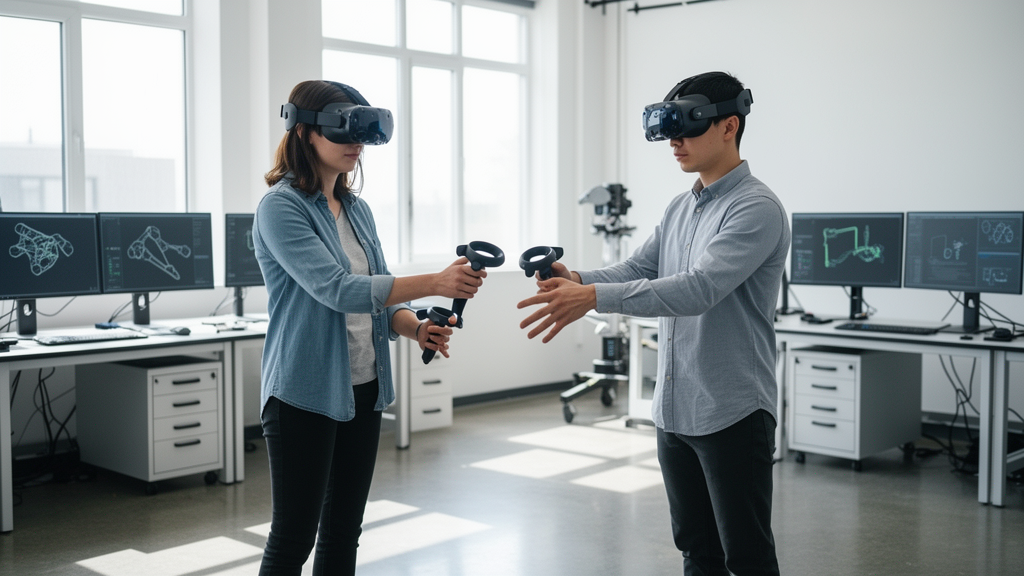
A collaborative virtual reality experience simulating daily practices from the Neolithic settlement of Çatalhöyük fostered mutual support, perspective-taking, and historical empathy among paired users, according to an evaluation conducted across research centers in Greece and the United Kingdom. Published in Frontiers in Virtual Reality, the investigation evaluated Çatalhöyük VR, an interactive system engineered to translate archaeological interpretations of ancient egalitarian life into structured social mechanics. Rather than focusing strictly on didactic transmission, archaeological preservation, or passive observation of architecture, the project deployed multi-user interaction design to examine how contemporary audiences enact, experience, and interpret non-hierarchical community organization. By engaging participants in coordinated activities inspired by prehistoric domestic life, the study tested whether immersion in past communal values could stimulate relational engagement between partners and reflective connections with ancient populations.
Archaeological research at Çatalhöyük, a UNESCO World Heritage site on the Konya Plain of Central Anatolia dating from 7100 to 5950 calibrated BCE, indicates a large settlement defined by dense mudbrick architecture without marked evidence of institutionalized social or economic inequality. Excavations have revealed comparable house dimensions, shared access to subsistence resources, wall paintings, and intramural burials beneath domestic floors, testifying to a social fabric anchored in extensive non-biological communal bonds. The research team sought to operationalize this egalitarian model into digital mechanics across six interrelated dimensions: distributed agency, mutual dependency, shared decision-making, collective responsibility, negotiated pacing, and joint meaning-making. In doing so, the authors aimed to address an existing gap in heritage computing, where virtual reality environments have historically prioritized solitary exploration, visual authenticity, and rote factual learning while largely leaving collaborative social mechanics and values-led ethical frameworks unexplored.
The evaluation encompassed thirty-four participants arranged into seventeen collocated pairs, with twenty-two individuals participating in Athens and twelve in York. The cohort was predominantly composed of young adults, including eleven individuals aged 18 to 25, fourteen aged 26 to 35, and six aged 36 to 45, reflecting diverse baseline familiarity with virtual hardware ranging from eleven first-time users to four individuals with extensive experience. Testing sessions paired individuals who were predominantly strangers or only loosely acquainted, placing each partner in the same physical room while equipping them with separate HTC Vive room-scale headsets, motion controllers, and noise-canceling headphones. Although users shared physical room spaces, their communication and sensory engagement occurred through real-time voice chat and network-synchronized avatars within a digital environment built in Unity 3D, Photon networking, and image-based photogrammetric renderings.
Within the virtual environment, users were embodied as stylized, genderless humanoid avatars featuring simplified oval heads, cylindrical torsos, and floating hands, designed to emphasize mutual presence rather than anthropomorphic replication. The overall experience spanned five progressive scenes, beginning with a monochromatic tutorial room shaped to match the footprint of an ancient mudbrick house. In this preparatory space, partners learned basic locomotion and object handling while introducing the core pacing mechanic: a mutual high-five gesture requiring physical palm alignment between avatars. Advancement across key transition points remained strictly blocked until both participants performed this synchronous gesture, thereby ensuring that neither individual could unilaterally control progression, rush past instructional prompts, or leave their partner behind.
Following orientation, participants entered a reconstructed experimental house containing mirrors, decorative pigment stations, and animal masks representing fauna documented in archaeological finds at Çatalhöyük, such as leopards, cows, sheep, and deer. Users selected mask types and body colors before explaining their choices to one another, followed by a mandatory joint decision where one participant took a stamp and the other a figurine into an inventory wrist pocket. The journey then moved into a hunting shrine featuring wall murals, where partners were guided to locate symbolic motifs matching their masks, jointly repair a damaged section of wall plaster, and stamp designs across the freshly coated surface using red ochre. These joint maintenance activities required shared physical labor, distributed environmental stewardship, and coordinated hand gestures, translating domestic conservation into practical cooperation.
The fourth scene took place in a vulture shrine centered upon a raised mudbrick platform that served both domestic living functions and funerary purposes. Working in tandem, partners dismantled the platform sections to uncover a subterranean human burial beneath the floorboards, prompting a narrated conversation comparing prehistoric interment with contemporary funerary customs. Participants could voluntarily deposit their collected figurines or stamps into the open grave as mortuary offerings before collaboratively reassembling the platform covering. Immediately after replacing the platform sections, the reconstructed ancient home dissolved into a modern photogrammetric reconstruction of the contemporary excavation site, visually revealing the wall stamps and grave offerings left behind by the users as enduring archaeological residues.
Across all seventeen pairs, the average duration of the experience was 26.5 minutes with a standard deviation of 4.4 minutes, ranging from 16 minutes in rapidly moving pairs to 33 minutes in pairs engaging in extensive discussions. Overall, participants completed an average of 16.1 out of 19 designated interactive tasks, with non-completions primarily driven by mishearing narrated instructions in eight pairs, while three pairs declined optional open-ended conversations and three pairs experienced minor technical issues. Analysis of video recordings revealed substantial social coordination, averaging 13.7 verbal exchanges per pair, with fourteen of the seventeen pairs displaying active verbal guidance, pace adjustment, and mutual encouragement. Observers documented pervasive mutual care behaviors across sessions, noting fifteen instances of joint decision-making, fifteen instances of emotional synchrony, thirteen occurrences of verbal affirmation, and twelve instances each of pace alignment, guidance, and empathetic reassurance.
Questionnaire data gathered immediately before and after the sessions indicated measurable shifts in contextual understanding and perceived historical continuity among participants. Paired non-parametric Wilcoxon signed-rank testing demonstrated statistically significant increases in self-reported familiarity with the site of Çatalhöyük, rising from a pre-test mean of 2.26 to a post-test mean of 3.18 on a five-point Likert scale. Similarly, agreement with the statement that modern people share an enduring connection to past populations increased significantly from an initial baseline mean of 2.71 up to 3.15 post-experience. In contrast, general baseline agreement regarding archaeology’s capacity to inspire alternate ways of thinking remained essentially stable, shifting non-significantly from 4.41 prior to exposure to 4.47 afterward.
Post-experience questionnaire evaluations demonstrated that users strongly embraced the collaborative structure over solitary engagement, yielding an average agreement score of 4.21 out of 5 for feeling connected to their partner and a low score of 2.12 for preferring to complete the journey alone. When asked to identify the most valued aspects of the session, 74 percent of participants prioritized exploring the virtual environment, 62 percent cited social interaction, 47 percent selected performing interactive tasks, and 38 percent emphasized making collective choices. Emotional engagement was highlighted by 35 percent of participants, while 12 percent prioritized reflective outcomes and only 3 percent focused on personal opinion formulation. Physical and vocal expressions observed during play supported these metrics, with laughter recorded in all 34 participants, vocal exclamations documented in 23 users, and spontaneous embraces observed in two participants.
Semistructured post-experience dyadic interviews revealed that the mandatory synchronization mechanisms encouraged psychological safety while establishing an atmosphere of shared vulnerability and interdependence. Users noted that navigating an unfamiliar virtual space alongside another person mitigated disorientation, provided emotional reassurance, and established shared accountability during complex manipulation tasks. In several instances, participants noted that waiting for partner readiness forced them to decelerate their natural exploration speed, allowing greater visual noticing and deeper contemplation of domestic spaces. The transition between the reconstructed Neolithic interior and the modern archaeological excavation elicited strong reflective responses regarding human temporality, mortality, and generational continuity, prompting users to articulate emotional resonance with the ancient occupants whose domestic environments and funerary traces they had handled.
Notwithstanding these positive outcomes, the authors identified several key methodological and design limitations that qualify the scope of the study findings. Testing was conducted exclusively within university laboratory settings in the United Kingdom and Greece rather than at the archaeological site itself, primarily because local technological infrastructure was lacking in rural Anatolia at the time of development. The participant pool was heavily weighted toward educated young adults between 18 and 35 years of age, limiting the generalizability of the findings to older populations or non-Western demographic contexts. Furthermore, several participants reported feeling constrained by the strict linearity of the pacing mechanics, noting that accidental triggers of the high-five gesture occasionally interrupted ongoing peer conversations or prevented them from repeating missed narration.
The researchers also noted that because the evaluation lacked an experimental control group using an alternative collaborative mechanic or single-user interface, the study cannot definitively determine the degree to which observed prosocial behaviors resulted uniquely from the egalitarian archaeological framing rather than generalized cooperative gameplay. In addition, reliance on post-hoc verbal self-reports and observational coding may not fully capture the complete range of subtle somatic and affective states experienced during immersion. Nevertheless, the study demonstrates that structuring multi-user virtual heritage systems around explicit relational mechanics, mutual consent, and shared physical stewardship can move public engagement beyond passive visual inspection, establishing collaborative virtual reality as an effective medium for exploring non-hierarchical human values and historical empathy.
Subject of Research: Evaluation of egalitarian social interaction design in multi-user cultural heritage virtual reality
Article Title: “There’s a connection between you and me”: exploring human values through social virtual reality for cultural heritage
Article References: Perry, S., Katifori, A., Koutiva, G., Roussou, M., Apaydin, V., Lougiakis, C., & O’Connor, K. (2026). “There’s a connection between you and me”: exploring human values through social virtual reality for cultural heritage. Frontiers in Virtual Reality, 7, 1901140. https://doi.org/10.3389/frvir.2026.1901140
Image Credits: AI Generated
DOI: 10.3389/frvir.2026.1901140
Keywords: virtual reality, cultural heritage, Çatalhöyük, Neolithic archaeology, egalitarianism, social interaction design, historical empathy, ethics of care, collaborative VR, multi-user environments, embodied interaction, joint action, distributed agency, mutual dependency, qualitative evaluation, HTC Vive
News Source: Courtney Benton. (November 13, 2026). Collaborative Virtual Reality Enacts Neolithic Egalitarian Values Through Guided Partner Mechanics. Scienmag.