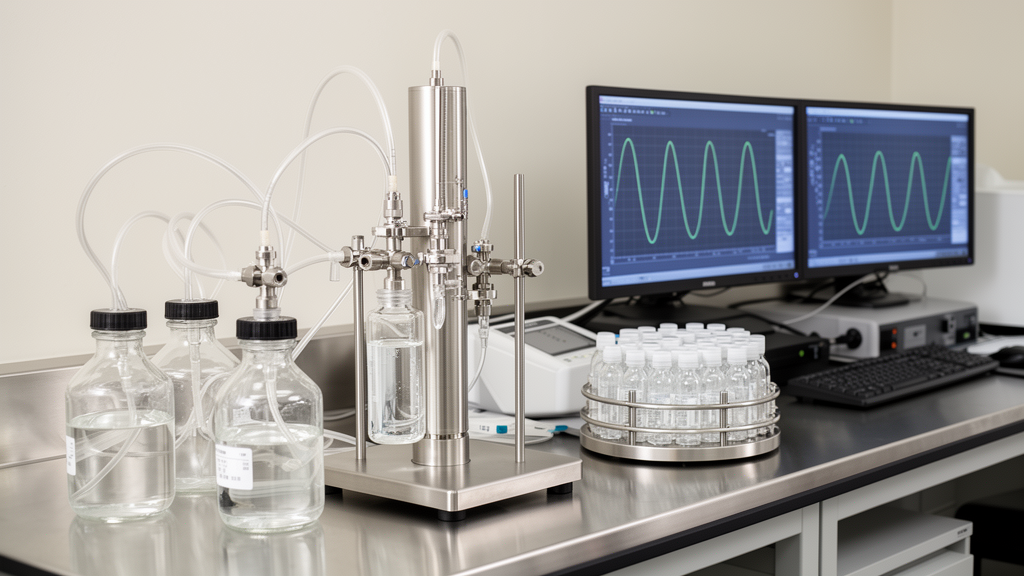
A new attention-based computational framework can accurately identify high-performance liquid chromatography anomalies before an experimental run finishes, according to research published in Discover Applied Sciences. High-performance liquid chromatography monitoring has historically relied on retrospective evaluations of complete pressure traces, a constraint that limits rapid intervention during active experiments. To address this operational bottleneck, researcher Junjun Cheng introduced the Early Attention-based Temporal HPLC framework, designated as EAT-HPLC, which is designed to predict whole-experiment anomaly labels from partially observed pressure traces.
The EAT-HPLC architecture addresses this limitation through a deployment-oriented design that integrates model-internal temporal localization and predictive uncertainty estimation.
The study specifically formulated the analytical challenge as partial-observation anomaly prediction rather than onset-aware early anomaly detection. This technical distinction arose from the structure of the training and validation data: while the benchmark dataset provided ground-truth anomaly labels corresponding to complete chromatographic runs, it lacked granular temporal annotations marking the exact physical onset of AirBubble events. Consequently, the modeling objective focused on inferring overall run status from early sequence windows without assuming temporal foreknowledge of perturbation points.
To rigorously evaluate diagnostic reliability across evolving time horizons, the framework was tested on a dataset comprising 961 expert-labeled high-performance liquid chromatography traces. Model validation utilized repeated stratified cross-validation across a structured progression of observation ratios ranging from 20 percent to 100 percent of the total trace duration. This progressive evaluation protocol enabled direct measurement of diagnostic accuracy as data completeness expanded throughout simulated chromatographic runs.
When operating with only 20 percent of a pressure trace available, EAT-HPLC achieved an anomaly-class F1-score of 0.866 ± 0.030, paired with an estimated false-alarm rate of 16.9% ± 10.7%.
Performance improved systematically as larger portions of the chromatographic trace were supplied to the model. The highest mean diagnostic performance was recorded at an observation ratio of 80 percent, where the framework achieved an anomaly-class F1-score of 0.945 ± 0.018. At this stage, the corresponding false-alarm rate decreased to 6.6% ± 9.9%, demonstrating strong discrimination between standard chromatographic behavior and anomalous profiles.
Comparative benchmarking demonstrated that EAT-HPLC secured the highest mean macro-F1 score among all evaluated baseline models across every tested observation ratio from 20 percent to 100 percent.
The study clearly defined the operational boundaries of these predictive findings, emphasizing the empirical trade-off between available trace length and classification certainty. The author noted that successful partial-observation predictions do not imply that model decisions strictly precede the physical onset of an AirBubble event, underscoring the distinction between sequence-based pattern detection and true prospective onset forecasting in chromatographic monitoring.
Subject of Research: Partial-observation anomaly prediction in high-performance liquid chromatography using attention-based temporal learning
Article Title: Predicting high-performance liquid chromatography anomalies from partial observations using attention-based temporal learning and uncertainty-aware inference
Article References: Cheng, J. (2026). Predicting high-performance liquid chromatography anomalies from partial observations using attention-based temporal learning and uncertainty-aware inference. Discover Applied Sciences. https://doi.org/10.1007/s42452-026-09730-7
Image Credits: AI Generated
DOI: 10.1007/s42452-026-09730-7
Keywords: High-Performance Liquid Chromatography, HPLC Anomaly Detection, Partial Observations, Temporal Learning, Attention Mechanism, Uncertainty Estimation, Pressure Traces, Early Prediction, Cross-Validation, AirBubble Events, Machine Learning, Analytical Chemistry, Chromatography Monitoring, F1-Score, False-Alarm Rate, EAT-HPLC
News Source: Teresa Odom. (November 13, 2026). Machine Learning Model Predicts Liquid Chromatography Anomalies from Incomplete Pressure Traces. Scienmag.