In an experimental investigation into the die-sinking electrical discharge machining of aluminium 6061 reinforced with boron carbide, an artificial neural network model reduced surface roughness prediction error at the process optimum by 64.6 percent compared with standard response surface methodology. The research evaluated seventy-four machining trials on stir-cast aluminium composite plates containing 6 weight percent boron carbide particles, identifying an operating condition that achieved a confirmed experimental arithmetic mean surface roughness of 2.2 micrometres. The artificial neural network predicted a surface roughness of 2.1 micrometres under this optimum, yielding a relative error of 4.5 percent, whereas response surface methodology yielded an error of 12.7 percent, a genetic algorithm yielded 12.0 percent, and simulated annealing produced an error of 34.8 percent.
Lightweight metal matrix composites are frequently utilized in structural and aerospace applications, including aerials, beam components, and panels, where reducing structural weight while maintaining mechanical strength is critical. Fabricating these composites through stir casting introduces hard ceramic particulates into a ductile metallic matrix, which substantially elevates both strength and abrasive wear resistance compared to elemental base alloys. In this investigation, composite ingots measuring 100 by 100 by 10 millimetres were cast using aluminium 6061 as the base alloy and particulate boron carbide as the reinforcing phase across three distinct compositions of 3, 6, and 9 weight percent. Rockwell hardness testing of specimens sectioned via wire electrical discharge machining established that the 6 weight percent boron carbide formulation achieved the highest hardness at 86.33 HRB, representing a 5.7 percent increase over the 3 weight percent formulation and an 11.1 percent increase over the 9 weight percent composition, thereby designating it as the workpiece material for machining tests.
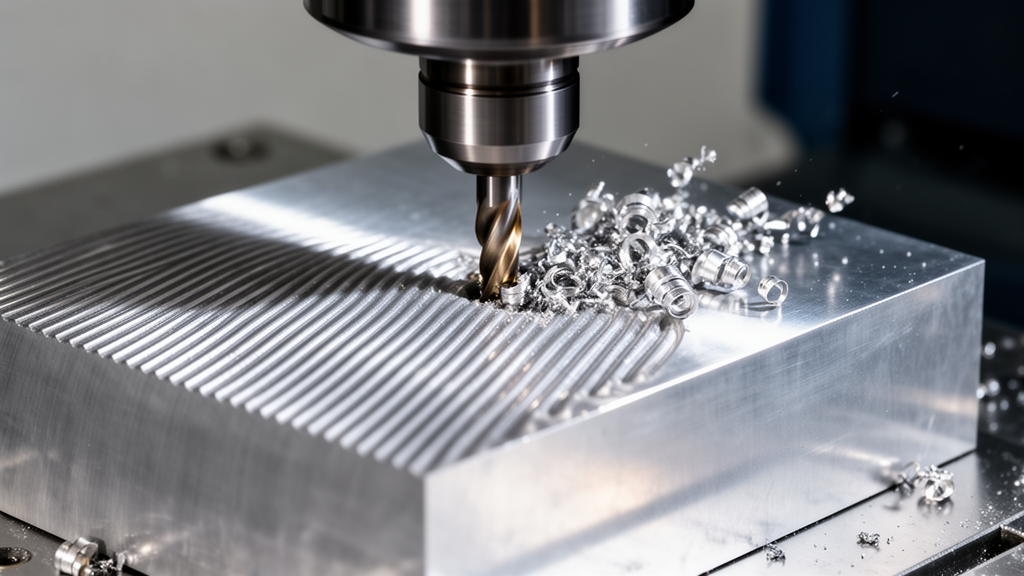
X-ray diffraction analysis confirmed the successful incorporation and uniform dispersion of boron carbide within the aluminium matrix, identifying characteristic diffraction peaks at 21.564, 27.361, 28.753, 30.148, 31.665, 34.811, 35.442, 36.310, 37.105, 40.828, 42.542, and 43.794 degrees clustering around the primary diffraction peaks of the base aluminium alloy at 39.172 and 45.394 degrees. However, machining such particulate-reinforced composites using conventional cutting tools remains challenging because abrasive ceramic particles accelerate tool wear and degrade surface finish. Non-traditional manufacturing via die-sinking electrical discharge machining circumvents mechanical cutting forces by utilizing repetitive discrete electrical sparks between a tool electrode and the conductive composite workpiece submerged in a dielectric fluid. Establishing precise process control over electrical discharge machining parameters is vital for minimizing surface roughness without compromising composite structural integrity.
The experimental setup employed a Sparcatron SM25N die-sinking machine equipped with a 90-ampere pulse generator, utilizing straight polarity where the composite workpiece was connected to the negative terminal and a 10-millimetre diameter copper electrode was connected to the positive terminal. Machining was carried out under commercial hydrocarbon dielectric oil maintained at a controlled tank temperature of 25 plus or minus 2 degrees Celsius, continuously circulated through a paper-cartridge filter by a positive-displacement pump. Side flushing was directed into the spark gap through a dedicated nozzle, and the tool electrode was redressed before each trial to remove accumulated debris. The machine was allowed to stabilise for five minutes between consecutive runs, and all experimental conditions were repeated three times to calculate mean surface roughness values measured with a Mitutoyo profilometer.
To capture process physics comprehensively, the design of experiments varied seven machine settings simultaneously within a central composite design framework, departing from earlier literature that typically restricted investigations to three or four process variables while holding flushing settings fixed. The parameters encompassed peak discharge current from 3 to 15 amperes, electrode working time from 2 to 10 seconds, electrode lift time from 1 to 2 seconds, pulse-on time from 50 to 250 microseconds, gap voltage from 35 to 40 volts, duty factor from 80 to 90 percent, and dielectric flushing pressure from 0.2 to 0.5 kilograms-force per square centimetre. Electrode working time and electrode lift time operate as servo cycle timers measured in seconds, regulating the physical duration of tool advance and retraction to permit fresh dielectric circulation, distinguishing them physically and numerically from the microsecond-scale pulse-on time that dictates individual electrical spark duration.
Analysis of variance on the seventy-four experimental runs revealed that only three of the seven controllable machine factors were statistically significant predictors of surface roughness at the 95 percent confidence level. Electrode working time emerged as the single largest contributor, accounting for 30.22 percent of total variation with an F-value of 148.99 and a p-value below 0.001. Discharge duration, represented by pulse-on time, contributed 19.82 percent with an F-value of 97.74, while peak discharge current contributed 19.59 percent with an F-value of 96.60. Together, these three variables explained 69.63 percent of the total variation, whereas electrode lift time, gap voltage, duty factor, and flushing pressure were not statistically significant individually, contributing only 1.06 percent combined. A Pareto chart confirmed that only electrode working time, pulse-on time, and discharge current exceeded the critical standardized effect threshold of 2.02.
Surface roughness exhibited a monotonic increase with higher discharge current, pulse-on time, and electrode working time. Higher currents and longer pulse durations elevate the nominal discharge energy, approximately given by the product of gap voltage, current, and pulse-on time, which intensifies plasma channel growth and melts an expanded pool of matrix material exceeding the 652 degrees Celsius melting point of aluminium 6061. Because non-conductive boron carbide particles melt at approximately 2450 degrees Celsius, they do not erode from spark heat but instead become dislodged as the surrounding aluminium pool melts, creating microscopic cavities. Conversely, longer electrode working times degrade surface roughness by delaying tool retraction, allowing eroded conductive debris to accumulate within the spark gap, lowering dielectric breakdown strength, and inducing secondary arcing discharges that produce deeper, irregular craters.
A second-order polynomial response surface model was fitted to the seventy-four runs using least squares, incorporating linear terms, quadratic terms, and two-factor interaction terms, yielding a coefficient of determination of 0.9108 and an adjusted coefficient of determination of 0.8521. In parallel, a feed-forward back-propagation artificial neural network was designed in MATLAB featuring a 7–10–1 topology, which mapped the seven normalized input variables through a single hidden layer of ten neurons utilizing hyperbolic tangent sigmoid transfer functions to a linear output neuron. Trained with the Levenberg–Marquardt algorithm over twelve epochs, the neural network converged with a mean squared error of 0.0477 square micrometres and an overall correlation coefficient of R = 0.9975. Across all experimental runs, the neural network reduced the root mean squared error from 0.3022 micrometres in the response surface model to 0.2184 micrometres, achieving a 27.7 percent overall predictive accuracy improvement.
When optimization routines were benchmarked, a significant divergence emerged between surrogate-driven algorithms and direct experimental validation. Optimization via response surface methodology identified an optimal setting of 3 amperes current, 2 seconds electrode working time, 1 second lift time, 50 microseconds pulse-on time, 35 volts gap voltage, 90 percent duty factor, and 0.2 kilograms-force per square centimetre flushing pressure, predicting a roughness of 1.92 micrometres. The artificial neural network identified the identical parameter combination with the exception of a 40-volt gap voltage, predicting a roughness of 2.1 micrometres. In contrast, a genetic algorithm utilizing 1000 generations and simulated annealing executing 7,337 function evaluations both minimized the polynomial response surface equation rather than the physical process, converging onto extreme boundary solutions characterized by high working times and long pulse durations that predicted poor surface finishes of 4.93 and 2.87 micrometres respectively, with confirmed experimental roughness values of 4.4 micrometres.
Physical confirmation trials validated the optimal parameter setting recommended by the artificial neural network of 3 amperes discharge current, 2 seconds working time, 1 second lift time, 50 microseconds pulse-on time, 40 volts gap voltage, 90 percent duty factor, and 0.2 kilograms-force per square centimetre flushing pressure. The resulting workpiece exhibited a verified surface roughness of 2.2 micrometres, closely matching the 2.1-micrometre neural network prediction. Scanning electron microscopy of this optimized surface revealed dense patterns of overlapping shallow craters formed by low-energy discharges of approximately 6 millijoules, contrasted with the 131 millijoules generated under harsh settings. Micrographs exhibited a thin, discontinuous recast layer, minimal resolidified spherical droplets, limited particle pull-out, and complete absence of micro-cracks or heat-affected zones, confirming that low spark energy and adequate debris flushing preserve surface integrity.
Subject of Research: Optimization of electrical discharge machining parameters for aluminium 6061 boron carbide composite
Article Title: Artificial intelligence based optimization of electrical discharge machining parameters for minimizing surface roughness of aluminium 6061 boron carbide metal matrix composites
Article References: Shyn, C. S., Rajesh, R., Anand, M. D., & Rajendran, A. R. (2026). Artificial intelligence based optimization of electrical discharge machining parameters for minimizing surface roughness of aluminium 6061 boron carbide metal matrix composites. Discover Mechanical Engineering, 5(1), Article 176. https://doi.org/10.1007/s44245-026-00365-x
Image Credits: AI Generated
DOI: 10.1007/s44245-026-00365-x
Keywords: Electrical Discharge Machining, Metal Matrix Composites, Aluminium 6061, Boron Carbide, Surface Roughness, Artificial Neural Networks, Response Surface Methodology, Genetic Algorithm, Simulated Annealing, Central Composite Design, Stir Casting, Electrode Working Time, Pulse-on Time, Discharge Current, Scanning Electron Microscopy, Die-Sinking EDM, Manufacturing Engineering
News Source: Denise Maddox. (November 13, 2026). Neural Network Cuts Surface Roughness Prediction Error in Machined Aluminium Composite. Scienmag.