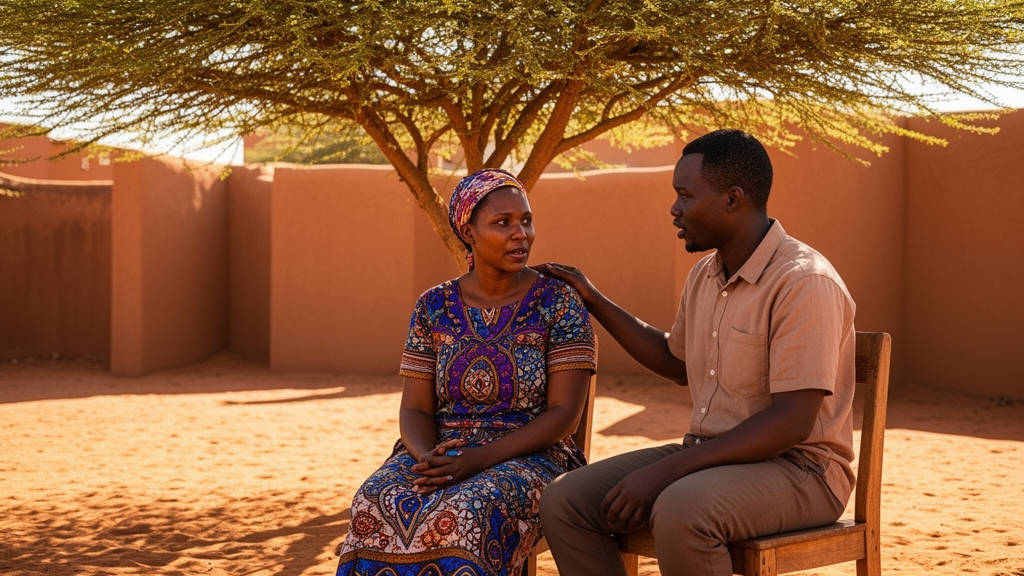
A Delphi expert consensus study published in BMC Psychiatry has culturally adapted the Mental Health First Aid guidelines for supporting individuals at risk of suicide in Namibia. Researchers Miriam Faust and Olivia Spiegler investigated how evidence-based suicide intervention recommendations could be tailored to address local cultural contexts and health system frameworks. By engaging local panels of professionals and people with lived experience, the project sought to equip community members with systematic guidance to assist vulnerable individuals across social networks.
Addressing suicide constitutes a pressing public health concern in Namibia, where accessible prevention strategies remain critical for community-level intervention. Existing international Mental Health First Aid resources offer evidence-based actions for individuals encountering peers experiencing suicidal crises. Nonetheless, researchers recognized that transferring protocols directly without contextual adjustments could overlook specific cultural expectations, community dynamics, and healthcare infrastructure limitations. The investigation therefore sought to evaluate and reshape established suicide-risk action statements directly within the Namibian national setting.
To establish a rigorous framework for adaptation, the investigators conducted a two-round Delphi expert consensus study utilizing two distinct panels. The panel composition comprised twenty-two participants representing both Namibian mental health professionals and individuals possessing lived experience of suicide. Panellists were drawn from three administrative regions across the country, with predominant participation originating from the Khomas region. This configuration ensured that professional clinical perspectives and real-world experiential insights informed the assessment of every proposed intervention action.
The evaluation procedure required participants to systematically review 163 statements extracted from the re-developed 2014 Mental Health First Aid suicide-risk guidelines. Panellists rated the importance of each item for inclusion in the newly adapted Namibian guidelines. In addition to scoring existing recommendations, panel members were invited to suggest novel, culturally relevant actions designed to address local community conditions. Under the study protocol, statements were accepted into the final guidelines only if at least 80 percent of panellists endorsed them as essential or important.
Across the two iterative survey rounds, the consensus process yielded a final collection of 164 statements that successfully satisfied the pre-specified pooled endorsement threshold. The overwhelming majority of the accepted items originated from the source protocol, with 159 statements retained from the original guidelines. Complementing these established principles, panellists formulated and endorsed five completely new statements generated directly from qualitative feedback and suggestions provided during the assessment cycles.
The final adapted guidelines maintain the foundational structure of the source Mental Health First Aid guidelines while integrating distinct local refinements. The authors observed that the high rate of retention reflects a broad shared foundation in first-aid intervention principles, paired with critical localized nuances necessary for practical application. By establishing consensus across both mental health practitioners and individuals with lived experience, the study provides a preliminary framework tailored to community responders in Namibia.
The researchers noted that establishing consensus represents an initial benchmark in the implementation pathway for culturally tailored suicide prevention tools. The authors underscored that further empirical research must evaluate the feasibility, acceptability, and practical execution of the guidelines across diverse community environments. Additional operational investigations will be essential to establish how effectively these consensus-derived actions can be deployed throughout different regions and healthcare settings across Namibia.
The methodological consensus approach reflects a broader international effort to adapt suicide-risk first aid strategies to diverse cultural landscapes and health systems. Similar Delphi expert consensus studies have previously adapted the Mental Health First Aid suicide prevention guidelines for other national settings, including research published on Brazil in 2022, Sri Lanka in 2021, and China in 2020. These related investigations highlight how established intervention frameworks can be systematically reviewed and reshaped to align with distinct regional health infrastructure and community realities.
In the Namibian study, the adaptation process relied specifically on evaluating the 2014 re-developed source guidelines to identify both universal core actions and locally relevant additions. Although 159 original statements proved applicable, incorporating five novel statements created directly from panellist feedback ensured the inclusion of unique context-specific practices. Because the panel drew participants predominantly from the Khomas region and comprised 22 total experts, the authors noted that future evaluations must investigate guideline implementation, practical acceptability, and operational feasibility across other intended local settings throughout Namibia.
Subject of Research: Cultural adaptation of Mental Health First Aid guidelines for suicide risk in Namibia
Article Title: Cultural adaptation of the mental health first aid guidelines for assisting a person at risk of suicide in Namibia: a Delphi expert consensus study
Article References: Faust, M., & Spiegler, O. (2026). Cultural adaptation of the mental health first aid guidelines for assisting a person at risk of suicide in Namibia: a Delphi expert consensus study. BMC Psychiatry. https://doi.org/10.1186/s12888-026-08754-y
Image Credits: AI Generated
DOI: 10.1186/s12888-026-08754-y
Keywords: mental health first aid, suicide prevention, delphi study, namibia, expert consensus, khomas region, public health, cultural adaptation, lived experience, mental health professionals, guidelines, health systems, community intervention, crisis assistance, bmc psychiatry, suicide risk
News Source: Glenn Wilkins. (November 13, 2026). Delphi Study Adapts Mental Health First Aid Suicide Guidelines for Namibia. Scienmag.