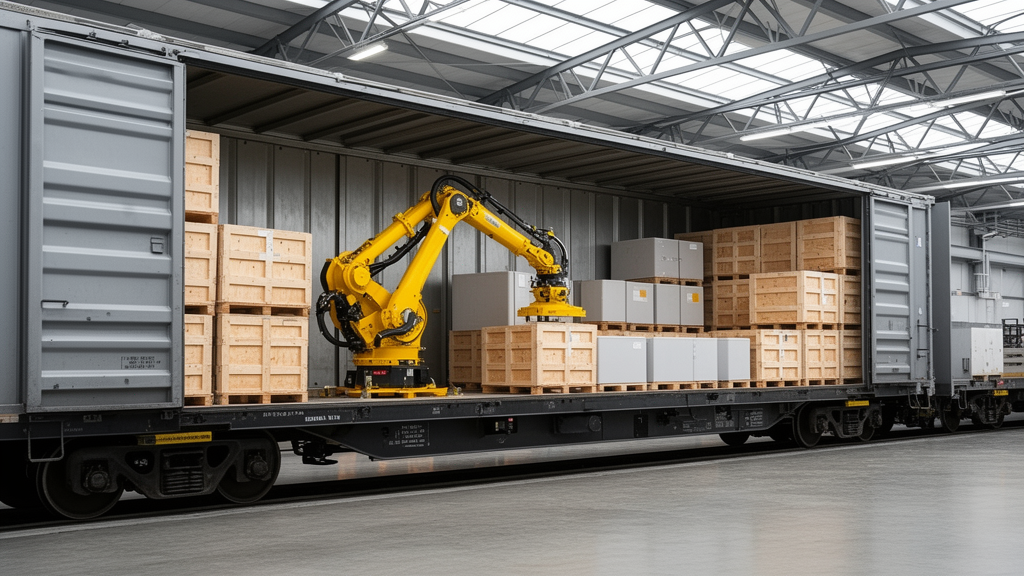
A joint optimization framework that couples three-dimensional spatial packing with physical robotic trajectory planning has demonstrated substantial improvements in freight wagon loading performance, achieving an average space utilization of 87.4 percent and a loading success rate of 91.2 percent in high-density logistics scenarios. Developed by engineering researchers Pin Zhang, Dali Wu, Xuechun Huang, and Guohui Tang, the computational method addresses a longstanding operational bottleneck in railway freight transport, where theoretical packing layouts frequently fail during real-world execution because robotic manipulators cannot reach target placement coordinates without colliding with previously stacked containers or carriage boundaries. By embedding inverse kinematics, obstacle modeling, and dynamic path-reachability calculations directly into the decision steps of a deep reinforcement learning policy, the system eliminates physically impossible actions before placement decisions are made, while simultaneously penalizing inefficient, convoluted trajectories.
Automated loading inside railway freight compartments presents spatial constraints that differ markedly from standard warehouse depalletizing or static container packing. Inside a railcar, loading efficiency directly governs wagon turnover rates, warehousing throughput, and transport economics. However, cargo does not arrive with idealized, error-free geometry, and every box placed inside the carriage alters the available volume, load support structures, and robotic access corridors for all subsequent operations. Conventional operations research models abstract this challenge into static three-dimensional bin packing or palletizing problems, relying on heuristic rules, genetic algorithms, or integer programming to optimize volume compactness.
To overcome the separation between spatial arrangement and mechanical feasibility, the research team structured the loading process as a closed-loop Markov decision process governed by front-end computer vision, structured spatial encoding, and masked attention mechanisms. In the initial stage of each loading cycle, an overhead three-dimensional camera scans incoming packages alongside the internal carriage space, extracting geometric dimensions, spatial poses, and occupancy distributions. The optical perception module demonstrated sub-millimeter precision during experimental validation, confining container length and width estimation errors to between 0.14 and 0.20 millimeters, while height detection errors remained near zero. The perceptual data acquisition cycle was completed in under 0.5 seconds per container, providing accurate, structured inputs that prevent upstream geometric uncertainties from propagating into downstream collision predictions and stability assessments.
The system converts these sensory inputs into a multi-layered three-dimensional state representation composed of a height map, an occupancy mask, and cargo dimensional tensors mapped across the carriage floor. The height map records the maximum vertical elevation at each coordinate grid on the floor, providing a compact geometric description of the uneven surface formed by already deposited cargo without requiring computationally demanding three-dimensional voxel grids. Simultaneously, candidate front-left-bottom placement coordinates are generated along the outer boundaries of already placed goods, including their top, rear, and lateral faces. This boundary-derived candidate mechanism transforms continuous spatial search into a discrete set of structurally compact placement points, preventing the policy network from evaluating arbitrary, floating locations and focusing decision bandwidth exclusively on positions adjacent to the established cargo mass.
Central to the decision pipeline is a Transformer-based policy network that incorporates sinusoidal three-dimensional position encoding to maintain awareness of absolute and relative spatial coordinates within the railcar. The network represents packed goods, items awaiting loading, and virtual filler tokens as a unified dynamic node sequence, using multi-head self-attention to identify sequential dependencies, load-bearing contacts, and path-blocking relationships across the cargo set. The virtual filler tokens preserve consistent tensor lengths across varying batch sizes, allowing the model to process arbitrary cargo quantities without modifying network dimensions. Continuous geometric features, including item dimensions and coordinate offsets, are projected into a shared 128-dimensional latent embedding space, normalized against railway wagon dimensions, enabling the model to learn long-term spatial trade-offs across extended packing sequences.
Rather than evaluating mechanical executability after generating an entire wagon layout, the framework links motion planning to every individual placement candidate through a dynamic feasibility mask. For each candidate action—defined by box identification, rotational orientation, and front-left-bottom coordinates—the system computes the target end-effector pose of the palletizing robot. The kinematic planner immediately attempts an inverse kinematics solution against the robot’s physical joint limits. If no kinematically valid joint configuration exists, or if trajectory generation encounters geometric obstacles among the carriage walls, loaded items, or stationary equipment, the action is marked unreachable. The candidate’s feasibility flag drops to zero, and a hard feasibility mask removes the option from the action distribution before softmax sampling occurs, ensuring that the network never samples an mechanically unviable placement.
For candidate placements that clear the hard reachability check, the system computes a normalized path execution cost that directly modulates action scoring. This cost function incorporates three weighted elements: normalized trajectory length weighted at 0.50, obstacle proximity cost weighted at 0.30, and kinematic strain penalties weighted at 0.20. The obstacle evaluation protocol continuously monitors the distance between the robotic arm and dynamic obstacle boundaries along the planned trajectory, enforcing a strict safety clearance of 0.08 meters. Any trajectory breaching this clearance envelope receives escalating penalties, while direct collisions trigger immediate rejection. Kinematic penalties penalize joint positions, velocities, and accelerations approaching manufacturer limits, steering the policy toward smooth, repeatable mechanical execution rather than high-stress edge configurations.
The policy network was trained using proximal policy optimization across one million environment steps, using five independent random seeds to evaluate stability and convergence. The multi-objective reinforcement learning reward balanced volumetric space utilization, path cost, collision risk, structural stability, and loading sequence order. Space utilization served as the primary benchmark weight, while secondary penalty weights were assigned through coarse-to-fine validation, setting collision risk at 0.25, path cost at 0.20, placement instability at 0.15, and sequence order violations at 0.10. Implemented in Python 3.10 and PyTorch 2.1.2 with CUDA 12.1 acceleration on an NVIDIA workstation with 24 gigabytes of video memory, the complete policy network executed individual planning and placement decisions in an average of 28 milliseconds, while the complete perception-to-decision pipeline demonstrated an end-to-end latency of 146 milliseconds.
In comparative benchmarks against representative algorithms—including constrained deep reinforcement learning, perception-driven bin packing, and motion-aware genetic algorithms paired with rapidly exploring random trees—the proposed framework achieved superior aggregate performance across all operational metrics. Compared with the strongest existing learning baseline, the method improved space utilization by approximately 3.3 percent and boosted loading success rates by 3.9 percent. Crucially, the model achieved a package completion rate improvement of 0.183, a collision reduction rate of 0.271, and an overall stability gain of 0.226. Among the baselines, 3DVision-DRL did not explicitly couple robot trajectory feasibility with each candidate placement, while GA-RRT* showed lower space utilization and loading success alongside higher computational latency.
Ablation experiments isolating specific architectural components confirmed that joint path modeling, mask constraints, and spatial feature encoding operate synergistically. Without an effective candidate placement mechanism, constraint mask, or spatial feature representation, the model proved prone to layout fragmentation, local non-compact stacking, and unusable remaining space. Performance also varied across sequence priors: structured sequence CUT-1, which prioritizes spatial continuity and local compactness, produced the highest reward convergence between 7.3 and 7.7 within 50,000 steps, whereas random sequencing weakened long-term trajectory optimization, leading to lower final space utilization distributed between 45 and 65 percent.
Physical validation on an experimental testbed—comprising an industrial palletizing robot, a pneumatic suction-cup gripper, an industrial air pump, and a high-resolution three-dimensional depth camera—confirmed the practical viability of the simulated trajectories across multi-stage loading cycles. Trajectory density analyses demonstrated that the system generated highly regular, parallel scanning paths during repetitive layer-by-layer stacking, effectively suppressing erratic detour motions and idle travel. Sensitivity evaluations further revealed that increasing the collision avoidance penalty coefficient reduced physical intervention rates from 0.084 to 0.043, while elevating the loading success rate to 0.916. Increasing the path penalty coefficient reduced normalized path execution costs from 0.768 to 0.684, demonstrating predictable tuning behavior between movement efficiency and maximum volumetric density.
Despite its performance gains, the researchers highlighted key operational boundaries governing the system’s current deployment. The present geometric modeling assumes rigid rectangular cuboids with discrete allowable orientations, making the boundary point generation and height map representation less suitable for irregular, deformable, or non-convex items without incorporating continuous mesh or voxel inputs. Furthermore, path reachability and kinematic calculations remain closely tied to the specific dimensions, joint limits, and gripper geometries of the calibrated palletizing manipulator.
Subject of Research: Deep reinforcement learning and 3D computer vision for joint optimization of railcar cargo packing and executable robotic loading paths
Article Title: Perception-constrained joint optimization of 3D railcar loading and executable loading paths via deep reinforcement learning
Article References: Zhang, P., Wu, D., Huang, X., & Tang, G. (2026). Perception-constrained joint optimization of 3D railcar loading and executable loading paths via deep reinforcement learning. Discover Artificial Intelligence, 6(1), Article 1732. https://doi.org/10.1007/s44163-026-02659-1
Image Credits: AI Generated
DOI: 10.1007/s44163-026-02659-1
Keywords: deep reinforcement learning, railcar loading, robotic palletizing, 3D computer vision, motion planning, transformer policy network, spatial state representation, height maps, feasibility masking, inverse kinematics, trajectory planning, cargo packing, collision avoidance, combinatorial optimization, logistics automation, space utilization, proximal policy optimization
News Source: Denise Maddox. (November 13, 2026). Deep Reinforcement Learning Optimizes 3D Railcar Packing and Executable Robotic Paths. Scienmag.