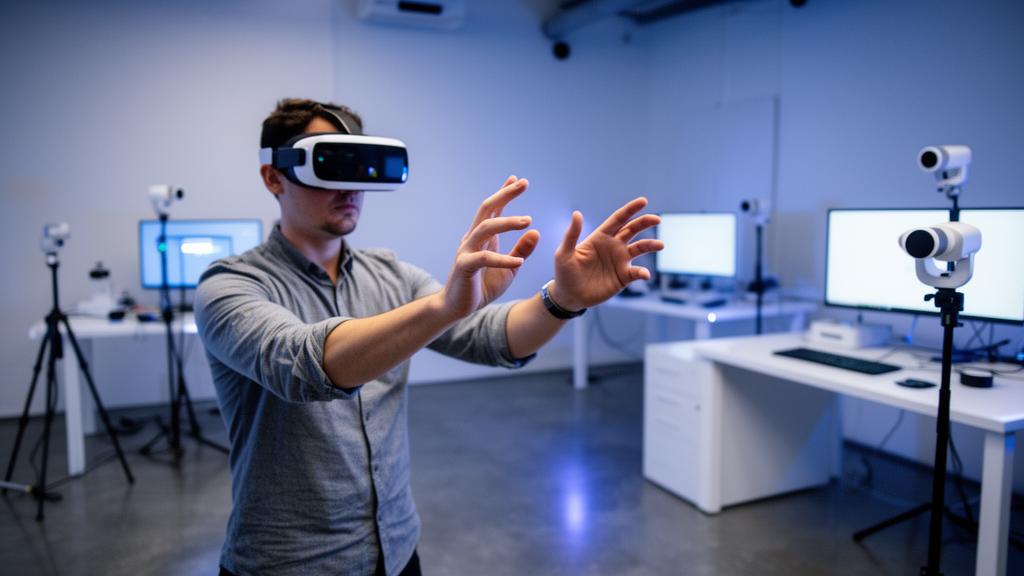
Researchers have developed an interactive adaptation framework that integrates mini-batch gradient descent with AlexNet and dynamic time warping to optimize multi-sensor data fusion in virtual reality systems. The computational model aims to address longstanding engineering challenges in virtual reality environments, where traditional multi-sensor fusion methods often struggle to balance real-time tracking demands with spatial precision. By refining heterogeneous data processing workflows, the architecture seeks to provide a practical technical pathway for deeply connecting sensor inputs directly with immersive user interfaces.
Conventional data fusion approaches frequently exhibit structural flaws that impede seamless immersion, either introducing latency that disrupts interaction or sacrificing positional accuracy. To overcome these limitations, the investigators targeted both feature optimization and temporal matching, configuring deep learning algorithms alongside time-series alignment tools to handle continuous tracking tasks more effectively.
The first component of the newly proposed architecture combines mini-batch gradient descent with AlexNet to extract and optimize features from heterogeneous multi-sensor streams. Utilizing mini-batch gradient descent enables AlexNet to process these diverse data streams efficiently, establishing optimized feature representations while significantly constraining overall model complexity and parameter volume during training.
To complement the deep feature extraction stage, the researchers paired fuzzy C-means clustering with dynamic time warping. This combination handles the high-dimensional time series data generated during continuous virtual reality interactions.
By combining the mini-batch gradient descent-AlexNet pipeline with the fuzzy C-means clustering-dynamic time warping module, the research team constructed an exclusive adaptation model linking fused sensory data with virtual reality interaction. In comparative experimental evaluations, the newly constructed system demonstrated training durations and parameter volumes that were significantly lower than those recorded for comparative baseline models, highlighting noticeable gains in training efficiency and model compactness.
Operational testing confirmed rapid runtime performance alongside robust tracking precision. The proposed model sustained an inference speed of 98.32 frames per second, ensuring responsive real-time interaction capabilities within graphical environments. In spatial measurement evaluations, the root mean square error for position was recorded at 1.89 millimeters, while the root mean square error for pose reached 0.76 degrees. These figures reflect reductions of 36.15 percent and 36.44 percent, respectively, when evaluated against standard AlexNet-dynamic time warping configurations.
Further dimensional and structural evaluations demonstrated that the architecture achieved a feature dimension compression rate of 89.38 percent, significantly streamlining sensory representations. In cluster evaluations, the Davies-Bouldin index converged to 0.36, indicating well-defined and compact data partitioning. Stress testing under adverse transmission conditions revealed that the model maintained fusion accuracy rates of 89.3 percent in high-noise environments and 86.4 percent during high-packet-loss scenarios, confirming resilience against channel degradation.
The study demonstrates that integrating mini-batch gradient descent, AlexNet, fuzzy C-means clustering, and dynamic time warping enables efficient, low-latency multi-sensor fusion with high adaptation mapping for virtual reality systems. By sustaining high inference rates and reducing tracking errors under noisy and lossy conditions, the system presents a verified, reusable technical solution for advancing multi-sensor tracking within immersive interactive environments.
Subject of Research: Multi-sensor data fusion and virtual reality interaction modeling using deep learning and dynamic time warping
Article Title: Multi-sensor data fusion and VR interaction based on AlexNet and DTW
Article References: Wang, Y., & Li, K. (2026). Multi-sensor data fusion and VR interaction based on AlexNet and DTW. Discover Applied Sciences. https://doi.org/10.1007/s42452-026-09860-y
Image Credits: AI Generated
DOI: 10.1007/s42452-026-09860-y
Keywords: virtual reality, multi-sensor data fusion, AlexNet, dynamic time warping, mini-batch gradient descent, fuzzy C-means clustering, inference speed, root mean square error, pose tracking, position tracking, feature dimension compression, Davies-Bouldin index, noise resilience, packet loss, high-dimensional time series, interactive adaptation
News Source: Blake Davidson. (November 13, 2026). Deep Learning and Time Warping Improve Virtual Reality Interaction Tracking. Scienmag.