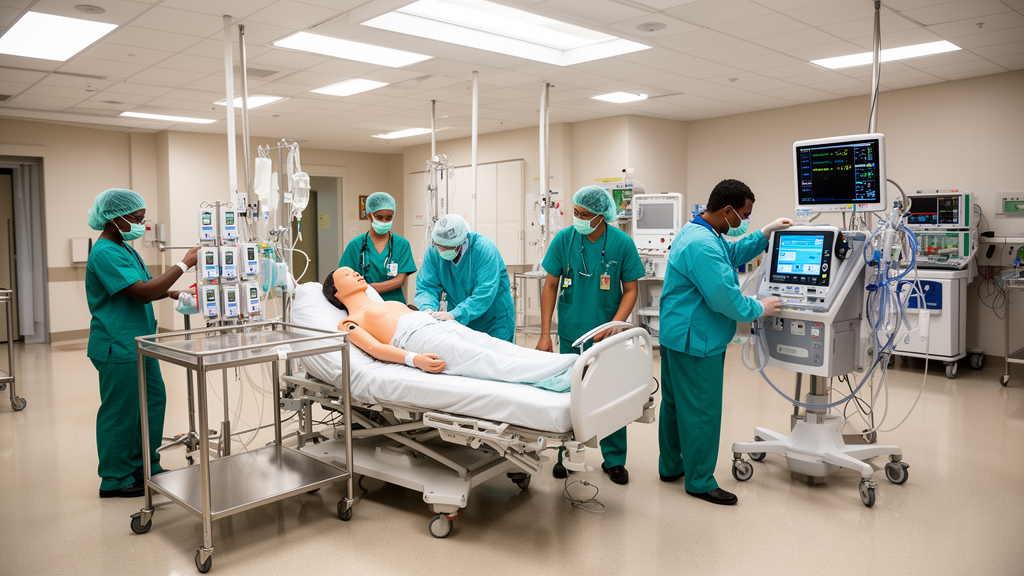
Hospital intensive care clinicians who practice emergency scenarios within their actual clinical environments report higher realism, enhanced psychological safety, and more effective skill transfer when they train in their habitual professional roles rather than trading positions with colleagues. According to a qualitative ethnographic investigation conducted in an eight-bed intensive care unit within an 809-bed Danish teaching hospital, healthcare teams found that in situ simulation offered substantially greater fidelity than traditional off-site simulation centers. However, the common educational practice of cross-training, wherein team members step into duties outside their regular medical or nursing professions, frequently undermined learners’ psychological safety and hindered educational outcomes. This negative effect was particularly acute among junior staff members who faced cognitive strain and vulnerability, whereas practicing within authentic professional identities grounded in familiar working surroundings enabled clinicians to engage deeply and implement procedural adjustments directly into clinical practice.
The study sought to address critical gaps in medical education concerning how practicing clinicians perceive in situ simulation and role substitution on an individual level. In situ simulation places training scenarios directly inside active hospital spaces, allowing interprofessional teams to test organizational systems, uncover latent safety threats, and refine collaborative critical care responses under realistic operational pressures. While prior literature had established that simulated exercises could facilitate cultural transformation and enhance clinical timing during critical events such as trauma resuscitation, training programs frequently rely on off-site facilities and cross-training strategies for administrative and logistical convenience. Historically structured educational silos often create distinct barriers to everyday teamwork, prompting educators to introduce cross-role exercises under the assumption that experiencing a colleague’s tasks fosters team cohesion. Nevertheless, controversy has persisted regarding whether role swapping truly improves clinical performance or merely introduces caricatured behaviors that distort authentic clinical reality.
To investigate these dynamics, researchers implemented an ethnographic and phenomenological-hermeneutic study design tracking unannounced and scheduled simulation exercises in the critical care ward. In situ simulation sessions occurred three to four times per year, with scenarios developed by the lead investigator to reflect everyday clinical situations encountered in the intensive care unit. Each training day comprised three ninety-minute sessions, with each participant engaging in exactly one simulation per day so as not to disrupt clinical duties. The structured sessions opened with a concise five-minute pre-brief introducing the rules of engagement and the HAL S3201 adult patient simulator, proceeded through approximately thirty minutes of immersive clinical simulation, and concluded with a detailed forty-five-minute debriefing. Participation remained voluntary, and every clinician involved provided written informed consent under protocol approvals granted by the Danish Regional Committee on Health Science and Ethics and the King’s College ethical committee.
The participant cohort encompassed intensive care nurses across multiple experience tiers as well as junior and senior anesthesiologists, all of whom held active clinical assignments on the day of the exercise. Each scenario team consisted of two physicians, specifically one junior doctor and one senior anesthesiologist, alongside two or three nurses representing varied seniority levels. The lead investigator served as an ethnographic observer during both the live clinical simulations and the subsequent debriefings, taking detailed handwritten field notes. Over the three months following the simulation exercises, semi-structured interviews were conducted with participants to capture personal reflections regarding fidelity, psychological safety, and clinical application. Although thirty interviews were originally scheduled, the researchers reached empirical data saturation after completing sixteen interviews spanning from September to December 2022. The compiled qualitative dataset incorporated comprehensive field notes, audio recordings from four distinct debriefings totaling two hours, fifty-seven minutes, and thirty-seven seconds, and sixteen recorded interviews totaling four hours, thirty-one minutes, and twenty-seven seconds, with individual interviews ranging between twelve and twenty-eight minutes.
To maintain methodological rigor and qualitative validity, two independent researchers conducted consensus coding of the transcribed interview records, debriefing recordings, and observation notes. Their systematic thematic analysis identified four primary interrelated themes that governed the educational impact of intensive care simulation: fidelity, psychological safety, learning transfer, and cross-training. Clinicians characterized fidelity as a complex, multidimensional construct that extended far beyond realistic mannequin technology to encompass environmental fidelity, team composition fidelity, scenario fidelity, time fidelity, and resource availability. Clinicians consistently reported that running emergency scenarios within their actual physical unit produced an immediate sense of immersion that eliminated unnecessary mental burdens. As one junior doctor and junior nurse highlighted, practicing in the real ward meant they did not have to expend mental energy visualizing hypothetical surroundings, which encouraged them to take the simulation more seriously and engage wholeheartedly with the clinical problem.
The physical realism of the intensive care setting stood in sharp contrast to off-site simulation environments, where artificial surroundings frequently disrupted focus and provided convenient rationalizations for medical errors. Nine interviewees explicitly affirmed that environmental fidelity exerted a major impact on their overall learning, observing that mistakes committed in off-site centers were readily dismissed as artifacts of unfamiliar layouts or substitute equipment rather than genuine clinical oversights. Furthermore, scenario fidelity and authentic team composition proved essential for maintaining engagement. Clinicians noted that scenarios closely mirroring their everyday clinical reality fostered confidence, whereas artificial or implausible task expectations generated frustration and obstruction. Participants also singled out time fidelity as a decisive factor, explaining that unrealistic temporal shortcuts, such as a facilitator simply announcing that an intravenous line had been successfully placed in an infant simulator without requiring actual physical execution, broke their psychological immersion and hindered their ability to engage with the remaining clinical scenario.
Psychological safety emerged as a foundational prerequisite for effective simulation, determining the degree to which participants felt comfortable speaking up, voicing alternative clinical opinions, asking questions, and taking interpersonal risks without fear of censure. Clinicians indicated that psychological safety was substantially higher during in situ simulations where they worked alongside familiar colleagues, occupied their genuine professional roles, and were spared from external passive observers watching from behind glass or observation screens. However, familiarity with colleagues operated as a double-edged sword: while existing working relationships generally supported openness, pre-existing departmental tensions or entrenched hierarchies could also suppress candor during debriefings. The facilitator’s interpersonal competence was recognized as paramount, with participants emphasizing that polite, respectful guidance from instructors established an open environment that outweighed whether the exercise occurred on-site or off-site. Skilled debriefers who actively made room for every voice encouraged meaningful participation, whereas evaluative or dismissive facilitation compromised psychological security.
The study also revealed nuanced perspectives on workplace stress and anxiety during simulation exercises. Senior anesthesiologists noted that experiencing realistic time pressure and manageable levels of acute stress during the scenario served as a valuable pedagogical tool rather than a barrier, teaching them how to maintain composure, prioritize interventions, and manage physiological arousal in unpredictable clinical crises. This finding indicated that moderate emotional disturbance is an expected and productive element of critical care training when grounded within a supportive debriefing atmosphere. In contrast, artificial stressors unrelated to clinical care—most notably the interpersonal awkwardness and performance anxiety induced by unnatural role assignments—actively degraded psychological safety and impeded cognitive processing, particularly among less experienced clinicians who had not yet consolidated their professional self-efficacy.
When assessing learning transfer, eighty-one percent of participants agreed that in situ simulation facilitated greater application of newly acquired competencies to daily clinical practice compared with off-site training. Clinicians cited both procedural technical skills and social-cognitive competencies, referred to as SCOPE, as having been successfully integrated into routine patient care following ward-based simulations. While technical skills transferred rapidly and visibly, the adoption and open discussion of social-cognitive behaviors, such as leadership, assertiveness, and communication patterns, proved more sensitive during debriefings because clinicians occasionally felt that dissecting interpersonal dynamics touched uncomfortably close to personal character traits. Crucially, the in situ exercises also drove concrete organizational changes that enhanced hospital safety systems: after a simulation revealed significant physical difficulty in opening the packaging for emergency frontal neck access equipment within the unit’s tracheostomy kit, the department restructured the supply packaging, and a simulated anaphylaxis event prompted the routine daily assignment of an operating room anesthesiologist for emergencies.
The exploration of cross-training generated strongly divided reactions, revealing a pronounced tension between educational intentions and participant reception. Although faculty members generally endorsed cross-training under the premise that stepping into alternative roles would broaden systemic understanding and promote mutual empathy, most practicing clinicians strongly preferred training exclusively within their authentic professional identities. Junior doctors and junior nurses expressed clear aversion to cross-training, reporting that being forced into unfamiliar occupational duties during simulations stripped away their psychological safety, induced acute embarrassment, and created cognitive overload that stifled learning. Field observations showed that clinicians placed in synthetic roles frequently resorted to comedic or caricatured portrayals of other professions, undermining scenario seriousness and distorting genuine team interactions. More experienced senior clinicians occasionally found value in cross-training for reflective insight, yet they consistently favored adopting lower-acuity roles, such as hospital porters, where clinical decision-making was not required, reinforcing the conclusion that role authenticity remains vital for frontline critical care training.
The researchers noted several methodological limitations inherent to their qualitative design, including its execution within a single Danish intensive care unit, which limits direct external generalizability to disparate healthcare cultures where power distances and hierarchical structures may diverge significantly. Additionally, potential observer bias and the Hawthorne effect could not be entirely excluded, as the lead investigator was both a senior departmental anesthesiologist and the director of the simulation program, although anonymous consensus coding of transcripts and voluntary participation protocols helped mitigate these influences. Ultimately, the investigation demonstrates that in situ simulation achieves its highest educational and organizational potential when educational design respects authentic professional roles, replicates realistic temporal and environmental constraints, and relies on polite, skilled facilitation, while cross-training should be deployed with exceptional caution only among seasoned clinicians whose established professional self-efficacy can withstand role substitution.
Subject of Research: Qualitative evaluation of fidelity, psychological safety, and cross-training during in situ intensive care simulation
Article Title: Authentic roles matter: how in situ simulation influences fidelity, psychological safety, and learning transfer
Article References: Krarup, K. B., McKenzie, A. C., Al-Masri, A., & Abildgren, L. (2026). Authentic roles matter: how in situ simulation influences fidelity, psychological safety, and learning transfer. Advances in Simulation, 11(1), Article 62. https://doi.org/10.1186/s41077-026-00449-4
Image Credits: AI Generated
DOI: 10.1186/s41077-026-00449-4
Keywords: in situ simulation, intensive care unit, fidelity, psychological safety, learning transfer, cross-training, interprofessional education, qualitative research, clinical simulation, anesthesiology, critical care nursing, patient safety, debriefing, simulation training, translational simulation, healthcare education, medical simulation
News Source: Courtney Benton. (November 13, 2026). In Situ ICU Simulation Promotes Learning Better Within Authentic Clinical Roles. Scienmag.