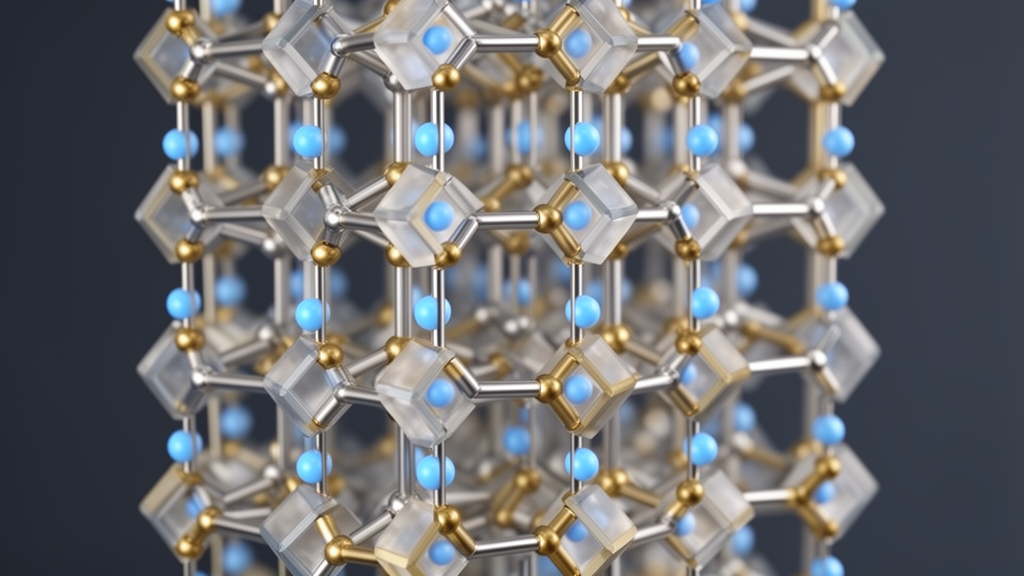
Lightweight lithium- and sodium-based vacancy-ordered double perovskite hydrides present attractive theoretical characteristics for solid-state hydrogen storage, according to a computational investigation of four stoichiometric compositions. Researchers evaluated the structural, mechanical, thermodynamic, electronic, optical, and hydrogen-storage properties of A2BH6 compounds, where A represents lithium or sodium and B represents germanium or tin. The investigation demonstrates that these candidate materials possess high theoretical hydrogen contents, making them viable subjects for further solid-state fuel storage exploration.
To model the candidate compounds, the research team employed the full-potential linearized augmented plane-wave method within the WIEN2k software package. Structural optimizations, energetic balances, elastic constants, and thermodynamic behaviors were computed using the Perdew-Burke-Ernzerhof generalized gradient approximation. In parallel, the electronic band structures and optical properties were examined using the Tran-Blaha modified Becke-Johnson exchange potential, providing refined insight into the fundamental behavior of the materials.
Energetic and structural evaluations revealed negative formation energies relative to the constituent elements for all four hydrides, indicating that the stoichiometric phases are energetically bound. Mechanical stability was confirmed through compliance with the Born stability criteria, while thermal stability under ambient conditions was supported by 20-picosecond ab initio molecular dynamics simulations carried out at 300 Kelvin. However, the authors noted that verification of dynamical stability via phonon calculations and stability against competing phases remain necessary next steps.
Mechanical assessments based on calculated elastic moduli classified all four double perovskite hydrides as brittle solids. The computed ratio of bulk modulus to shear modulus, denoted as B/G, ranged narrowly between 1.47 and 1.53 across the set. Correspondingly, Poisson’s ratio values fell between 0.22 and 0.23, reinforcing the mechanical designation of brittle behavior for these crystalline hydride structures under modeled mechanical stresses.
Theoretical storage evaluations established significant gravimetric hydrogen densities across the modeled series. The stoichiometric hydride Li2GeH6 exhibited the highest calculated gravimetric capacity at 6.53 weight percent, followed by Na2GeH6 at 4.85 weight percent, Li2SnH6 at 4.36 weight percent, and Na2SnH6 at 3.54 weight percent. These figures reflect ideal material-level concentrations derived from stoichiometric crystal compositions rather than complete storage systems.
Volumetric hydrogen storage metrics followed a similar comparative trend among the evaluated hydrides. Theoretical calculations yielded volumetric densities of 122.2 grams of molecular hydrogen per liter for Li2GeH6, 110.3 grams per liter for Na2GeH6, 92.3 grams per liter for Li2SnH6, and 86.5 grams per liter for Na2SnH6. The researchers emphasized that these material-level predictions are not directly equivalent to practical system-level targets, such as the 2025 benchmarks established by the U.S. Department of Energy of 5.5 weight percent and 40 grams of molecular hydrogen per liter.
Screening based on calculated formation energies produced indicative desorption temperatures for hydrogen release across the series. The modeled threshold temperatures were determined to be 315 Kelvin for Li2GeH6, 241 Kelvin for Na2GeH6, 224 Kelvin for Li2SnH6, and 204 Kelvin for Na2SnH6. These temperature metrics provide preliminary baselines for evaluating the thermal requirements necessary to trigger hydrogen release from each respective lattice.
Electronic band analyses classified all four compounds as indirect-gap semiconductors, with calculated band gaps spanning from 2.05 to 3.23 electron volts. Optical profiling indicated that strong optical absorption occurs exclusively within the ultraviolet spectrum at photon energies exceeding 5 electron volts, leaving the materials transparent to lower-energy radiation. While Li2GeH6 combined the highest theoretical hydrogen content with the strongest atomic binding, practical implementation will require experimental synthesis and further computational verification of decomposition pathways, reaction kinetics, and reversible cycling capacity.
Subject of Research: First-principles modeling of vacancy-ordered double perovskite hydrides for solid-state hydrogen storage
Article Title: First-principles insights into vacancy-ordered double perovskite hydrides A2BH6 (A = Li, Na; B = Ge, Sn) for solid-state hydrogen storage applications
Article References: Ayyaz, A., Ullah, M. A., Noor, M., Alhajri, F., Ameereh, G. I., Alkhaldi, N. D., AL-Anazy, M. M., Benghanem, M., & Mahmood, Q. (2026). First-principles insights into vacancy-ordered double perovskite hydrides A2BH6 (A = Li, Na; B = Ge, Sn) for solid-state hydrogen storage applications. Ionics. https://doi.org/10.1007/s11581-026-07636-3
Image Credits: AI Generated
DOI: 10.1007/s11581-026-07636-3
Keywords: hydrogen storage, double perovskite hydrides, solid-state storage, first-principles calculations, density functional theory, FP-LAPW, WIEN2k, PBE-GGA, TB-mBJ potential, Li2GeH6, Na2GeH6, Li2SnH6, Na2SnH6, gravimetric density, volumetric density, ab initio molecular dynamics, indirect-gap semiconductors, desorption temperature
News Source: Denise Maddox. (November 13, 2026). Double Perovskite Hydrides Show Computational Promise for Solid-State Hydrogen Storage. Scienmag.