A newly developed deep learning framework called FusionAction Net has established a method for evaluating athletic performance by simultaneously identifying human movement types and scoring the execution quality of complex sports actions in real time. Developed by researcher Changze Qiao and published in Discover Computing, the architecture couples an attention-enhanced spatiotemporal graph convolutional network with an improved dynamic time warping algorithm. Across rigorous laboratory evaluations involving twelve hundred and fifty standardized skeleton sequences, the integrated model achieved a macro-averaged action recognition accuracy of 93.9 percent alongside an evaluation score correlation coefficient of 0.92 when measured directly against independent national-level referee panels. The algorithm demonstrated an average absolute scoring error of only 0.85 points on a standardized ten-point scale, resolving long-standing technical trade-offs between high-level structural pattern recognition and fine-grained temporal alignment. By uniting these previously separated computational paradigms into an end-to-end differentiable system, the research provides a practical, automated mechanism capable of delivering objective, instant biomechanical feedback during competitive training sessions.
The evaluation of athletic technique in competitive sports, physical education, and athletic coaching has historically depended on visual observation and subjective appraisals delivered by human referees, judges, and specialized trainers. While expert human judgment captures artistic nuance, instantaneous manual scoring suffers from unavoidable observational bias, significant variance across scoring panels, and an inability to supply athletes with immediate, quantitative biomechanical breakdowns during training. Early technological initiatives attempted to bypass human observational subjectivity by outfitting athletes with wearable apparatus, including inertial measurement units and attached kinetic sensors. Although wearable sensor arrays provide accurate acceleration and orientation metrics, their high equipment costs, vulnerability to calibration drift, and physical encumbrance unavoidably restrict natural movement, making large-scale adoption impractical across athletic venues. Consequently, modern sports science has shifted toward contactless, computer-vision-based biomechanical tracking, deploying deep learning algorithms to extract two-dimensional or three-dimensional human skeleton coordinate streams directly from monocular video feeds without impeding athlete motion.
Despite rapid advancements in contactless skeletal pose estimation, automated athletic assessment systems have encountered fundamental computational bottlenecks that divide existing research into two disconnected methodologies. One common research direction focuses exclusively on action recognition and categorical classification by utilizing convolutional neural networks, recurrent architectures, or spatiotemporal graph convolutional networks. While these deep neural networks excel at extracting spatial topologies from joint coordinates, they function primarily as uninterpretable black boxes that classify broad movement categories without quantifying fine-grained temporal delays, localized limb displacement errors, or dynamic execution flaws. The alternative methodological tradition applies dynamic time warping algorithms to calculate cumulative distance metrics between athlete movement trajectories and ideal reference templates. Although classical dynamic time warping accommodates non-linear variations in movement speed through time-series alignment, it struggles when processing high-dimensional skeletal coordinate arrays, lacks semantic awareness of structural body hierarchies, and remains highly sensitive to superficial coordinate noise caused by sensor fluctuations.
To bridge this technical divide, the design of FusionAction Net constructs a collaborative computational pipeline that integrates hierarchical feature extraction, sequence alignment measurement, and decision-level feature fusion into a unified framework. Rather than treating categorical identification and performance scoring as separate post-processing steps, the model is formulated as a joint multi-task learning architecture that simultaneously solves a discrete action classification task and a continuous performance regression task. The system functions across two distinct operational environments: an offline training pipeline governed by unified multi-task loss backpropagation, and an online inference workflow dedicated to low-latency skeletal feature extraction and continuous numerical grading. By processing normalized skeleton sequences through synchronized computational stages, the architecture preserves semantic awareness across the entire human body while concurrently registering localized deviations in movement execution. The end-to-end framework thereby provides both a macro-level categorization of the performed athletic discipline and a granular diagnostic assessment of kinematic precision.
At the foundation of FusionAction Net lies an attention-enhanced spatiotemporal graph convolutional network engineered to extract deep semantic features from human skeletal topology. The human body is modeled as a non-Euclidean topological graph where physical anatomical joints serve as nodes and skeletal limb segments define directional edges. The network incorporates kinematic priors through a binary adjacency matrix that defines permissible biomechanical connections, combined with trainable spatial and temporal embedding vectors that generate an adaptive, dynamically weighted adjacency matrix. By stacking five consecutive spatiotemporal graph convolution layers equipped with rectified linear activation units, the module transforms raw input joint coordinates into a compact five-hundred-and-twelve-dimensional feature space. An integrated spatiotemporal attention mechanism dynamically calculates query and key transformation matrices, automatically focusing model attention toward critical anatomical regions—such as lower-limb joint trajectories during striking phases or trunk stability during static balance postures—thereby ensuring that subsequent analytical stages receive robust representations of core body mechanics.
The second major innovation of the framework is an enhanced dynamic time warping module that enforces strict semantic constraints onto temporal sequence matching. Traditional alignment methods evaluate differences based purely on raw spatial coordinate distances, rendering them vulnerable to superficial noise and anatomically implausible trajectory distortions. FusionAction Net replaces coordinate-level matching by calculating alignment costs directly across the high-level semantic feature sequences produced by the graph convolutional backbone. The local alignment cost function incorporates first-order temporal feature differences weighted by a dynamic factor of 0.5, capturing velocity and movement momentum alongside static posture configurations. To prevent biologically impossible alignments between widely separated movement phases, the model integrates a normalized temporal-position penalty weighted at 0.1 and enforces a normalized Sakoe-Chiba alignment window with a half-width parameter of 0.20. Sequence alignment calculations are governed by a differentiable Soft-DTW formulation using a smoothed minimum operator implemented via numerically stable log-sum-exp arithmetic with a smoothing factor of 0.1.
The mathematical differentiability of the Soft-DTW formulation enables complete end-to-end backpropagation across the entire system, resolving the disconnected optimization problems that impaired previous hybrid models. Alignment gradients derived from a Soft-DTW divergence loss propagate backward through the dynamic programming cumulative-cost lattice directly into the spatiotemporal graph convolutional encoder. For final evaluation scoring, global semantic feature vectors generated by the graph network and difference-metric vectors output by the alignment module are combined within a gated decision fusion head. This fully connected fusion layer utilizes a gated linear unit mechanism and hyperbolic tangent activation functions to dynamically assign importance weights between holistic movement semantics and localized temporal discrepancies. The entire network optimizes a composite multi-task objective function that combines cross-entropy action classification loss, mean squared error quality-score regression loss, and Soft-DTW alignment divergence loss, assigning respective loss weighting coefficients of 1.0, 1.0, and 0.1 to balance categorical precision, scoring accuracy, and trajectory alignment stability.
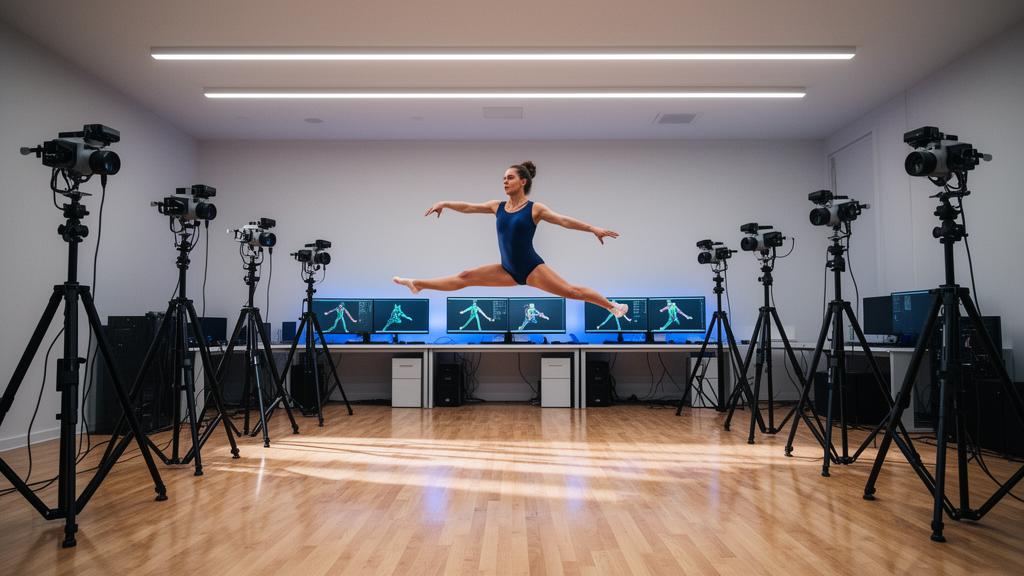
To rigorously validate the computational framework, the study constructed a specialized experimental dataset comprising twelve hundred and fifty continuous skeleton sequence samples across five distinct posture-centric athletic disciplines, maintaining exactly two hundred and fifty samples per action category. Biomechanical data was recorded from fifty healthy volunteer participants, consisting of thirty men and twenty women aged between eighteen and twenty-five, inside a professional indoor sports training facility under strictly controlled illumination. Movement performances were captured using a synchronized high-performance camera recording at full high-definition resolution of 1080p and sixty frames per second. The OpenPose pose estimation algorithm extracted standardized two-dimensional coordinate sequences across eighteen primary anatomical keypoints, which underwent skeletal centering, scale normalization relative to human body height, and moving average filtering to suppress tracking noise. To establish reliable ground truth benchmarks, three certified national-level athletic referees independently evaluated all movement samples across execution precision and fluency using a standardized ten-point rubric, attaining an intraclass correlation coefficient of 0.91.
Experimental evaluations performed across a dedicated testing partition representing twenty percent of the dataset demonstrated that FusionAction Net substantially outperformed established baseline architectures across every analytical metric. The proposed framework attained a macro-averaged action recognition accuracy of 93.9 percent, exceeding conventional dynamic time warping by 8.0 percentage points and outperforming standard graph convolutional networks by 4.8 percentage points. In action quality scoring, the model achieved a median absolute error of 0.82 points with an interquartile range spanning from 0.52 to 1.15 points, markedly lower than errors recorded for standalone dynamic time warping, pure graph networks, convolutional models, and recurrent long short-term memory baselines. For complex disciplines exhibiting intricate transitional movements, such as Taijiquan and Wushu Changquan, FusionAction Net yielded an 11.5 percentage point accuracy gain over baseline methods. Robustness evaluations confirmed that under extreme movement complexity, the model retained an 89 percent robustness score and an 0.86 consistency score, whereas traditional algorithms collapsed to 62 percent and 0.72 respectively.
Systematic ablation analyses verified the quantitative necessity of each architectural component, showing that adding spatiotemporal attention improved baseline recognition accuracy by 2.1 percent, semantic-constrained differentiable Soft-DTW contributed an additional 3.4 percent gain, and gated feature fusion provided a further 4.2 percent boost. Across ten independent experimental runs, paired t-tests confirmed that performance improvements under complex conditions remained statistically significant with a p-value below 0.001 and a narrow 95 percent confidence interval between 16.9 and 17.5 percent. Deployed on an Intel Core i9 processor and an NVIDIA RTX 3090 graphics card, the 2.8-million-parameter model required only 1.4 GFLOPs per frame, achieving a frame-level spatial extraction latency of 12 milliseconds and a sequence-level median evaluation speed of 122 milliseconds. External validation on the public AQA-7 video dataset yielded a Spearman rank correlation of 0.932 and an L2 error of 0.76, surpassing modern transformer baselines. The authors noted that future development must validate the system on larger, more diverse cohorts under unconstrained environmental conditions.
Subject of Research: Real-time evaluation of sports action quality using graph neural networks and dynamic time warping
Article Title: FusionAction Net: a real-time sports action quality evaluation algorithm based on GCN and improved DTW
Article References: Qiao, C. (2026). FusionAction Net: a real-time sports action quality evaluation algorithm based on GCN and improved DTW. Discover Computing, 29(1), Article 869. https://doi.org/10.1007/s10791-026-10815-5
Image Credits: AI Generated
DOI: 10.1007/s10791-026-10815-5
Keywords: sports action evaluation, FusionAction Net, graph convolutional network, dynamic time warping, soft-DTW, action quality assessment, skeleton sequence analysis, human pose estimation, spatiotemporal modeling, multitask learning, OpenPose, biomechanical feedback, athletic performance, sequence alignment, gated feature fusion, motion analysis, AQA-7 dataset
News Source: Denise Maddox. (November 13, 2026). Dual Algorithm Framework Accurately Evaluates Complex Athletic Movements in Real Time. Scienmag.